
Safety & Health Employee Program
ACKNOWLEDGMENT OF SAFETY & EMPLOYEE HEALTH PROGRAM
- I hereby acknowledge that I have been given a copy of BLT Companies’ Safety & Employee Health Program.
- I understand it is a condition of employment with BLT Companies that I read, understand and abide by the policies and procedures established by the Company in its written Safety & Employee Health Program.
- I understand my responsibilities as an employee in helping to achieve the Company’s goal of eliminating all occupational accidents and incidents and to create a work environment that is both safe and healthy.
- I understand if I have questions regarding the Company’s written Safety & Employee Health Program that I should discuss them with my supervisor.
- I understand if I feel I am not receiving proper or sufficient training, I should contact Brian L. Thomas, Owner/Manager at 928-726-1951.
- I understand it is illegal for an employer to take any action against an employee in reprisal for exercising rights to participate in communications involving safety.
- I UNDERSTAND THE CONTENTS OF THIS SAFETY & EMPLOYEE HEALTH PROGRAM DO NOT CONSTITUTE THE TERMS OF A CONTRACT OF EMPLOYMENT. Employment with BLT Companies is on an “at-will” basis. Our employment relationship may be terminated at any time by either the employee or the Company for any reason not prohibited by law.
- I acknowledge that I have been properly trained and have completed BLT Companies LLLP’s New Hire Onboarding 3-Phase Process.
- The Company has the right to make changes, additions or deletions as needed as circumstances or conditions change.
Employee Name Printed:

Employee Signature:

Date:

THE CONTENTS OF THIS SAFETY & EMPLOYEE HEALTH PROGRAM DO NOT CONSTITUTE THE TERMS OF A CONTRACT OF EMPLOYMENT. Except where a collective bargaining agreement or other written contract otherwise provides, employment with BLT Companies is on an “at-will” basis. Our employment relationship may be terminated at any time by either the employee or the Company for any reason not prohibited by law. POLICIES AND PROCEDURES OUTLINED IN OUR SAFETY & EMPLOYEE HEALTH PROGRAM ARE SUBJECT TO CHANGE WITHOUT PRIOR NOTIFICATION. This manual covers all aspects of BLT Companies’ entities:
- BLT Administration LLC
- BLT Asphalt LLC
- BLT Contracting LLC
- BLT CPT LLC
- BLT Materials LLC
- BLT Ready Mix Concrete LLC
- BLT Shop LLC
- BLT Trucking LLC
- Yuma Terminal LLC
Reader should recognize “BLT Companies” or “BLT” or “Company” represents all entities listed above throughout this program.
Equal Employment Opportunity Policy
BLT Companies LLLP is committed to providing a non-discriminatory employment environment for its employees.
The policy of BLT Companies LLLP is to fully comply with applicable federal, state and local laws, rules and regulations in the area of non-discrimination in employment. Discrimination against employees and applicants due to race, color, religion, sex (including sexual harassment), national origin, disability, age (40 years or older), military and veteran status is prohibited. Violations of this policy will be subject to discipline, up to and including termination.
Equal employment opportunity and non-discriminatory commitments include, but are not limited to, the areas of hiring, promotion, demotion or transfer, recruitment, discipline, layoff or termination, rate of compensation and Company sponsored training.
All employees are expected to comply with this Equal Employment Opportunity Policy. Managers and supervisors who are responsible for meeting business objectives are expected to cooperate fully in meeting BLT Companies LLLP’s equal employment opportunity objectives.
Any employee who believes he or she has been discriminated against must immediately report any incident to a Company manager. The Company will not tolerate retaliation against any employee who reports acts of discrimination or provides information in connection with any such complaint.
TABLE OF CONTENTS
- STATEMENT OF POLICY ON EMPLOYEE SAFETY
- OVERVIEW OF SAFETY & EMPLOYEE HEALTH PROGRAM
- GENERAL SAFETY COMMITTEE
- ASSIGNMENT OF RESPONSIBILITIES
- GENERAL SAFETY RULES
- EMPLOYEE RESPONSIBILITIES
- EMPLOYMENT AT WILL DOCTRINE
- Background Check Policy
- DISCIPLINE AND ENFORCEMENT REGARDING SAFETY INCIDENTS
- DASHCAM POLICY
- EMPLOYEE GENERAL DISCIPLINE AND ENFORCEMENT GUIDELINES
- ACCIDENT AND INCIDENT REPORTING GUIDELINES
- GENERAL SAFETY GUIDELINES
- EMPLOYEE SAFETY RULES AND REGULATIONS
- SAFETY TRAINING & REMINDERS
- HAZARD COMMUNICATION PROGRAM
- PETROLEUM STORAGE TANKS
- BLOOD BORNE PATHOGENS EXPOSURE CONTROL PROGRAM
- INFECTION CONTROL PROGRAM
- PERSONAL PROTECTIVE EQUIPMENT ASSESSMENT, SELECTION AND TRAINING
- SUBSTANCE ABUSE POLICY/DRUG & ALCOHOL TESTING POLICY
- AERIAL PLATFORM EQUIPMENT PROGRAM
- SCAFFOLDING PROGRAM
- FALL PROTECTION PROGRAM
- FLEET SAFETY PROGRAM
- FORKLIFT PROGRAM
- RESPIRATORY PROTECTION PROGRAM
- PROPER LIFTING TECHNIQUE
- HEAT STRESS PREVENTION/SUNLIGHT EXPOSURE
- WAREHOUSE & PLANT FACILITIES
- MINE SAFETY
- ASPHALT PLANT
- SECURE TAILGATE
- COMMUNICATION AND TRAINING METHODS
- TOOL BOX MEETINGS
- DEFINITIONS
- SAFETY & EMPLOYEE FORMS (TO FOLLOW)
- EMPLOYEE GENERAL DISPLICINE REPORT
- DRIVER/OPERATOR NAME:
- DATE & TIME OF INCIDENT:
- EMPLOYEE INCIDENT REPORT
- DRIVER/OPERATOR NAME:
- DATE & TIME OF INCIDENT:
- EMPLOYEE SAFETY INCIDENT REPORT
- DRIVER/OPERATOR NAME:
- DATE & TIME OF INCIDENT:
STATEMENT OF POLICY ON EMPLOYEE SAFETY
It is the policy and priority of BLT Companies that the first consideration in the performance of work will be the safety of employees and maintaining a safe working environment. All reasonable methods, procedures, and equipment necessary to achieve this will be used. I hope that during your work shift, safety is always on your mind. Safe job performance is the best way to avoid incidents and the costs associated with those incidents. BLT Companies has adopted rules, policies, and procedures to benefit everyone. Every employee is a key player in the safety process. These operations include the mining site, concrete batch plants, asphalt plant, maintenance shops, fabrication shops, electrical shops, warehouses, crane & rigging operations, heavy hauling operations, and office facilities. Your supervisor will provide you with the appropriate training to fulfill your job expectations upon the time of initial assignment. In the event, your position requires annual review of your job duties; your supervisor will provide such refresher training as necessary.
Being aware of potential hazards in your working environment should always be a top priority. If you feel endangered in your working environment, make immediate contact with your supervisor to inform them of the situation.
Safety for all is my concern. Unfortunately, accidents do happen; however, the majority of accidents are preventable. Think before you act in potentially hazard situations. This Company takes every possible precaution to make sure your working conditions safe. Safety guards, personal protection devices, equipment, and special tools are provided to eliminate specific job hazards. However, in the final analysis, the real safety job is up to you. Remember to think, act and work safely at all times.
The Safety & Employee Health Program includes the following objectives:
- To completely integrate safety with production and operation.
- To provide safe working conditions.
- To train employees in practices for the safe conduct of their work.
- To enforce safety measures.
You have definite responsibilities, which the Company expects you to fulfill with respect to (1) safety of yourself, (2) safety of your fellow employees, (3) protection of the public, and (4) protection of Company equipment and property. The acceptance and fulfillment of the above responsibilities is a condition of employment with BLT Companies.
- Before starting work under conditions, which you believe, are unsafe, you must call these conditions to the attention of your supervisor. You are expected to report to your supervisor any unsafe conditions you may observe.
- Your suggestions and ideas toward improving methods and making conditions safer are earnestly sought. If you have any ideas or suggestions regarding safety or the Safety & Employee Health Programs, report them to your supervisor immediately, do not wait for a safety meeting.
- All accidents, whether resulting in a personal injury or not, must be reported to a supervisor, regardless of how minor they may be. Even minor accidents may indicate an unsafe condition, which should be corrected.
- Teamwork and cooperation are expected from each employee in safety matters, the same as they are in all other activities making up our Company's operations.
- For the Safety & Employee Health Program to be effective, you must take a proactive, productive part.
- Set a good example for fellow employees, customers and visitors. If you see someone doing something in an unsafe manner, do not hesitate to diplomatically call the error to his or her attention. In safety, we are our brother's keeper!
- Report all unsafe conditions to your supervisor.
- Conduct job hazard analysis for all routine and non- routine jobs.
- Promptly report all vehicle/equipment accidents and personal injuries to your supervisor, regardless how minor.
- Practice defensive driving. This applies not only on the highway, but in the yard as well.
- Wear and use required safety equipment/personal protective equipment (PPE).
- Do all you can to perform your job safely.
- Obey all safety rules.
- Attend and participate in all safety meetings.
- Participate in all required safety training.
Failure to abide by these responsibilities will subject employees to disciplinary action, which may in include termination. THERE WILL BE NO COMPROMISE WITH SAFETY! Our goal is to eliminate all occupational accidents and incidents. This objective can be met only with the complete cooperation and dedication of every employee. Accountability for safety must be accepted at all levels from management through each individual employee.
In the implementation of our Safety & Employee Health Program management including all levels of
supervision has the responsibility to:
- Provide or make available to each employee such protective equipment or clothing needed to perform their work safely.
- Provide employees with tools and equipment that are safe.
- Provide employees with the necessary instruction and training to perform their work safely.
- Provide a continuing program of safety training through all available employee communication methods, including new hire orientation, weekly toolbox meetings, workshops, seminars, posters, check attachments and a written Safety & Employee Health Program.
- Engage in a continuing program of investigation of improved safety methods, techniques, concepts and equipment and of adopting those deemed advantageous to the overall Safety & Employee Health Program through our General Safety Committee.
In order for this policy to be fully effective, it must be the responsibility of all employees to:
- Observe applicable office, yard and job site safety rules, policies and procedures.
- Keep work areas free of unnecessary hazards.
- Maintain work habits and attitudes that will protect other employees as well as themselves.
YOU MATTER…..THINK SAFELY —– WORK SAFELY
Brian L. Thomas -Owner/Manager
OVERVIEW OF SAFETY & EMPLOYEE HEALTH PROGRAM
Safety and the prevention of accidents and incidents are a priority with BLT Companies. Realizing the only way to have an effective program is to have awareness at all levels of the Company, we have implemented ways to involve each employee in our Safety & Employee Health Program.
- EMPLOYEE HANDBOOK: Each employee will receive a handbook during the hiring process. Our Employee Handbook contains a Statement of Policy on Employee Safety. Our Employee Handbook also states it is a condition of employment that employees read, understand and abide by the policies and procedures outlined in our Safety & Employee Health Program.
- SAFETY & EMPLOYEE HEALTH PROGRAM: Each employee will receive a copy of our Safety & Employee Health Program during the hiring process. While the Safety & Employee Health Program cannot cover every situation or condition that may arise while working, it does act as an informative document which can be utilized as a) statement of Company policies and procedures. b) quick reference guide and c) training aid.
- GENERAL SAFETY COMMITTEE: The committee will meet to help implement, monitor and improve our safety and accident prevention program.
- SAFETY TRAINING SESSIONS FOR SUPERVISORS: Periodic safety training sessions will be held for supervisors as deemed appropriate for the topics to be discussed.
- TOOLBOX MEETINGS: Supervisors will conduct weekly tool box meetings for the on-going safety training of crew members.
GENERAL SAFETY COMMITTEE
A General Safety Committee has been formed as part of BLT Companies’ Safety & Employee Health Program. The main purpose of the committee will be to help implement, monitor and improve our safety and accident prevention program. The General Safety Committee members include safety director, management and supervisors. They meet on a regular basis with the meetings conducted by Brian L. Thomas as Chairman of the Committee. Functions to be performed by the General Safety Committee are as follows:
- Discuss and report on unfinished business from the previous committee meeting.
- Review accident/injury reports and discuss root causes and corrective actions.
- Review and discuss new or outstanding recommendations or projects regarding safety and accident prevention.
- Actively participate in safety and health instruction programs, including weekly tool box meetings conducted by supervisors at job sites and hazardous materials training meetings, and evaluate the effectiveness of these programs.
- Regularly inspect the yard, shop and job sites to detect unsafe conditions, practices or potentially hazardous situations.
- Discuss and recommend improvements to existing safety and health rules, policies and procedures.
- Discuss and recommend suitable hazard elimination or reduction measures.
- Periodically review, discuss and recommend changes when needed in existing work practices and hazard controls.
- Assess implications of changes in work tasks, operations and processes before implementing them.
- Monitor and evaluate the effectiveness of safety recommendations and improvements.
- Communicate information to employees regarding safety, health, hazardous materials and hazardous situations through weekly toolbox meetings.
- Immediately investigate any serious workplace accident.
- Study and analyze accident and injury data.
ASSIGNMENT OF RESPONSIBILITIES
CHAIRMAN OF GENERAL SAFETY COMMITTEE – Brian L. Thomas, Manager/Owner of BLT Companies and Chairman of the General Safety Committee, is responsible for the implementation of our written Safety & Employee Health Program. This chairman monitors the effectiveness of our Safety & Employee Health Program through the General Safety Committee. Discussions of problems and review of injury and accident reports in committee meetings allow the Chairman to continually assess our Safety & Employee Health Program and the results of new policies and procedures as they are incorporated into our existing Safety & Employee Health Program.
SUPERVISOR RESPONSIBILITIES – Our supervisors are responsible for monitoring safe work practices and the implementation of policies and procedures established in our Safety & Employee Health Program as they visit job sites. They are responsible for helping to maintain a safe work environment by finding and controlling unsafe work conditions, practices and procedures. The supervisors are also responsible for keeping employees trained in new safety policies and procedures and to help in the implementation of these changes as they occur. It is their responsibility to enforce our Safety & Employee Health Program and to use all reasonable methods, procedures and equipment necessary to achieve a safe work environment and protect employees from injury. The responsibilities of the supervisors include:
- Assessing job sites prior to beginning work to determine potentially hazardous situations or conditions and determining what if any personal protective equipment will be needed by employees.
- Training crew members regarding safety including as appropriate fall protection, scaffolding safety, personal protective equipment, hazardous materials awareness, blood borne pathogen and MRSA awareness and job site specific emergency information prior to beginning work at a job site
- On-going training of crew members through weekly toolbox meetings held at the job site.
- Instructing crew members in the recognition and avoidance of unsafe conditions.
- Training crew members regarding regulations applicable to their work environment to control or eliminate any hazards or other exposure to illness or injury.
- Maintaining a signed record of weekly toolbox meetings showing date and place of meeting, crew members in attendance and topics discussed.
- Maintaining a safe work environment by finding and controlling unsafe work conditions, practices and procedures.
- Enforcing use of safety equipment, including personal protective equipment, as deemed necessary.
- Watching crew members for “chance takers” and correcting any unsafe work practices observed.
- Making sure employees handle materials, equipment and tools in a proper and safe manner.
- Making periodic job site safety inspections.
- Attending safety meetings and training sessions required by management.
- Reporting all accidents, no matter how minor as specified in our Safety & Employee Health Program.
HIRING PERSONNEL – Personnel processing new hires are responsible for giving new employees the appropriate paperwork including our Safety & Employee Health Program. All new hires must meet and be signed off by general manager.
PRE-EMPLOYMENT – It may become necessary to obtain information about a person to evaluate the qualifications necessary for employment. This information may include motor vehicle reports, background checks, credit reports, etc. This information will be used to evaluate the acceptability as an employee to operate a motor vehicle, equipment, etc. within the course of the employment. We reserve the right to decline hiring an individual based on the results of these checks.
Upon hiring, depending on your position, you may receive items, such as keys, uniforms, vehicle, etc., which belong to the Company. In the event of termination of your employment, those items must be returned prior to your final paycheck.
DRIVER QUALIFICATION GUIDELINES – All employees required to drive Company vehicles will be required to produce a valid State operator's license for the applicable type (s) of vehicles. Once each year the Company will obtain from the Arizona Motor Vehicle Department the driving record of every employee in a position, which may require the operation of a licensed motor vehicle in the course of employment. Any employee whose driving is governed by the Federal Motor Carrier Safety Regulations (FMCSR) must have a Commercial Driver’s License and will be required to meet all applicable provisions of the FMCSR in addition to meeting the preceding requirements.
DRIVER VIOLATION REVIEW – All over-the-road drivers are subject to DOT regulations, and one of these requires an annual review of the driver's record. This review will focus on the driver's accident record and any evidence that the driver has violated laws governing the operation of motor vehicles. Driving privileges will be considered for violations, such as speeding, reckless driving, alcohol, substance abuse or any other evidence that the driver has exhibited a disregard for the safety of the public. This review may result in revocation of driving privileges if evidence is found that the driver is disqualified under the DOT rules. Each driver is required to immediately report to management any suspension or revocation of his CDL license. In addition, the DOT rules require each driver to furnish the Company, once a year, a report of any traffic violations personally received by the driver, excluding parking citations.
GENERAL SAFETY RULES
- Emergency telephone numbers, i.e., fire, rescue, and police are posted in prominent locations at the plant site.
- Abide by all Federal, State, and local safety and environmental regulations which include OSHA & MSHA.
- Safety meetings will be conducted weekly. You are required to attend at least three per month. If you cannot attend, you must meet with your supervisor.
- All employees are required to be familiar with and comply with BLT Companies Drug/Alcohol Policy.
- Use only proper tools for the job intended.
- Perform Job Hazard Analysis (JHA) for all routine and non-routine work.
- Tools, parts, etc. are to be raised and lowered from the ground to elevated work areas with a rope.
- When lifting, use proper lifting techniques. Persons performing lifting and strenuous activities should follow proper lifting techniques at all times. Use of supports is not guaranteed to prevent back injuries although using them will help keep wearer mindful to use proper lifting techniques. Get firm footing. Keep your feet apart for a stable base, point toes out. Bend at your knees (not at the waist). Tighten stomach muscles. Lift with your legs. Let the powerful leg muscles do the work, not your weaker back muscles. Keep the load close to your body. Keep your back upright, avoid twisting.
- Horseplay is dangerous and will not be tolerated. Horseplay of any kind will subject employees to disciplinary action up to and including discharge.
- When climbing up or down a ladder, three points of contact must be maintained at all times. All ladders except stepladders are to be tied off.
- Jewelry, loose hair, or loose clothing that interferes with the safe operation of machinery is prohibited.
- Company radios and other Company communication devices (including Citizen Band radios) are to be used for Company business only.
- Intentionally disabling or circumventing any alarms, guards or any other safety device will result in discharge.
- LOTO – Always lock and tag-out equipment.
- Only authorized employees shall repair or maintain electrical circuits or devices.
- Unauthorized stickers or markings on Company vehicles, equipment, hard hats or other Company property are not allowed.
- Learn the location and proper use of fire-fighting equipment in your department.
- Possession of weapons on the job will not be tolerated and will subject employees to disciplinary actions, up to and including discharge.
- No unauthorized person is to be in any shop area. Only technicians, mechanics, welders and management are permitted. If your equipment needs servicing, leave it outside the shop. Report to your direct supervisor or the shop foreman of the issue. Stay in the designated areas. Do not cross the yellow restricted areas.
- Only dispatch and management are permitted in the batch offices.
- Acts of violence or harassment towards management or another employee may be grounds for immediate discharge.
- Whenever there is an accident involving a Company vehicle or heavy equipment, an accident review hearing may be convened to review the accident.
- Company provided cellular phones are for Company use only and will be returned at point of termination of employment. Cellular phones are not to be used by CDL drivers while vehicle is operating. BLT Companies employees agree to abide by both federal through FMCSA (Federal Motor Carrier Safety Administration) and local laws regarding cell phone usage which bans the use of hand held cell phones for talking or texting while driving commercial and non-commercial vehicles. Supervisors may use phones while driving only if they have a hands-free device. For those operating commercial vehicles or heavy equipment, BLT Companies’ policy is the use of any mobile phones is prohibited while any vehicle is in motion. If you must use a cell phone, you must pull over and be at a complete stop. You must avoid any activity that diverts your attention off driving, such as eating, fiddling with radios, etc. This is a serious violation that warrants termination. Regarding personal phone calls, none should be made or received during working hours. If a family member has an emergency, they are to call the location of where that employee works. From there, the employee will be contacted over the radio. If the employee must call back from his personal phone, he/she is to get off the machinery or pull his vehicle over to the side of the road before he/she makes the call. He or she must actually stop work before he uses the phone. Always be alert and aware of your surroundings when you are using the phone. REWORD TO USE HAND FREE DEVICE.
- Any employee involved in a theft or suspected involvement in a theft or crime involving BLT Companies will be subject to disciplinary action up to and including termination. Automatic suspension with no pay will be implemented begins when the Company lists you as a suspect, until case is closed by law enforcement.
- If you see a fellow worker in danger of being injured, do not hesitate to inform them. You could prevent a serious injury, and perhaps save a life.
- Never ride on mobile equipment other than in the seat provided. Always wear seat belts. First offense is a warning, second offense is possible termination.
- Report any personal injury or incident regardless of how slight it may be to your supervisor and/or group leader on the same day that the incident/accident occurs.
- Failure to report an injury before the end of your shift may jeopardize your Workers' Compensation benefits.
- Citations issued by MSHA or OSHA, due to an employee's action or negligence may result in a safety reprimand or other disciplinary action, if appropriate.
- Devices that prevent proper hearing (i.e. – headphones, etc.) are not to be worn, unless the device is used as ear protection and is deemed necessary in your assigned work environment.
- Violation of any safety rules will subject employees to disciplinary action up to and including termination as determined by management through an internal investigation.
- All drivers that have tarps on vehicles must use the tarps at all times when loaded while vehicle is in motion.
- Equipment always has the right of way.
EMPLOYEE RESPONSIBILITIES
Each employee is responsible for their own safety as well as the safety of their fellow employees, to the best of their ability. It is only by each employee becoming familiar with the hazards of their job and doing what is necessary to ensure a safe work environment that we can achieve safe working conditions deserved by all employees. BLT Companies expects each employee regardless of their position within the organization to cooperate in every aspect of our Safety & Employee Health Program; therefore, it is a condition of employment that each employee:
- Be on time for assigned shift. Not only is the Company counting on the employee, but customers are as well. If an employee must miss a shift or if you will be late for your shift, employee must report to their supervisor before your shift so that supervisor has the opportunity to cover the shift. Texting or calling anyone besides your direct supervisor is not the appropriate method and can count against you.
- Read, understand and abide by the policies and procedures outlined in our Safety & Employee Health Program. Complete, sign and return acknowledgment forms in the Company’s Employee Handbook and Safety & Employee Health Program.
- Report physical limitations to ensure employee is assigned work that can be performed safely.
- Comply with prescribed job procedures and instructions given by our Safety Director, supervisors.
- Report all accidents and injuries immediately to their supervisors no matter how minor they may appear.
- Wear the proper personal protective equipment including hard hats, safety glasses, respirators, proper shoes, appropriate clothing and other equipment deemed necessary by the job site supervisors. There will be no exceptions to this requirement. Failure to comply will result in disciplinary action up to and including termination.
- Report hazardous conditions and other safety concerns immediately to the job site supervisor, Safety Director.
- Know what to do in case of an emergency.
- Contact a job site supervisor, superintendent or Safety Director for information if exposed to a material directly or indirectly and do not know if it is hazardous and/or are concerned about the physical or health hazards associated with it.
- If your position requires you to utilize our computers, the computers must be limited to the functions necessary to perform the job for which you were hired. Web searching, social media, gambling, games, etc. expose our network to malicious threats. Damages caused by such threats on the computer are costly and the Company reserves the right to pass the expense of repair on to you.
- If the job for which you perform is dependent on the effects of weather, it is your responsibility to call in to verify your job would be performed on that ‘bad weather’ day. You will not be paid if you simply show up and do not call to verify the schedule.
EMPLOYMENT AT WILL DOCTRINE
It is the right of the Company to terminate your position, anytime, without good cause, under the Employment at Will Doctrine. It is equally the right of the employee to terminate his/her position, anytime, without good cause.
As your employer, we are appreciative of your willingness to perform the job for which you were hired. Every employee is part of our team here at BLT and we are grateful for every one of our employees. BLT does not condone disruptive behavior that elicits negativity which creates a toxic workplace, such as bullying, harassment, conniving acts, malicious gossip, slurs, insults, rough housing, pranks, backstabbing, hatefulness, acts of scam artists, offensive conduct, etc. and can be grounds for immediate dismissal, thereby forfeiting any warnings and write-ups referenced elsewhere in this booklet. Personal disputes should not be brought to the workplace. If you are dissatisfied with your job, do not feel obligated to continue working at BLT as that creates a negative environment for both you and your co-workers. Simply inform your supervisor of your wishes to terminate employment, preferably with sufficient notice, and continue your life’s path.
Background Check Policy
All applicants who are offered employment with the Company will be subjected to a check of their background either by the Company or a third party vendor. As such, applicants and employees may be subject to a consumer report or investigative consumer report. The Company will review the relevant background information to select and retain the most qualified employees with the end goal of maintaining a safe and productive work environment. This policy applies to the criminal history screening of prospective and current employees. The Company will conduct all third party background checks in accordance with the Fair Credit Reporting Act (FCRA), other applicable federal and state laws, and Company procedures.
Obtaining Background Reports – Prior to the background check being conducted, the applicant will be required to complete disclosure and authorization forms authorizing the Company to conduct specific background checks. This authorization will be made in either electronic or written form and will remain valid throughout the employee’s employment with the Company, if hired as allowed by applicable law. Background checks will be kept confidential and will only be shared with individuals who have a business need to review the information to make employment decisions. Reports will be retained in accordance with the Company’s document retention procedures and federal and state regulations.
Criminal Background Reports – The existence of a criminal record will not automatically disqualify an applicant from employment. If a criminal record is received during the background check, the information in the record will be compared with the information on the disclosure and authorization form and any other identifying information provided by the applicant to ensure the record belongs to the applicant. In the event that an applicant’s background check includes a criminal offense, the Company will conduct an individualized assessment to determine whether excluding an applicant based on the offense is job related and consistent with business necessity.
Factors that may be taken into consideration prior to making an employment decision, include, but are not limited to:
- The nature and gravity of the offense
- The nature of the position held or being sought, including the specific duties and responsibilities of the position
- The relevance of the offense to the position being sought
- The time which has elapsed since the offense
- The age of the applicant at the time of the offense
- The facts or circumstances surrounding the offense
- The number of offenses for which the individual was convicted
- Evidence that the individual performed the same type of work, post conviction with no known incidents of criminal conduct
- The length and consistency of the applicant’s employment history before and after the offense
- Relevant evidence of rehabilitation, including any education or training completed following the offense
- Employment or character references or other relevant information regarding fitness for the position held or sought
- The interest of the Company in protecting property, and the safety and welfare of other employees or the general public
- False statements or material omissions made by the applicant on the employment application or during an interview
- Any other factors mandated by federal or state law
Adverse Action – An applicant or employee will be provided with a copy of the criminal record obtained from the Company’s third party vendor prior to the Company questioning the individual about his or her criminal record. Prior to taking any adverse action in whole or in part on information in the background check, the applicant will be provided with a pre-adverse action notice along with a copy of his or her background check, a summary of rights under the FCRA, and any other applicable documents as required under the FCRA or state law. Applicants will be afforded an opportunity and an appropriate time period to provide information or data that explains any discrepancies or inaccuracies contained in the background report before an employment decision is made. If after that time period, adverse action is still deemed necessary, the applicant will be provided with an adverse action notice regarding that decision.
PROBATIONARY PERIOD The probationary period begins your first date of full-time work and continues for three months, or 90 days, whichever is shorter. This period allows BLT Companies to evaluate you as a new employee. Employer has the right to retain training records for a duration of no less than 3 years. By signing the “Employee Training Verification Statement”, you are acknowledging that you agree to all statements and will abide by all safety requirements throughout this manual.
NON-EXCUSED ABSENCES & TARDINESS, NO CALL/NO SHOW These could warrant immediate termination at the discretion of management. Non-excused absences for any reason for one day, including NO CALL/NO SHOW:
- FIRST OCCURENCE – Verbally warned & written up for file
- SECOND OCCURENCE – 3 days off suspension (no pay) & written up for file
- THIRD OCCURENCE – 5 days off suspension (no pay) & written up for file
- FOURTH OCCURENCE – Termination & written up for file
At any time, if employee does not come in for two consecutive non-excused working days:
- FIRST OCCURRENCE – Employee is given 5 days off (no pay)
- SECOND OCCURRENCE – Termination & written up for file
At any time, if employee does not come in for three consecutive non-excused working days:
- FIRST OCCURRENCE – Employee is automatically terminated
Tardiness will be at the discretion of either management or dispatch office personnel. Excessive tardiness will result in the following consequences:
- FIRST OCCURENCE – Verbally warned & written up for file
- SECOND OCCURENCE – 3 days off suspension (no pay) & written up for file
- THIRD OCCURENCE – 5 days off suspension (no pay) & written up for file
- FOURTH OCCURENCE – Termination & written up for file
TIMECLOCK – It is the responsibility of each employee to clock in and out, whether to begin or end your shift or to leave for lunch or any other reason. If you forget, you will need to contact your supervisor or the main office so that your time can be entered. Please make this part of your routine. Written timecards will still be needed for those performing hauling, crane and contracting jobs. Those performing those jobs will also ‘clock in’ at the beginning of the shift and ‘clock out’ at the end. This does not include mixer drivers, interplant drivers, mechanics, or the pit. The Company has the authority to adjust time when it deems necessary, including times during out of service.
PAY Employees who receive an hourly wage will receive their earned wages based on the time worked as gathered from the Timeclock (see section 9 above). Employees that receive a salary, versus an hourly wage, will receive their earned wages based on an average of 40 hour per week. Pay periods begin Sunday midnight and run through Saturday midnight for which employees are paid the following Friday. Overtime hours are limited and are closely monitored by management. Work schedules may demand overtime on occasion; however, this is a rarity and should not be expected. In the event that overtime may be warranted, approval must be authorized by your supervisor. No overtime is paid to salaried employees unless under the discretion of management, except when hours exceed USDOL current regulations regarding salaried overtime pay.
INSURANCE – Group health insurance is offered to employees upon the end of the probation period. For the most up to date information on our group insurance plan and premiums, please contact the main office. Dental, Vision and other types of benefits are offered at the financial responsibility of the employee. COBRA is offered to employees who leave the Company for which employees would be responsible for the full monthly premium.
HOLIDAY & PAID TIME OFF (PTO) – For employees that are eligible for paid holidays (must work here for one year), the employee must work the day before and the day after the holiday in order to receive the paid holiday.
The Company provides every employee with Paid Time Off (PTO), formerly known as Vacation. Employees may use PTO for: (1) their own medical treatment or condition, (2) care of a family member with a medical condition, (3) closure of the Company or the employee's child's school due to a health emergency or when the employee or family member is quarantined, (4) dealing with the effects of domestic violence, sexual violence, abuse, or stalking of either the employee or his/her family member, or (5) scheduled vacations or time off approved by the employee's supervisor.
All existing employees accrue one hour of PTO for every 30 hours worked up to a maximum of 40 hours per Company Year. Any employees hired after July 1, 2017, shall not be eligible to use PTO until after their 90th day of employment with the Company. The Company Year, for purposes of this policy, begins on July 1 and goes through June 30. Exempt employees are presumed to work 40 hours per week for PTO accrual. Employees may use PTO in hourly or daily increments. The Company pays PTO at the employee's hourly rate. Exempt employees will be paid at their weekly salary divided by 40 hours. Employees may not use PTO before it has accrued, unless approved in advance by the Company in writing. Unused accrued PTO will not be carried over to the next Company Year. If an employee chooses not to take time off, the employee can opt to receive his/her 40 hours of PTO in a separate pay. If an employee resigns, the unused PTO may be paid upon manager's discretion. If an employee is terminated by the decision of the Company, the employee will not be paid for any unused PTO.
Employees requesting PTO are required to talk to their supervisor, write or email, or complete a form at Human Resources. The Company requires five days advance notice of the need for PTO when employees know in advance of their need to take PTO, so the Company's operations will not be disrupted. If the employee becomes ill, injured or an unexpected emergency arises which prevents his/her coming to work, and the employee has accrued unused PTO, the employee must notify his/her supervisor no later than one hour before the start of the scheduled work day of the need for PTO. If the supervisor is not available, employees must contact a member of management. If the employee is physically unable to contact the Company s/he must direct another person to make the contact on his/her behalf. Contact may be orally, in writing or by email or text to the supervisor or a member of management. Leaving a message with a fellow staff employee or with the answering service or texting his/her supervisor is not considered proper notification. When an employee calls in absent, s/he is to advise the Company of the expected date of return.
The Company PTO policy complies with the requirements of Arizona Revised Statute §23-371 et. seq. and takes the place of our current 40-hour vacation policy.
BLT reserves the right to amend or modify this Policy at any time to address changes or developments in Arizona law or due to changing economic conditions.
DRESS CODE– Office personnel – Business casual is appropriate.
All employees who work outside – whether on the property grounds of BLT or on customers’ jobsites, the following guidelines must be followed:
- Jean pants must be worn at all times. No holes or low riding jeans.
- A clean, button down, Company logo, “blue & white” shirt will be worn at all times. No gang related or questionable attire.
- Boots, steel toes, must be worn. No tennis shoes, sandals, dress shoes, etc.
- You must wear the Company provided, Company paid uniform and PPE at all times, excluding a hard hat within the shop areas or when operating vehicles/equipment. We have a Zero Tolerance policy for not wearing Company uniform & PPE at all times when clocked in (which includes Saturdays).
DISCIPLINE AND ENFORCEMENT REGARDING SAFETY INCIDENTS
It is part of every employee’s job to adhere to all safety rules, regulations, policies and procedures which have been adopted for the safety, protection and well-being of all employees. Progressive disciplinary actions that will be taken against employees who violate our safety standards have been established to help maintain safe working conditions for all employees and to have employees be responsible for their own actions.
Written violation citations will be issued by our Safety Director, any supervisor, or other management person who observes a violation being committed. The written safety violation citation is to be signed by the person issuing the citation and also by the employee receiving the citation. They have the discretion of issuing a verbal warning in place of a written safety violation citation if the violation is minor. An employee receiving a verbal warning must agree to correct the situation causing the violation.
The person issuing the citation will submit the written violation citation to the office within 24 hours where it will be determined what the disciplinary action will be based on the number of written violation citations if any previously received. Progressive disciplinary action will be based on the number of written violation citations received by an employee during the course of any twelve-month period.
An employee who has received a written violation citation, their supervisor will receive a written statement of the disciplinary action to be taken based on the number of citations on file as follows:
- Zero Tolerance for not wearing Company uniform & PPE at all times when clocked in.
- First Offense: Employee will receive a written safety violation citation classified as a warning.
- Second Offense: Employee will receive a written safety violation citation requiring a two-day suspension without pay.
- Third Offense: Employee will receive a written safety violation citation requiring a five-day suspension without pay.
- Fourth Offense: Employee will receive a written safety violation citation requiring discharge and will not be eligible for rehire for a period of three months.
Refusal to use or wear required safety equipment or willful violations that endanger them or other employees will result in immediate discharge. An employee who receives a written safety violation citation may request our Safety Director review the violation with them if they do not feel it was warranted. Our Safety Director will have the authority to void a written safety violation citation if they determine it was not justified.
DASHCAM POLICY
Dashcams are for both the protection of the driver as well as BLT Companies. In the event of an incident, whether minor or major accident, the dashcams will provide evidence of the facts. Additionally, the dashcams will also help to reduce BLT’s insurance premiums. As an industry standard, our installation of the dashcams is well behind our intended timeline, however, it has become an essential and vital need to protect you as the driver and BLT overall. With the continued use of these dashcams, it is our intent to help make you be the best & safest driver you can be, focusing on these major areas:
- SAFETY: Ensuring driver safety by monitoring driving behavior (speeding, harsh braking, no seatbelts, cellphone usage, inattentive driving, rolling stops, etc.) and providing evidence in case of accidents.
- LIABILITY PROTECTION: Help provide clear, objective evidence in case of legal disputes or insurance claims, protecting the company from false claims.
- DRIVER MONITORING: Encourage better driving habits through monitoring and feedback.
The type of dashcam that we have installed is the dual facing cameras. The forward camera monitors the road ahead. The driver facing camera monitors the driver’s behavior (distractions, fatigue etc.) It will trigger a safety alert to the administrative personnel when AI detects no seatbelt, inattentive driving, rolling stops, harsh braking, harsh acceleration, speeding, cell phone usage, distractions, fatigue, lane departure, obstructed camera or in the event there is an accident. The cameras are always recording when the vehicle is in motion. It does take periodic pictures of both the road and the driver. The cameras also know who the driver is through artificial intelligence “AI” facial recognition.
DATA STORAGE & ACCESS – Video footage will be stored on cloud servers. There will be limited administrators who will have access to the videos and storage. BLT will use footage for training, accident reviews, disciplinary actions.
ACCIDENT INVESTIGATION: Dashcam footage will be used to help reconstruct accident events, providing crucial details in case of disputes. BLT will review the footage after an accident with the supervisor, truck boss and employee and other administrators if necessary.
Some footage will be used for training to make BLT drivers the best that they can be. We will review the footage and make suggestions to help improve your driving habits.
DISCIPLINARY ACTIONS: BLT Companies will be enforcing laws and for those who cannot seem to abide by the law and BLT policies will be disciplined.
- Speeding, No seat belt, rolling stops, distractions, fatigue & other moving violations will result in:
- 1st offense: write-up in employee file
- 2nd offense: 3 days off w/o pay
- 3rd offense 5 days off w/o pay & up to termination.
- 4th offense termination and will not be eligible for rehire.
- Obstructed or damaging cameras, dialing and/or texting cell phones, inattentive driving, harsh turns, aggressive driving, hand gestures to other drivers will not be tolerated.
- 1st offense: write up in file and 3 days off w/o pay.
- 2nd offense: 5 days off w/o pay and up to termination.
- 3rd offense: termination
EMPLOYEE GENERAL DISCIPLINE AND ENFORCEMENT GUIDELINES
The Company would like to consider every event as a learning experience. The company would always prefer to give the employee the benefit of the doubt. The Company’s policy is to have as many verbal conversations with an employee, who is not performing the job for which they were hired, to discuss the problem and provide suggestions for the employee to better understand the specifics in how to improve their job performance. It is up to management as to the number of verbal warnings necessary prior to termination. No written report is necessary for termination, however, in the event management chooses to document poor performance, the appropriate document found in the forms section should be used, Employee General Discipline Report; Employee Incident Report; or Employee Safety Incident Report. If management feels the employee will not grow and learn, even after the 1st verbal discussion, management has the right to terminate the employee. A multitude of reasons would justify termination, including but not limited to poor attitude, gross negligence, safety violations, abuse of drug and/or alcohol, bringing weapons to work, stealing, procrastinating, disobedience, fighting/arguing, tardies, unsafe practices, uncleanliness, laziness, disorganization, screwing off, hiding, deliberately damaging equipment, not performing the job for which you were hired, pass the buck to others, taking other employees’ tools, lying about work completed, misrepresenting the truth, etc. or simply just being a bad employee could get you terminated on your first verbal offense. The company will have the stance from the first verbal discussion to provide the employee every chance to improve, however, not all can be helped and ultimately, termination, without warning or cause, is justified.
ACCIDENT AND INCIDENT REPORTING GUIDELINES
- ACCIDENT REPORTING AND EMERGENCY PROCEDURES Report all accidents, injuries, and hazardous conditions, regardless of how minor they may seem, to a supervisor immediately. If you sustain an injury requiring medical attention, you must see a doctor authorized by the Company. To assure competent and accessible medical services for all of our employees and to be in compliance with State Workers' Compensation law, we only use authorized medical providers for all on-the-job injuries. Should you injure yourself and require medical treatment, contact your supervisor immediately.
- First aid kits are located in all permanent facilities. Firefighting equipment is located throughout the plants and aboard all mobile equipment.
- ACCIDENT REPORTING WHEN PUBLIC IS INVOLVED After you have notified your supervisor or dispatcher, he or she will call the police, fire department, rescue squad or ambulance if needed. Do not discuss the accident with anyone but the police, your supervisor, the Safety Department, or a representative of the Company. Try to obtain the names, addresses and telephone numbers of as many witnesses as possible. Cooperate with the investigating officers and give only the information required by them. Do not volunteer information or opinions as to who was at fault. Do not move your vehicle unless the police or a representative of the Company tells you. Stay close to your vehicle and radio in case you are needed to relay further instructions and/or information.
- GROSS NEGLIGENCE In the event of property or vehicle damage, where gross negligence, dishonesty or willful acts are involved, the employee will pay the expense, at a cost determined by management.
- TRANSITIONAL RETURN TO WORK PROGRAM Should you be injured on-the-job, notify your supervisor immediately or by the end of your shift and they will send you to our authorized medical provider. Failure to report an injury is subject to disciplinary action up to and including termination. When the treating physician releases you, unless you have been hospitalized or restricted to bed rest, you must report to work for your next scheduled shift. You are required to return any and all paperwork concerning your injury to your supervisor as soon as possible.
Listed below are forms to be used as part of our Safety & Employee Health Program for reporting, investigating and analyzing accidents and incidents. Blank forms are available from any supervisor, Safety Director or the office.
- Employee’s Report of Injury: Employees must report all injuries immediately to their supervisor, no matter how minor the injury may appear. As a follow-up, employees are to complete and submit this form as soon as possible.
Employees who required medical attention after a work place related injury are required to submit to an alcohol impairment test and a drug test for the unlawful use of any controlled substance prohibited under Arizona’s criminal statues within twenty-four hours after we have been notified of the injury.
- Supervisor’s Report of Injury and Investigation: The injured employee and/or supervisor must notify our office of an injury within 24 hours. As a follow-up, supervisors are to complete and submit this form as soon as possible. The supervisor’s investigation of the injury will be guided by the following checklist including the following actions when applicable:
SUPERVISOR’S REPORT OF INJURY AND INVESTIGATION CHECKLIST
- SECURE SCENE IF NECESSARY
- To prevent further injury or damage.
- To preserve evidence.
- IF THERE IS PERISHABLE OR TRANSIENT PHYSICAL EVIDENCE
- Examine immediately.
- Photograph completely.
- Record position with sketches.
- INTERVIEW WITNESSES AND PRINCIPAL PERSONS INVOLVED
- Injured employee.
- Other employees of our Company.
- Job related persons.
- Truck drivers/delivery persons.
- Equipment operators.
- Employees of other companies.
- Other witnesses.
- EXAMINE THE INJURY SCENE
- A. Reconstruct the occurrence (when warranted).
- Have witnesses act out the sequence of events.
- Photograph actors in key events.
- Photograph entire scene before disturbing evidence.
- B. Record technical data as applicable.
- Equipment name, model, manufacturer, year, numbers.
- Sketch and photograph dials, controls, etc.
- C. Cite violations of safety regulations.
- DETERMINE THE RESULTS OF THE INCIDENT
- Injuries.
- Fatalities.
- Property damage.
- Other losses.
- REPORT THE INJURY
- Who?
- What?
- When?
- Where?
- How?
- DETERMINE THE IMMEDIATE CAUSES OF THE ACCIDENT
- Unsafe act (examples)
- By-passing or removal of safety devices.
- Horseplay.
- Ignoring safety rules.
- Unsafe condition (examples)
- Debris and clutter.
- Cords left exposed.
- Ramp not properly constructed.
- DETERMINE ROOT CAUSE OF ACCIDENT & RECOMMEND PLAN OF ACTION
- General Safety Committee Accident Follow Up: Our office industrial injury claims person will complete the top portion of this form, attach a copy of the Employee’s Report of Injury and Supervisor’s Report of Injury and Investigation, and give to chairman of the General Safety Committee.
- The chairman of the General Safety Committee will submit injury report packages he determines need to be discussed at the following committee meeting.
- The General Safety Committee will determine what if any action needs to be taken to avoid future injuries of the same nature by discussing any recommended plan of action proposed by the investigating supervisor and or Safety Director after reviewing the immediate and root cause of the accident determined by the Safety Director. Any actions taken will be documented in the minutes of the meetings.
- The injury packages will also be used to watch for trends in kinds of injuries or an increase in frequency of injuries.
- Employer’s Report of Industrial Injury (Form No. ICA 04-101): Our office industrial injury claims person will complete and submit this form to our workers’ compensation carrier and the Industrial Commission within ten working days of when the Company has knowledge of an injury.
- Near Miss/Potential Accident Report: Supervisors are to complete the top portion of this form if they observe a “near miss”, see a situation which may potentially cause an accident, or if a near miss or potential accident is reported to them by an employee. The General Safety Committee will review the form at the following committee meeting and determine what, if any, additional action should be taken.
- Employee Report of Vehicle Accident Involving Company Vehicle: Any employee involved in an accident while driving a Company vehicle must complete and submit this form. All accidents involving a Company vehicle must be reported to the police. See section in this Safety & Employee Health Program on our Fleet Safety & Employee Health Program.
- Supervisor’s Follow Up Report of Vehicle Accident: Superintendents will investigate vehicle accidents and complete this form for review at the next General Safety Committee Meeting.
- Incident Report: Employees are to complete and submit this form if they are involved in or witness an incident or accident in which an employee or Company property is involved, and a person who is not our employee is injured or there is damage to equipment or property not belonging to our Company. This form may also be used by management to report any incident.
- Employee Safety Information Report/Safety Violation: Employees are to complete and submit this form if they want to report an unsafe work place condition or practice, or if they would like to recommend a safety suggestion to our Company.
- Report of Theft: Employees are to complete and submit this form to report the theft of Company vehicles, equipment, materials, tools or other property. All thefts must be reported to the police.
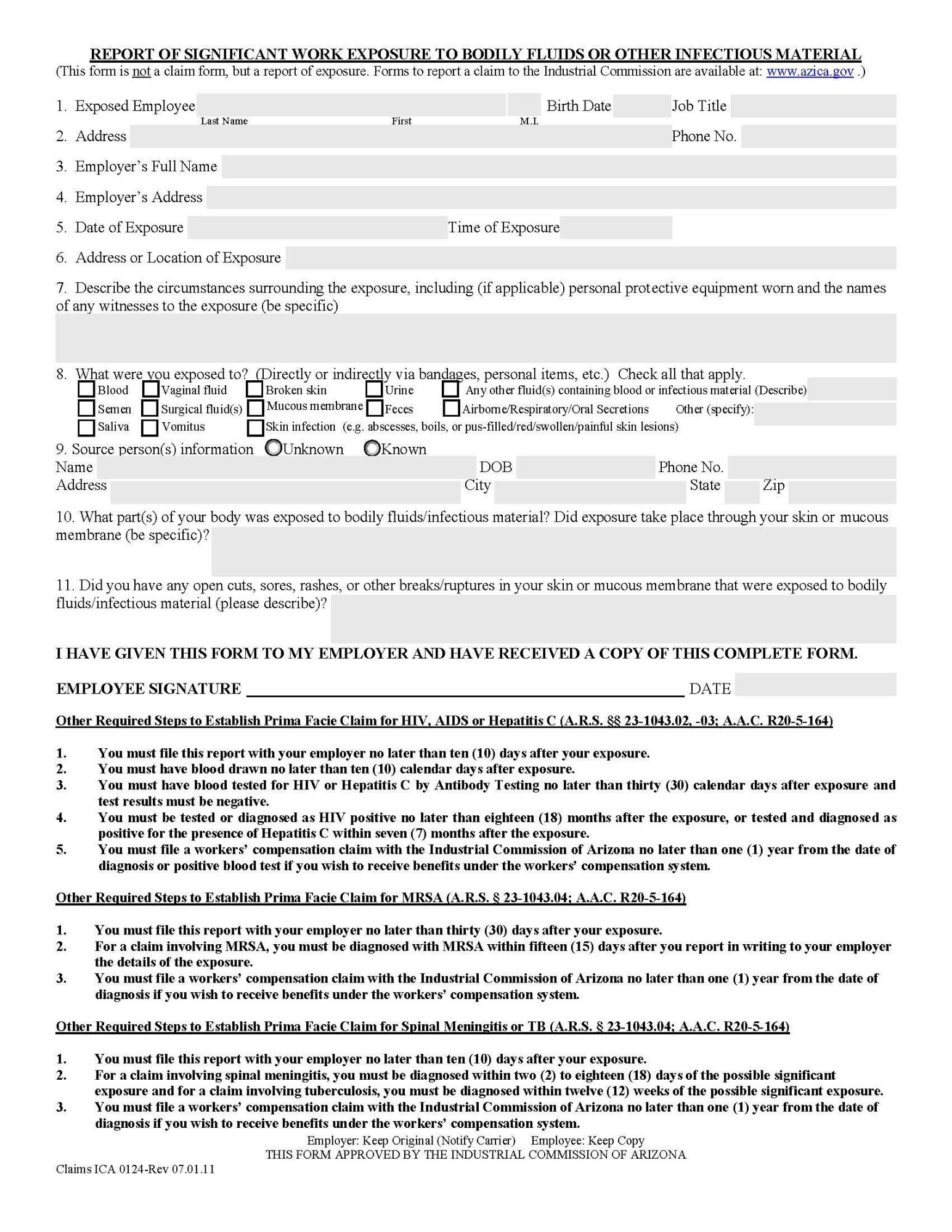
- Report of Significant Work Exposure to Bodily Fluids: Employees must complete and submit this form to our office immediately but in no case later than ten calendar days after significant work exposure to bodily fluids. See section in this Safety & Employee Health Program on our Blood Borne Pathogens Exposure Control Program.
MISCELLANEOUS SAFETY & EMPLOYEE HEALTH PROGRAM FORMS
Listed below are a description of miscellaneous forms which are included in our Safety & Employee Health Program. Blank forms are available from the office.
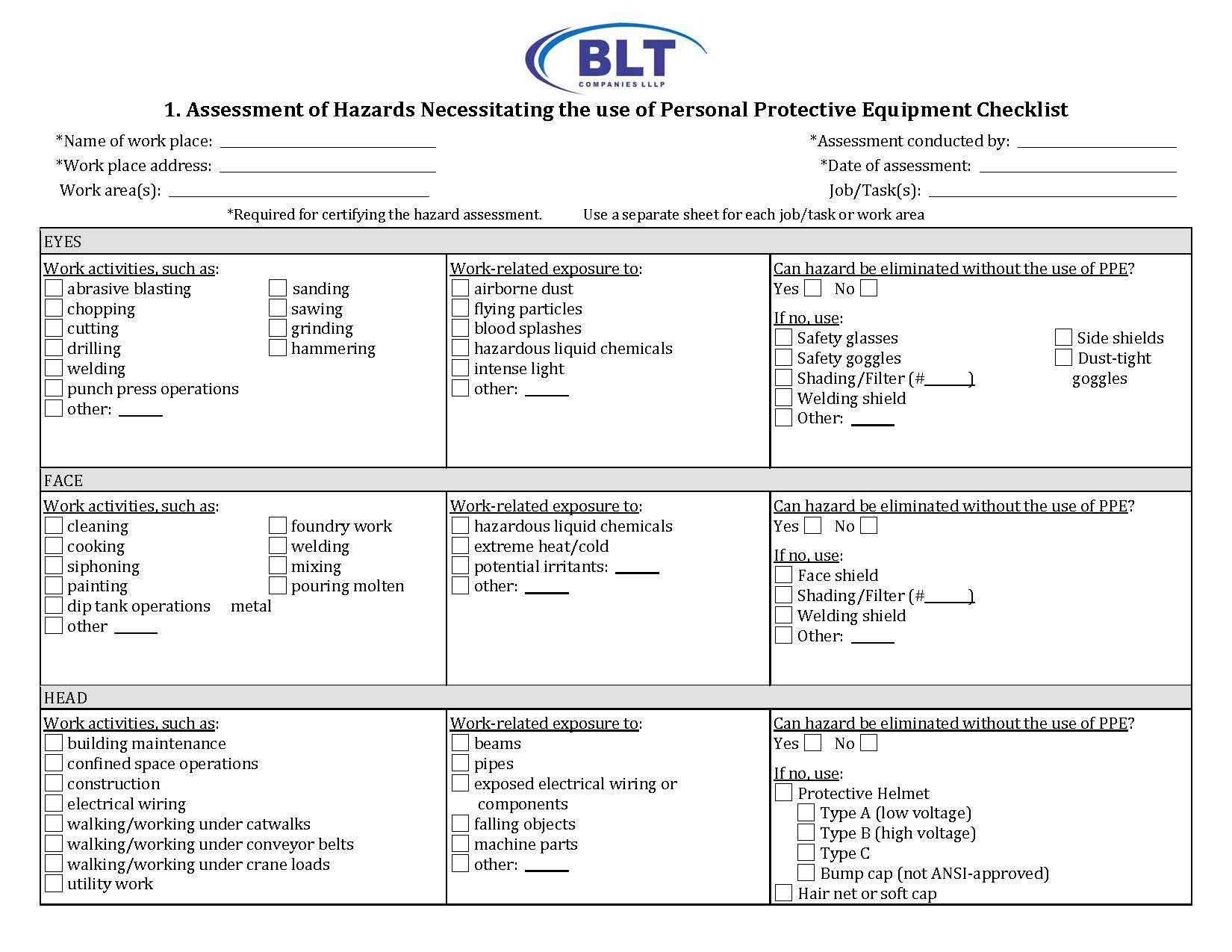
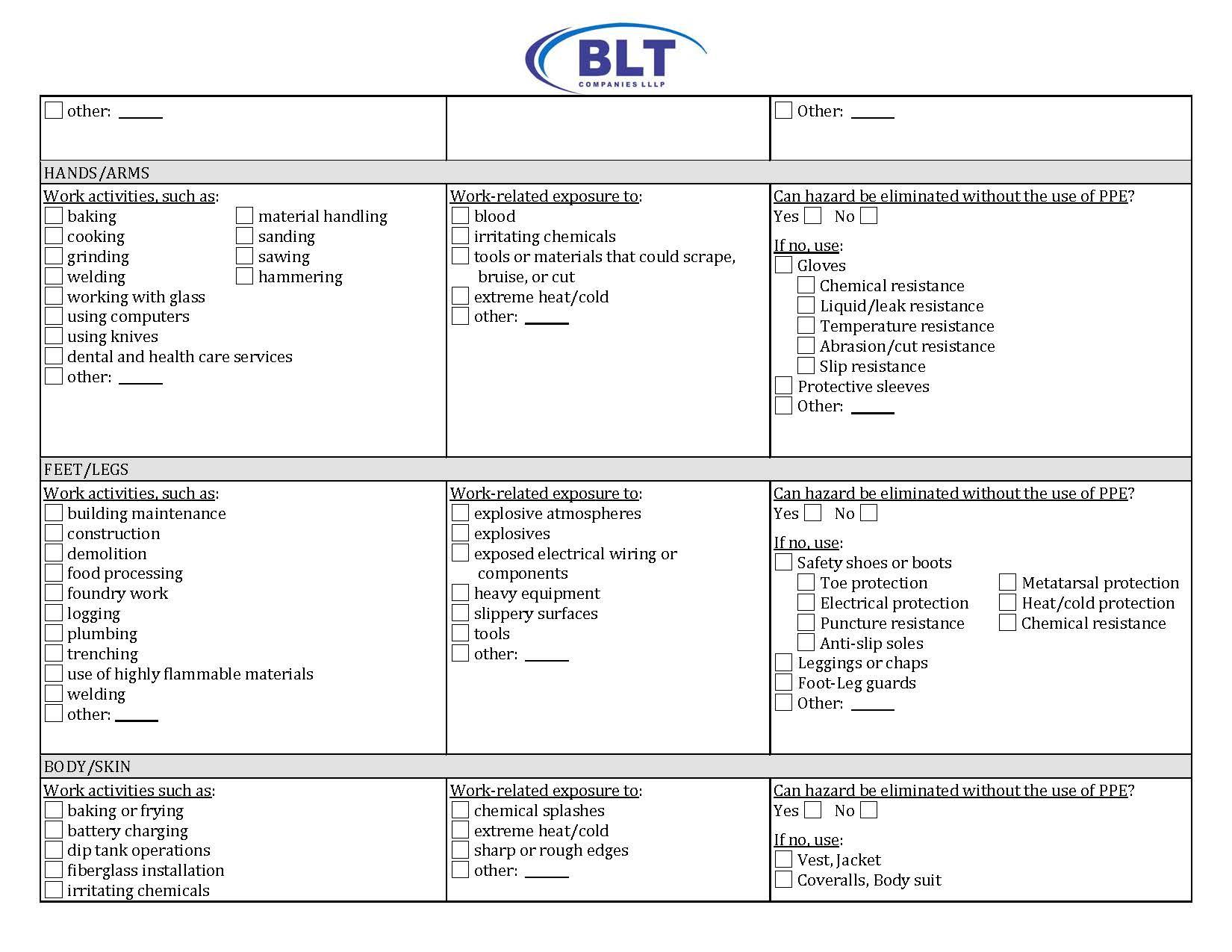
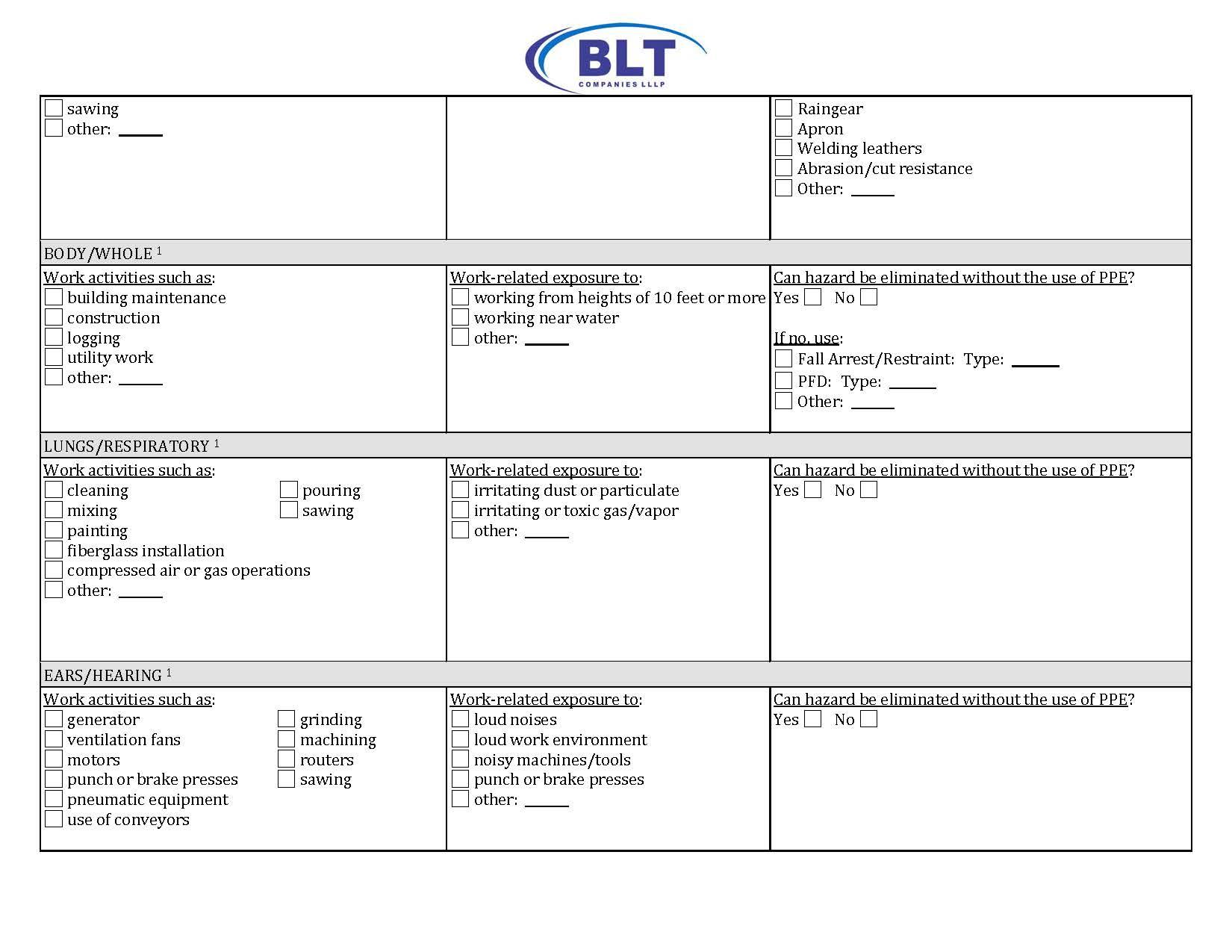
- Assessment of Hazards Necessitating the use of Personal Protective Equipment Checklist: Prior to beginning work at a job site, supervisors are to assess hazards requiring personal protective equipment. This form is to be used as a checklist for the survey to be conducted at the job site and the sources of potential hazards for which they will be watching. See the section in this Safety & Employee Health Program on our Personal Protective Equipment Assessment, Selection and Training Program for more information.
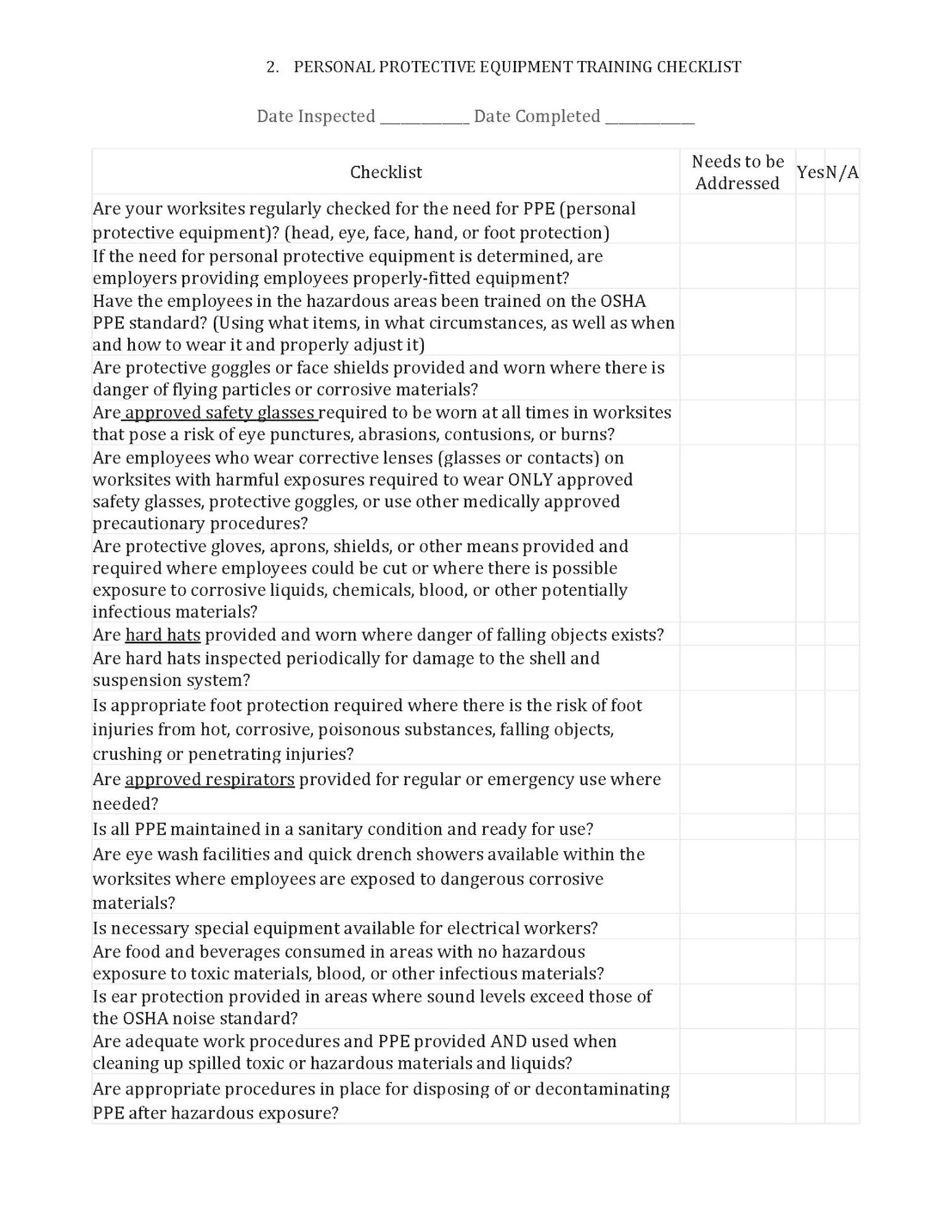
- Personal Protective Equipment Training Checklist: After a supervisor has completed an assessment of a job site to determine hazards necessitating the use of personal protective equipment and has selected the appropriate personal protective equipment each crew member is to be trained on when, what, how, limitations, care and maintenance of the personal protective equipment selected for the job. Supervisors are to use this checklist as a guide.
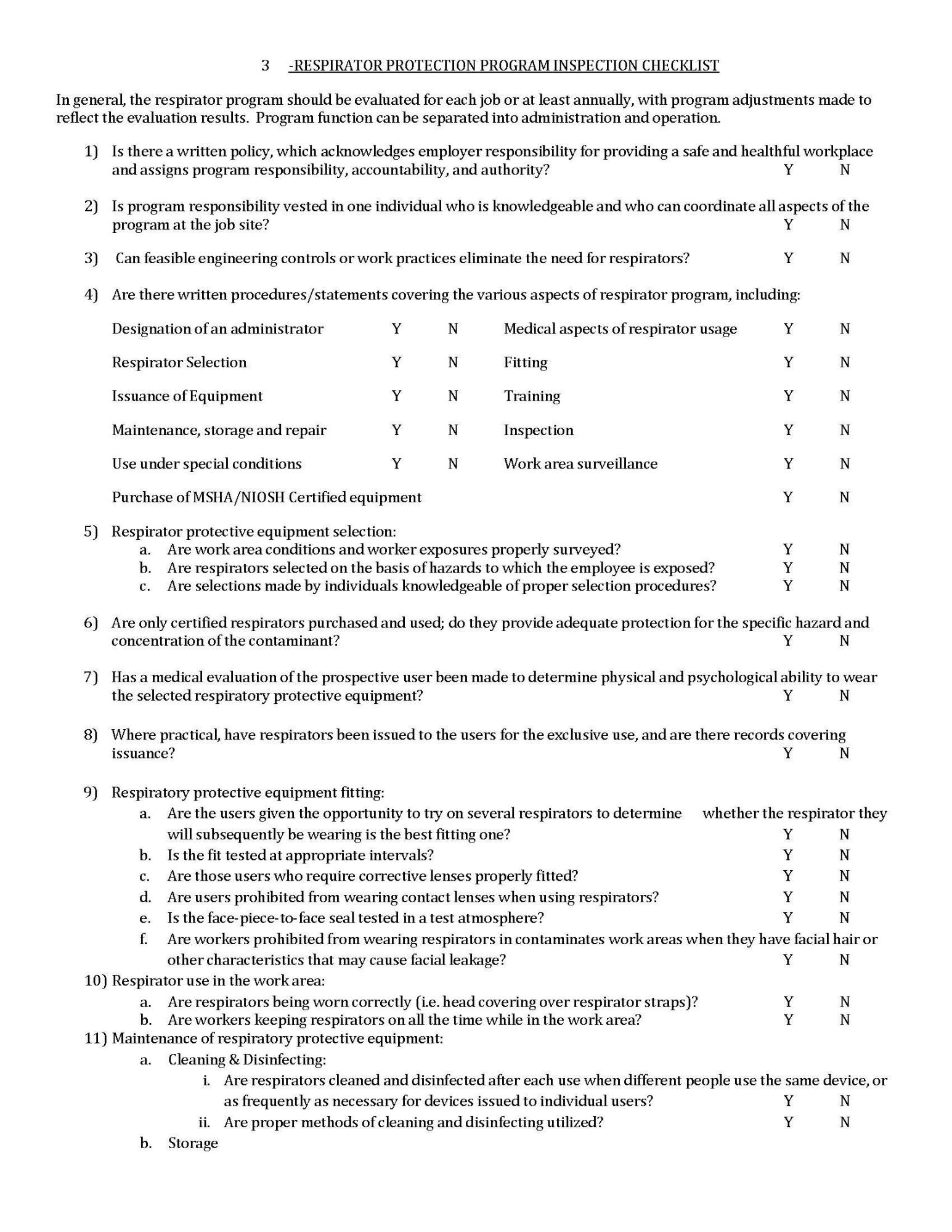
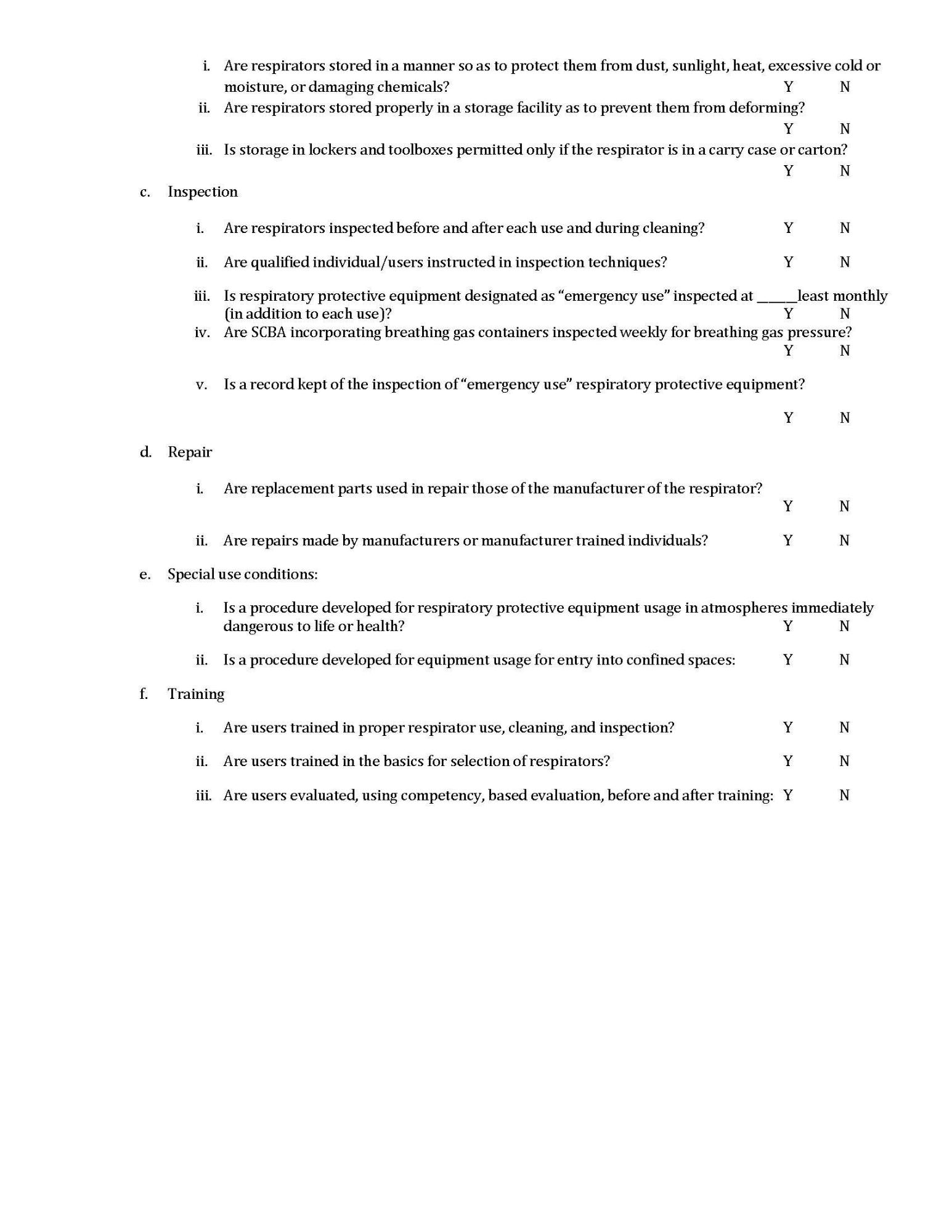
- Respirator Protection Program Inspection Checklist: Our Safety Director and supervisors will inspect job sites randomly for individual employee and supervisor compliance with our Respiratory Protection Program using this checklist as a guide.
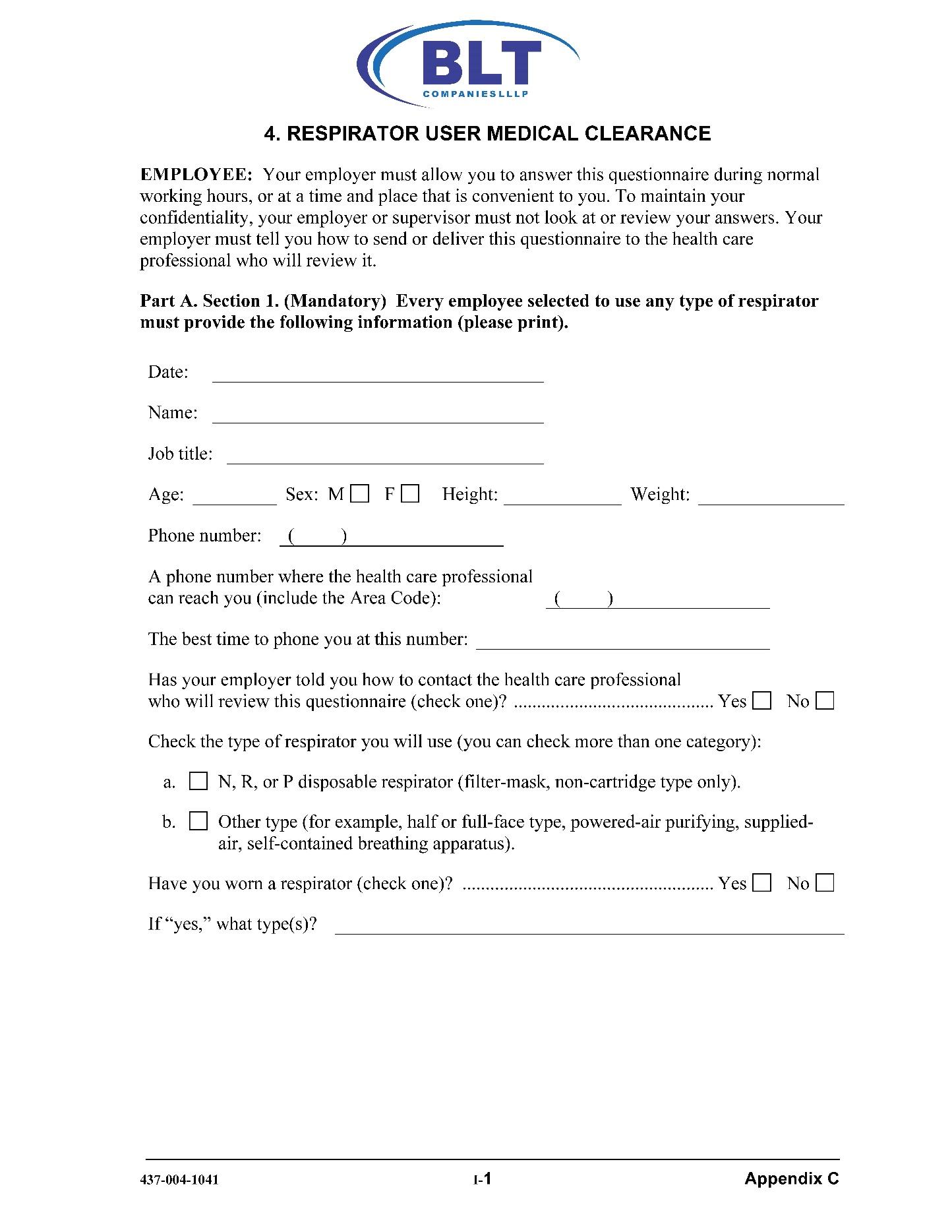
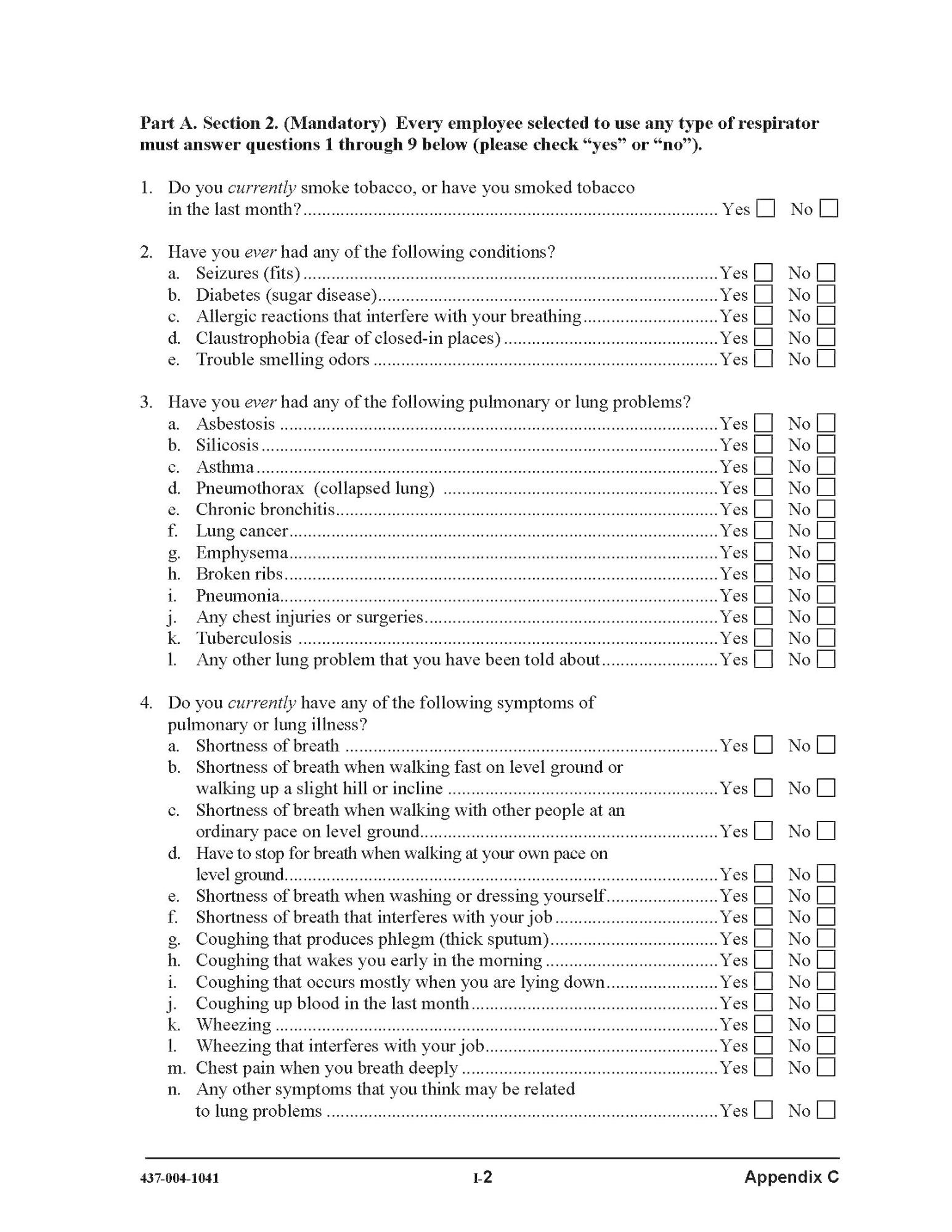
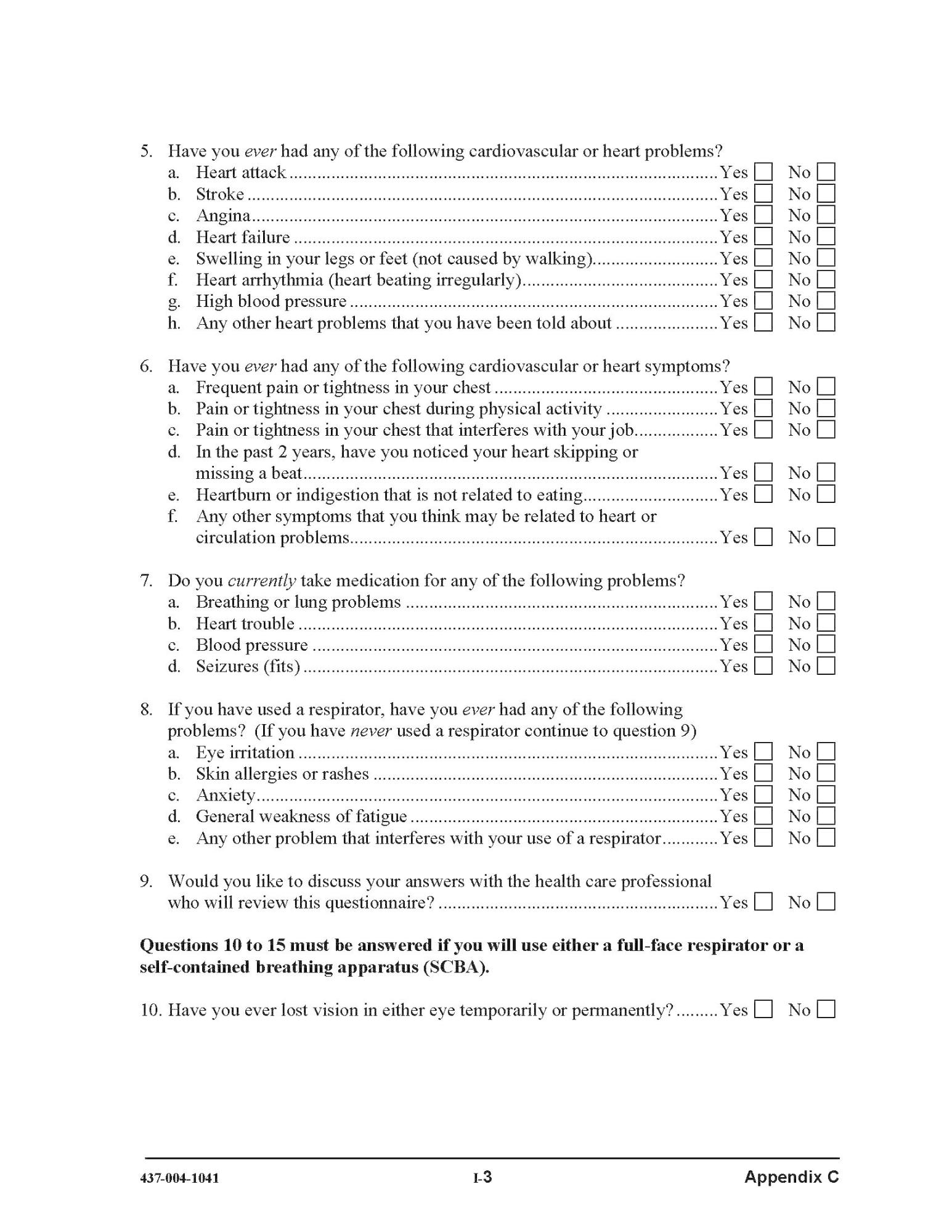
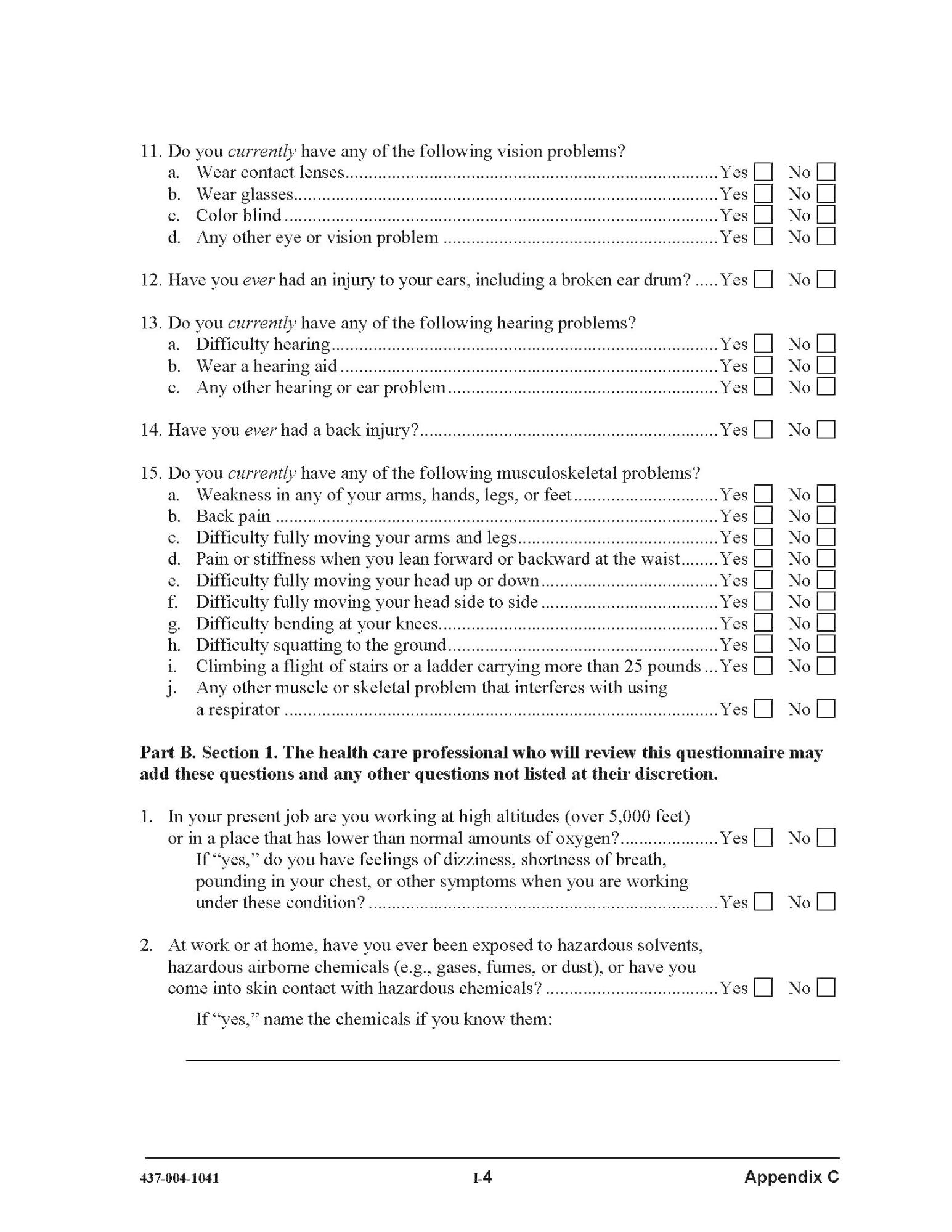
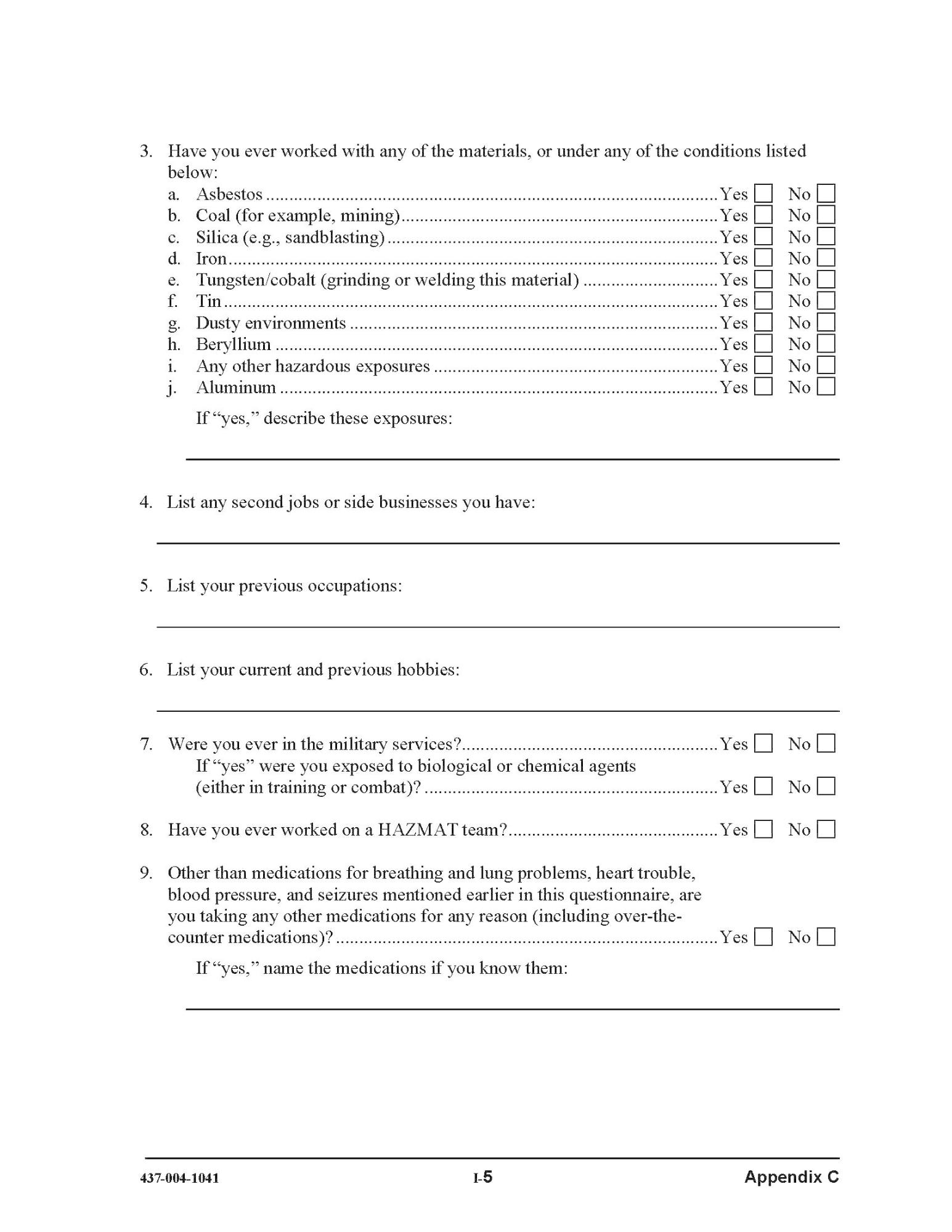
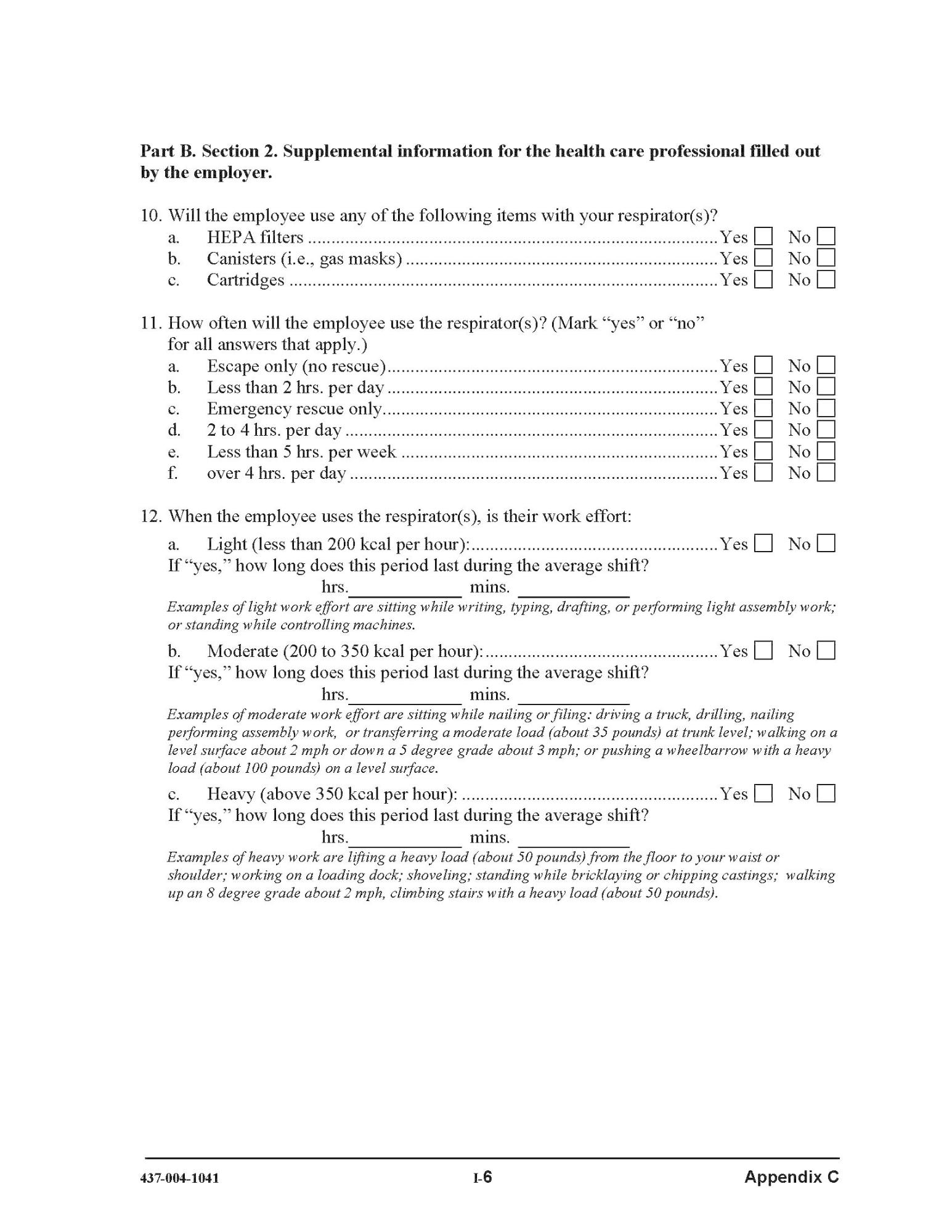
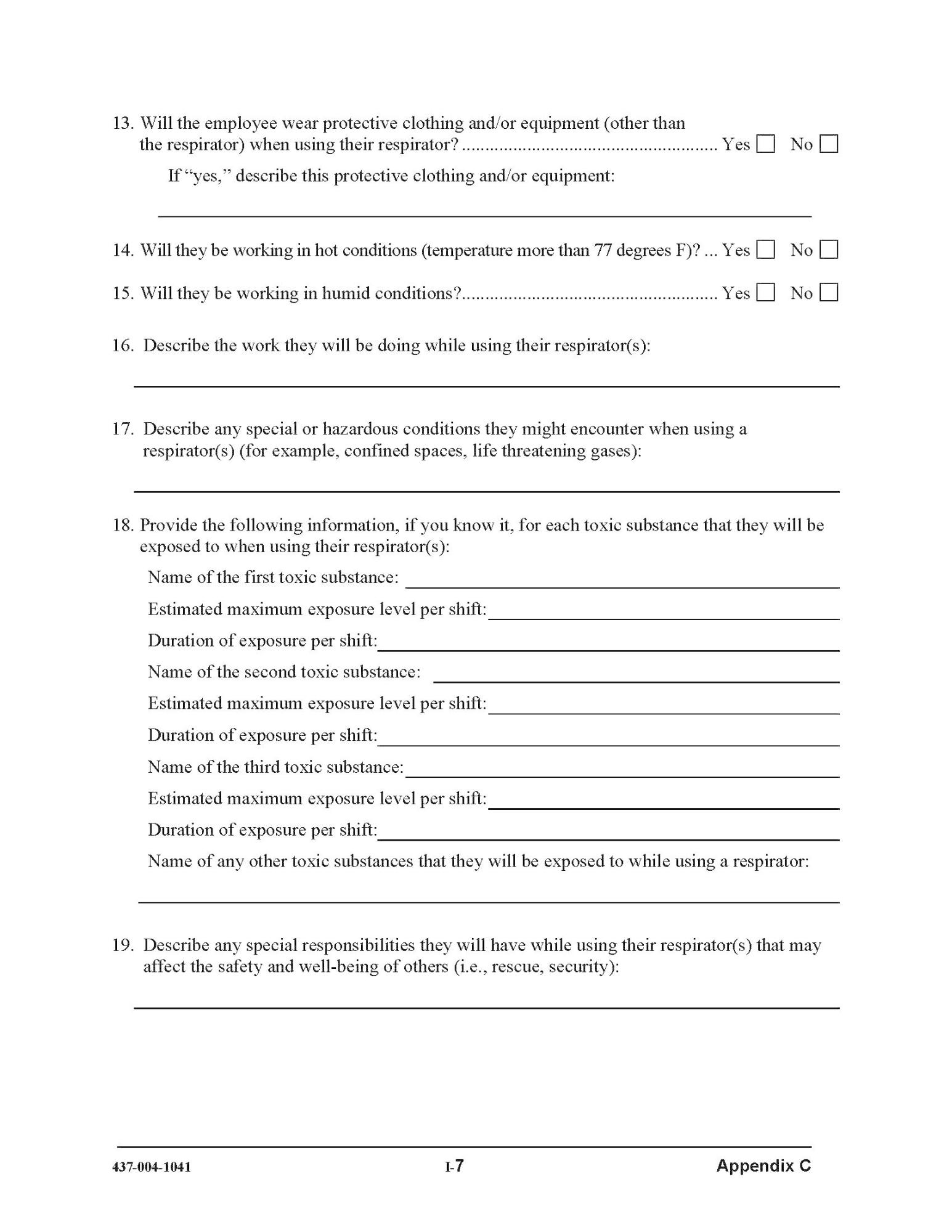
- Respirator User Medical Clearance: Employees who will need to use respirators as part of their personal protective equipment will be sent for a medical evaluation prior to using a respirator to determine if they are physically able to perform the work and use the equipment. Respirator users will also be sent for medical examinations periodically as required by Arizona statutes to determine if there have been any changes in their health which would stop them from using a respirator. Employees are to take our Respirator User Medical Clearance form with them when they go for their medical evaluations. The examining physician will complete the form and return it to the office. See the section in this Safety & Employee Health Program on our Respiratory Protection Program for more information.
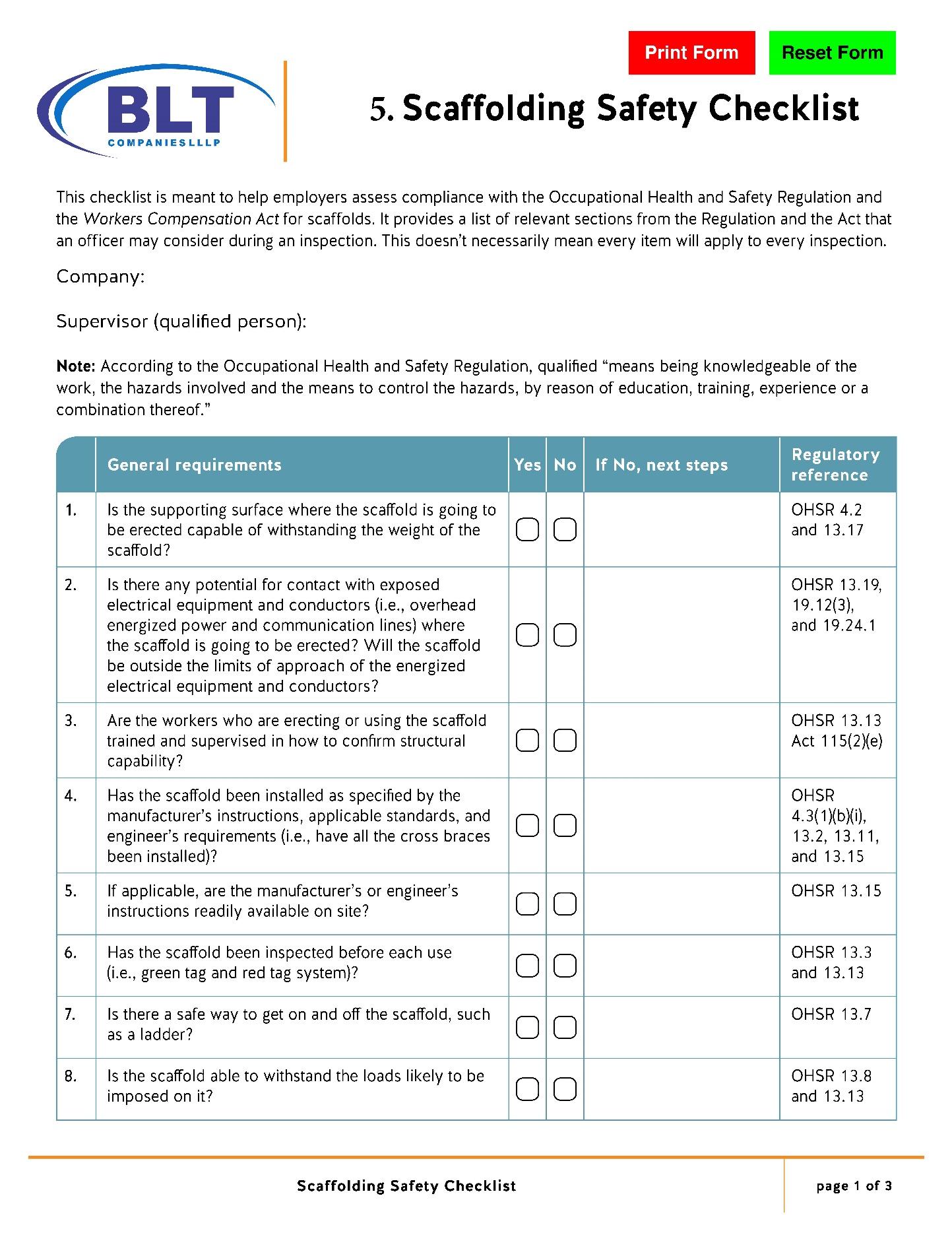
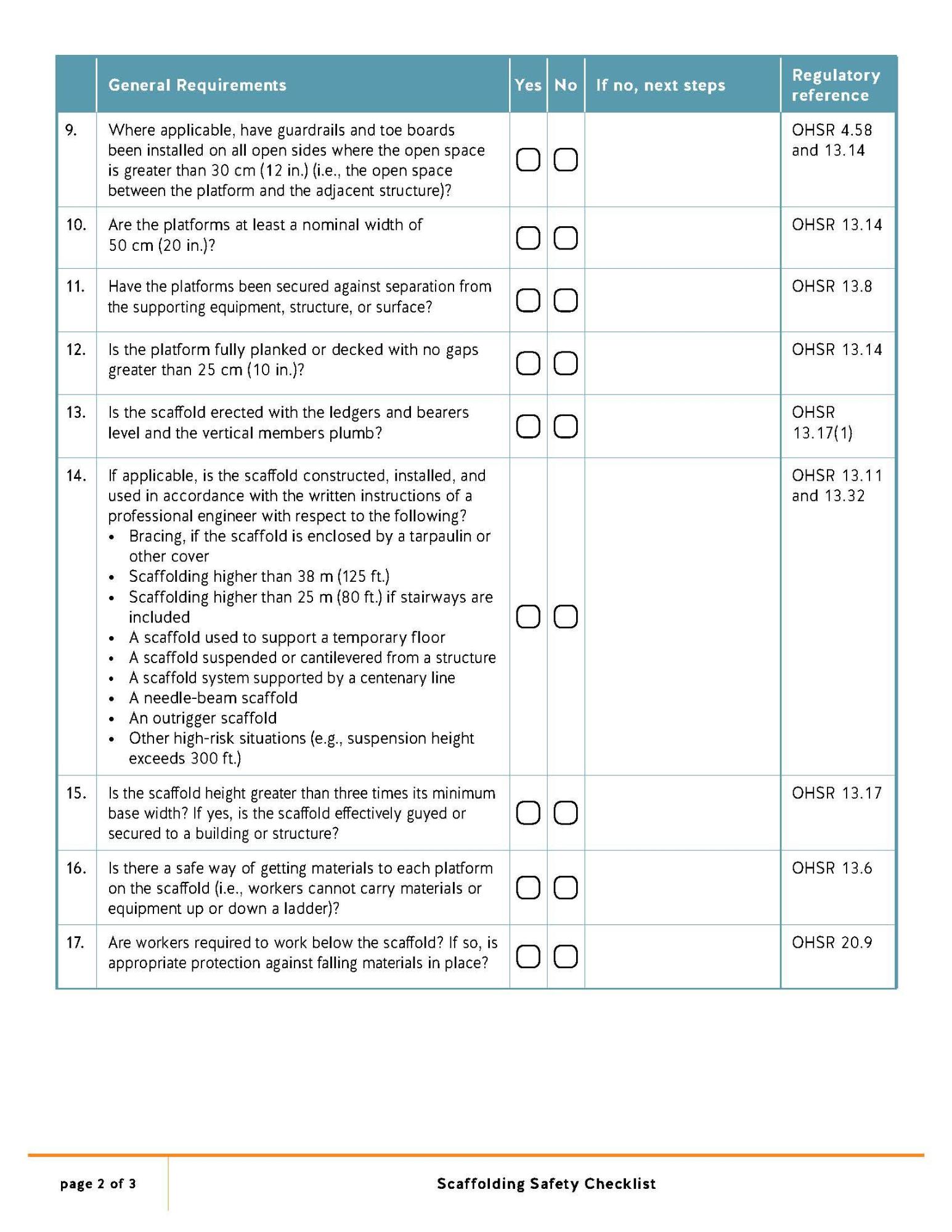
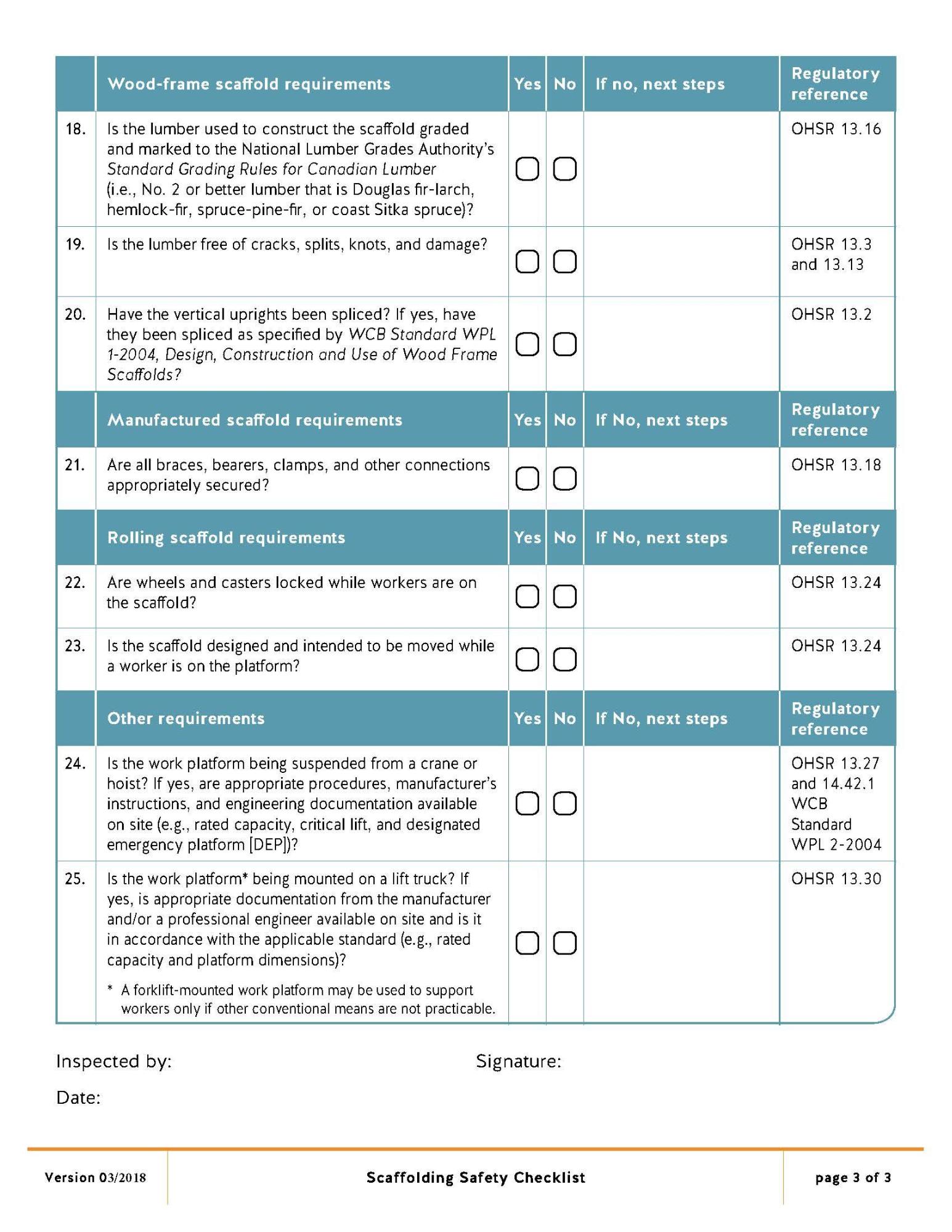
- Scaffold Safety Checklist: Supervisors are responsible for continual inspection of scaffolding to ensure it is erected correctly, safety features are not removed or by-passed by employees and to verify all scaffolding meets OSHA standards. Our Scaffold Safety Checklist is designed to help assess scaffolding at job sites on a daily basis and document findings.
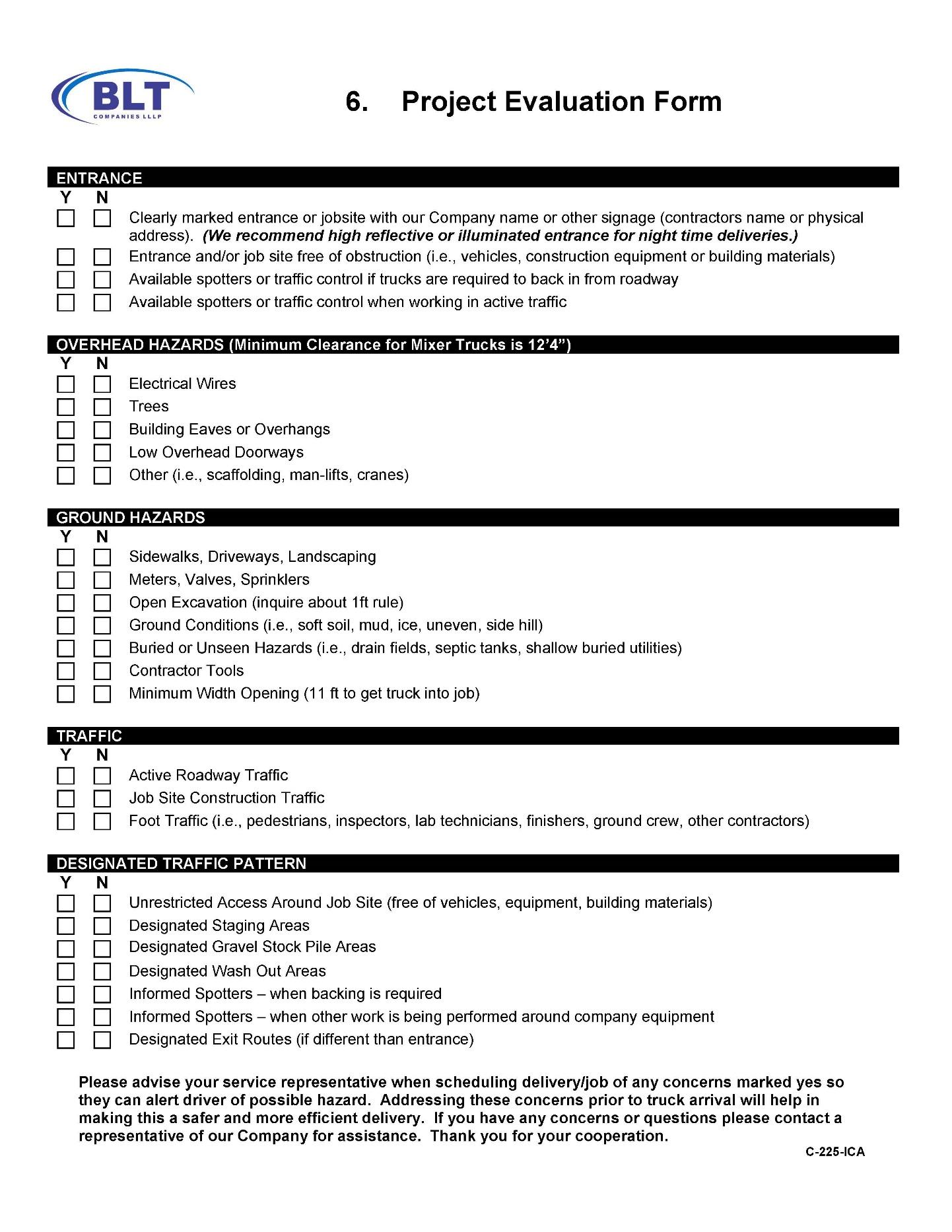
- Project Evaluation Form: Our Project Evaluation Form is to be used by our Safety Director during job site visits as an aid in evaluating whether our safety policies and procedures as well as Federal and State safety regulations are being followed.
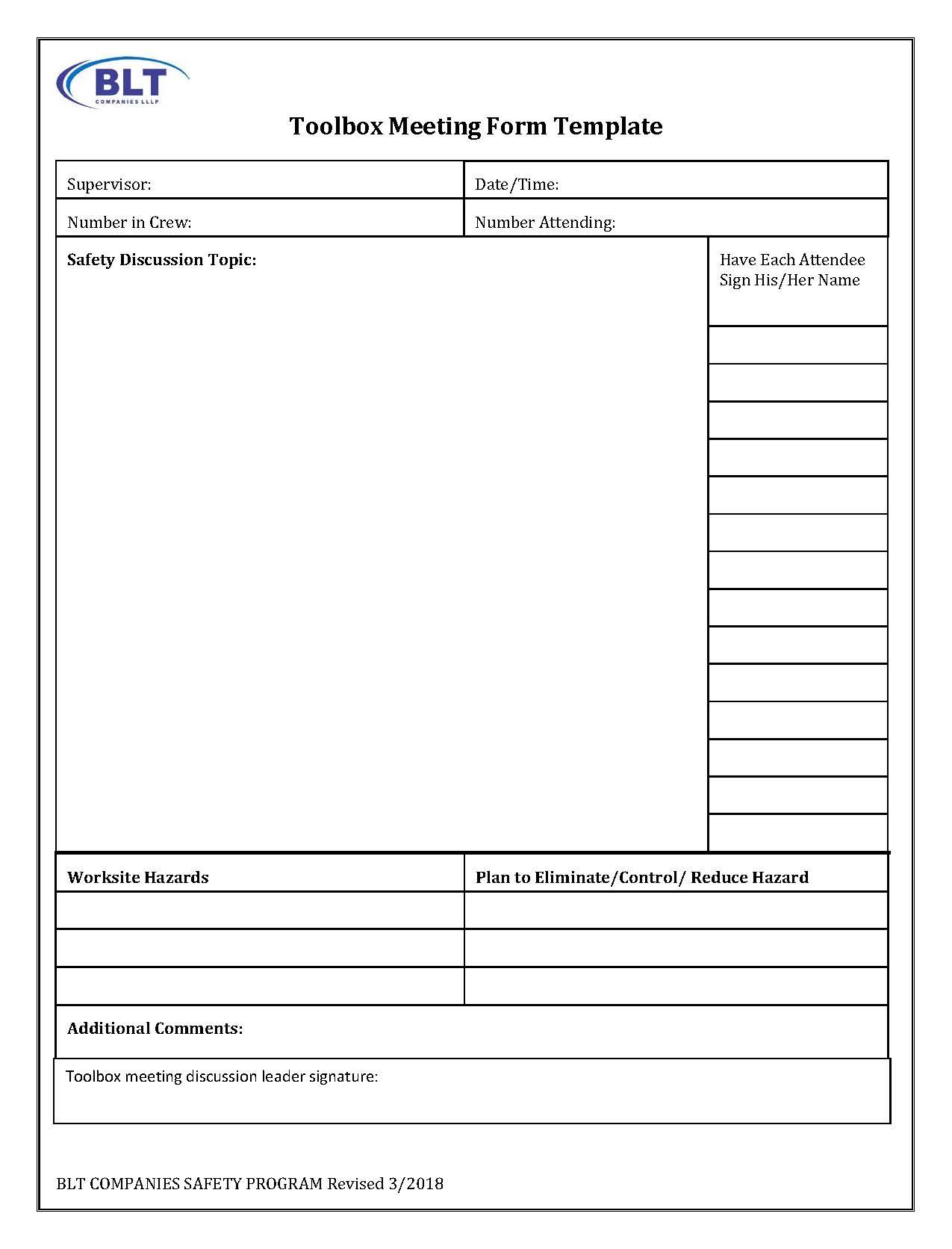
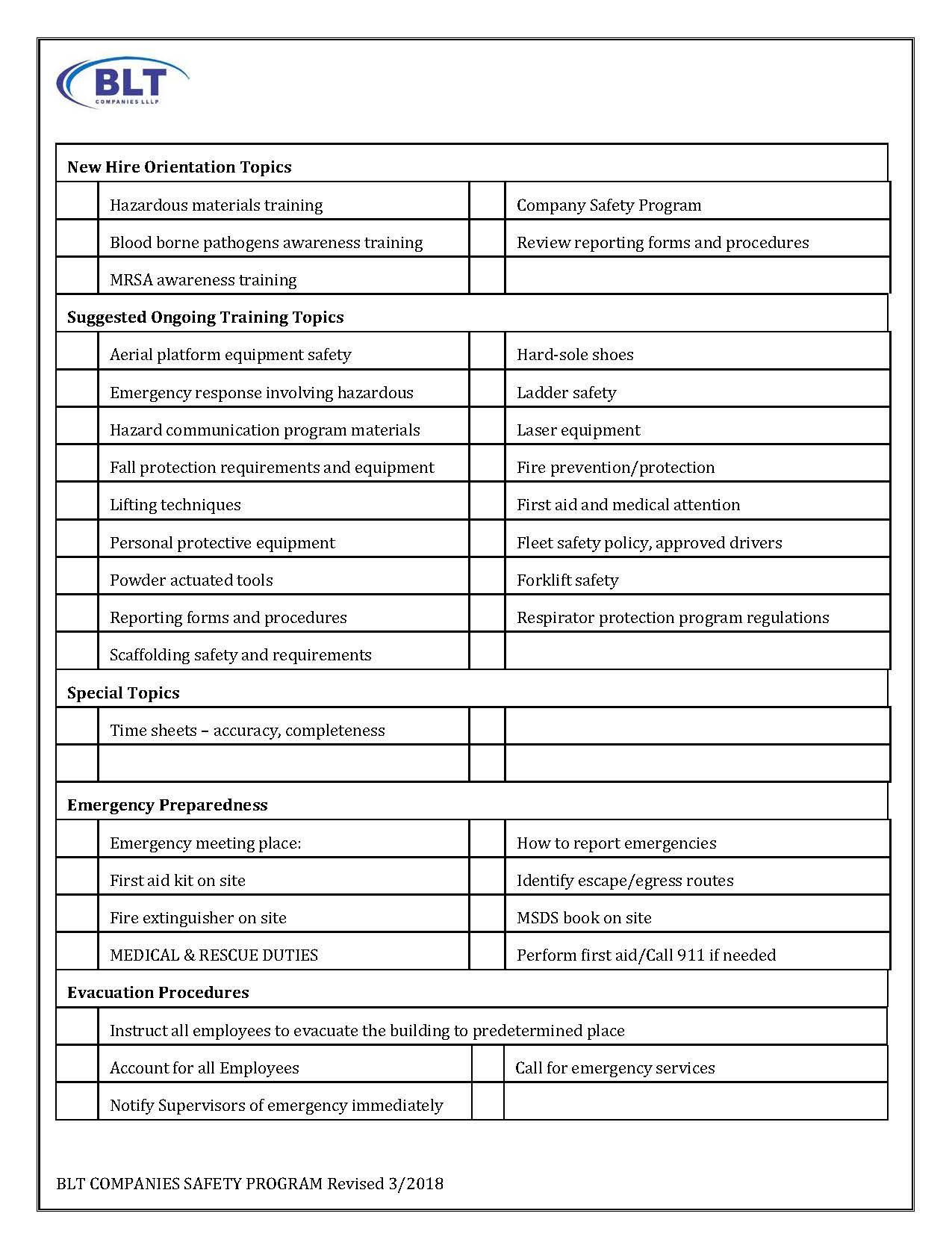
- Tool Box Meeting: Supervisors are required to conduct weekly tool box meetings at job sites to train new and existing employees in general safety guidelines, accident and injury prevention, fall protection, scaffold safety, hazardous materials, blood borne pathogens and MRSA awareness, the proper use and kind of equipment needed for specific job sites and conditions, and emergency procedures. All weekly toolbox meetings are to be documented by completion of this form and submitting it for review by our superintendents.
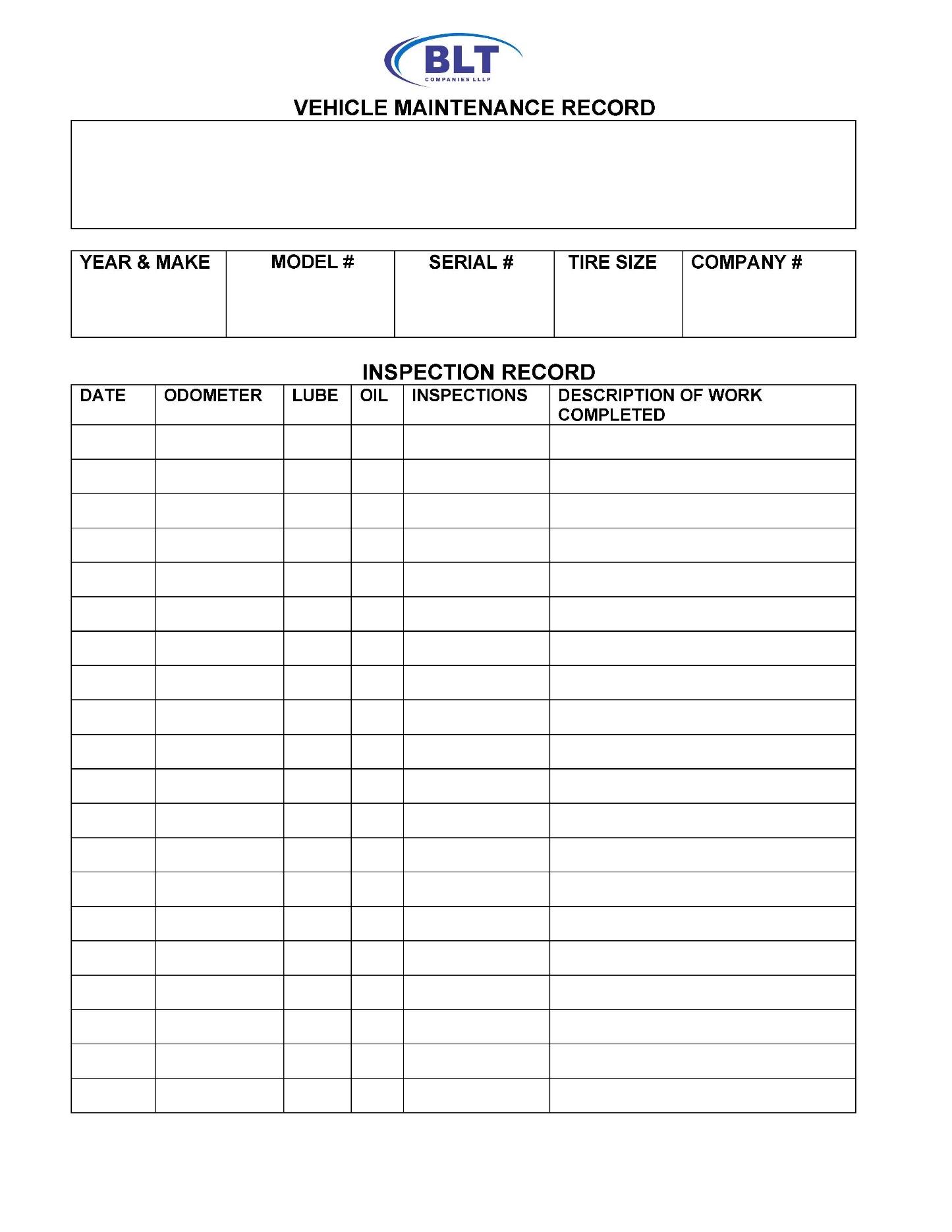
- Vehicle Maintenance Log: Employees assigned a Company vehicle have the responsibility of keeping it in good repair. Routine servicing and repairs should be recorded on this form and kept in the glove compartment of the vehicle. See the section in this Safety & Employee Health Program on our Fleet Safety & Employee Health Program for more information on vehicle maintenance. Company vehicles are for Company use only, not for personal use.
GENERAL SAFETY GUIDELINES
- Report immediately to your supervisor any accident that results in personal injury or damage to property. Complete our Employee’s Report of Injury form and submit as soon as possible. GET MEDICAL ATTENTION PROMPTLY WHEN NEEDED.
- Report immediately to your supervisor any condition or practice you think might cause injury to a person or damage to equipment. Complete and submit our Employee Safety Information Report form.
- Do not operate any equipment which in your opinion is not in a safe condition. Complete and submit our Employee Safety Information Report form.
- Use all prescribed safety and personal protective equipment as required and maintain it in good working condition. See the section in this Safety & Employee Health Program on our Personal Protective Equipment Assessment, Selection and Training Program.
- Obey all Company rules, government regulations, signs, markings and instructions. Be particularly familiar with those that apply directly to you.
- Lift using approved lifting techniques. Get help for heavy loads.
- Do not horseplay; avoid distracting others; be courteous.
- Use the right tools and equipment for the job you are doing. Use them safely and only when authorized.
- Practice good housekeeping. Return all tools, equipment, and materials to their proper places. Disorder wastes time, energy and material and will often result in injury.
- The use of drugs and/or intoxicating beverages is prohibited. See the section in this Safety & Employee Health Program on our Substance Abuse Policy/Drug and Alcohol Testing Policy.
EMPLOYEE SAFETY RULES AND REGULATIONS
Safety rules are established to protect employees from injuries. Our Company believes in your right as an employee to work in a safe and healthful environment. The safety rules outlined in this section of our Safety & Employee Health Program should not be construed as a complete safety guideline. Your supervisor will have a copy of the State of Arizona OSHA Safety and Health Standards for the Construction Industry (29 CFR Part 1926) to use as a reference guide and as an aid in training.
The following safety rules and regulations are part of our Safety & Employee Health Program. As a condition of employment, you must comply with them and do everything reasonably necessary to protect the life, health, safety and welfare of yourself and others on the job.
- Employees are not to operate any equipment without proper training and authorization.
- Employees are not to remove, displace, damage, destroy or carry off any safety device furnished and provided for their use or the use of another person. Employees are not to interfere with the use of any method or process adopted for the protection of themselves or another person.
- Employees are to comply with occupational safety and health standards (OSHA), and all rules and regulations which are applicable to their own actions and conduct.
- Employees are to report to their supervisor any physical impairment or condition which may affect their ability to perform safely before attempting to perform any work.
- Employees are to know their job duties and be aware of hazards that exist. If an employee becomes aware of a potentially hazardous condition or situation, they are to shut down the unsafe area and immediately notify their supervisor. Employees are to follow up with a written report of the situation by completing our Employee Safety Information Report form as outlined in this Safety & Employee Health Program. Continued use of an unsafe structure, equipment or vehicle is prohibited pending correction of the unsafe condition.
- Employees are to report all injuries to their supervisor immediately. As soon as possible the injured employee is to follow up with a written report of the injury by completing our Employee’s Report of Injury form as outlined in this Safety & Employee Health Program. Employees who require medical attention after a work place related injury are required to submit to an alcohol impairment test and a drug test for the unlawful use of any controlled substance prohibited under Arizona’s criminal statutes within twenty-four hours after we have been notified of the injury.
- Employees are never to move an injured person unless it is absolutely necessary due to danger of further injury. First aid training is not provided that would qualify employees to treat serious injuries. Supervisors may treat minor cuts and abrasions only. Other employees need to leave all treatment for authorized persons to handle. Employees should make the injured person comfortable until trained personnel arrive.
- The use or possession of intoxicants or drugs in the workplace is prohibited. If an employee reports for work intoxicated or under the influence of intoxicating liquor or drugs they will not be allowed to work or stay on the premises.
- Employees who are taking a prescription or over-the-counter drug are personally responsible for confirming with their physician that they may safely perform their normal job duties while taking it. If an employee is taking a drug that could impair their performance, they must advise their supervisor immediately. If duties which are not hazardous are available the employee will be reassigned by the supervisor; otherwise, the employee will be sent home.
- Employees are not allowed to have firearms at job sites or Company premises or in Company vehicles.
- Employees are not allowed to run in the yard or at job sites. Employees should watch where they are walking and keep alert to conditions, work processes and the movement of equipment and others around them so they can foresee and avoid potential dangers.
- Employees are not allowed to engage in fighting, gambling, the practice of sports, horseplay or other misconduct in the yard or at job sites. Threatening or attacks upon another employee will not be tolerated.
- Employees are to drive within the safe limits of all posted and known traffic regulations both on the street and at job sites. Employees are not to drive a Company vehicle unless they have been authorized as an approved driver. See the section in this Safety & Employee Health Program on our Fleet Safety & Employee Health Program.
- Employees are to properly use, maintain and dispose of personal protective equipment. Job sites will be assessed by our supervisors to determine what if any personal protective equipment will be required, under what conditions it is to be used and will train employees in the proper use, maintenance and disposal of it as well as its limitations. Personal protective equipment such as hard hats, safety glasses or goggles and respiratory protection that are required will be furnished by the Company. See the section in this Safety & Employee Health Program on our Personal Protective Equipment Assessment, Selection and Training.
- Employees are required to wear steel-toed shoes in the yard or at job sites. Sneakers, tennis shoes and open-toe shoes are not permitted on job sites. Supervisors will enforce this policy. Disciplinary action will include sending employees home if they are not wearing proper shoes.
- Employees who are working with hazardous materials requiring respiratory protective equipment will be provided with appropriate respiratory protective devices and will be trained in the proper use, maintenance and disposal of the devices as well as their limitations. See the section in this Safety & Employee Health Program on our Respiratory Protection Program.
- Employees are required to properly use and maintain all fall protection equipment determined to be necessary at a job site. Supervisors will assess each job site for fall protection requirements. Employees will be trained in fall hazards, fall protection equipment, and the proper use and maintenance of the equipment. See the section in this Safety & Employee Health Program on our Fall Protection Program.
- Employees are required to wear full body clothing to avoid sunburn and exposure to sparks and hazardous materials. “T-shirts” with short sleeves of at least three inches will be required as a minimum during hot weather. Shorts will not be allowed. Supervisors will enforce our clothing policy. Employees will be sent home if they are not in compliance.
- Employees are not allowed to work on ladders or scaffolding until they have received the proper training and are authorized to use it. Supervisors are to check all scaffolding to see that it has been assembled correctly and all safety features are in place prior to scaffolding being used. See the section in this Safety & Employee Health Program on our Ladder Program and our Scaffolding Program.
- Employees should be alert and heed all information and warning signs.
- Employees are not to attempt to repair or tamper with equipment that is not functioning properly unless they are authorized to do so. Employees are to report malfunctions to their supervisor immediately and follow up with a written report by completing our Employee Safety Information Report form.
- Prior to beginning work at a job site, employees are to receive training from our supervisors on emergency procedures and the location of emergency equipment applicable to the job site.
- Employees are to maintain good housekeeping at all times keeping waste, debris and rubbish cleaned up.
- No smoking on the property as per the Smoke-Free Arizona Act ARS 36-601-01. Employees are not to smoke in areas marked “No Smoking” or near flammable or combustible materials or their storage areas. Certain locations within our plants contain potential fire hazards and have been designated as NO SMOKING areas. In addition, all offices and equipment at BLT Companies are NO SMOKING areas. It is your responsibility to know these locations and comply with the NO SMOKING rule.
- Employees must receive hazardous materials training prior to beginning work at a job site. All hazardous materials must be properly handled, stored and disposed of according to government regulations and Company policies. Employees should not use chemicals without understanding their toxic properties. See the section in this Safety & Employee Health Program on our Hazard Communication Program.
- No pets are allowed at job sites or within the Company’s offices, yards, parking lots or vehicles.
SAFETY TRAINING & REMINDERS
Employees are required to attend weekly toolbox meetings conducted by supervisors. Any employee who is not receiving training at weekly toolbox meetings or who feels they have not received proper and sufficient safety and hazardous materials training should contact one of the following persons:
Brian Thomas, Owner/Manager, 928-726-1951 Safety Director, (928) 726-0435
Employees should follow up with a written report by completing our Employee Safety Information Report and submitting it directly to the office. Employees are not to begin a job until they have received the proper training and have been authorized to perform the job. Employees should not undertake a job that appears to be unsafe.
Shown below are safety reminders which should be adopted by all employees to help make safety a routine part of their work:
WORK SAFELY Safety is everyone’s business. Teach new employees safe work methods. Accidents can be prevented.
LIFTING Hold your back straight, bend your knees, get a firm grip on the object, hold it close to your body, space your feet for good balance; then lift exerting the lifting force with your strong leg muscles not the weaker back muscles.
MATERIAL HANDLING Do not throw objects; always carry or pass them. Use hand trucks or other equipment when possible. Get help with heavy or awkward objects.
TRASH DISPOSAL Keep sharp objects and dangerous substances out of the trash can. Dispose of them in approved containers.
CLEAN UP Remove refuse promptly to prevent slips and tripping.
PREVENT FALLS Keep aisles, workplaces and stairways clean, clear and well-lighted. Report slippery or faulty floor surfaces.
WALK, DON’T RUN Watch your step. Wear steel-toed shoes.
TOOLS Handle and store knives and other tools with sharp or cutting edges carefully. Do not use burred, defective or greasy tools. Use the right tool for the job.
FALLING OBJECTS Handle objects and tools carefully. Store them where they won’t fall.
PERSONAL PROTECTIVE EQUIPMENT Wear it when it is required. Maintain it to do the job it should. Replace it when it can no longer protect you as intended.
MACHINE GUARDS Keep guards in place at all times. Don’t clean machinery while it is running. Lock all disconnect switches while doing repairs or cleaning.
- Equipment Guards: All drive belts, gear shafts, pulleys, sheaves, spindles, drums, flywheels, chains, conveyor head, tail and idler pulleys, rotating or moving parts of equipment; pinch points, or other hazardous areas that are within reach of an employee must be provided with a guard to prevent anyone contacting or being exposed to a hazard.
- No guard, safety appliance, or other device shall be removed from machinery or equipment, or made ineffective, except for the purpose of making repairs or adjustments. Guards must be in place while the machinery or equipment is operating.
- To prevent accidental or unauthorized starts, the electrical disconnect must be locked and tagged in the OFF position on all pieces of equipment that are being repaired.
- All guards or safety devices that have been removed for repair, maintenance, or adjustment will be replaced before operating the equipment.
- Never attempt to oil, grease, clean parts of conveyor in use, unless grease fittings are piped to an area away from guarded pinch point and moving parts.
- Never attempt to cross over a moving conveyor belt unless a crossover with handrails is provided to cross the belt.
- Never attempt to walk on any stopped belt without following the lock and tag out procedures and the benefit of a safety harness.
- When grinding on bench grinder, all steady rests are to be adjusted to 1/8" from grinding wheel. Face shields are to be worn.
ELECTRICAL HAZARDS
- Do not stand on wet floor while using any electrical apparatus. Keep extension cords in good repair. Do not use worn or frayed electrical cords or cables. Do not make unauthorized connections or repairs. Do not overload outlets. Electricity can be dangerous. Its proper use requires specialized training. Authorized persons, under knowledge of shift supervisor only, shall install and repair electrical equipment. Only authorized persons can replace fuses (use properly sized fuse puller). This shall be done only after the equipment has been turned off, locked out, and checked by meter to ensure it is dead. If this is not possible, proper-type rubber and cover gloves shall be worn and special "Hot-line" tools used.
- Flexible cords may not be used as a substitute for fixed wiring, run through holes in walls, ceilings or floors, run through doors, windows, etc., attached to building surfaces.
- Flexible cords must be continuous lengths without splices or taps, fastened so that there is no pull-on joints or terminal screws, replaced when frayed or insulation has deteriorated equipment.
- Qualified electricians will perform electrical maintenance. Report all electrical malfunctions or problems of any type to your supervisor immediately. Do not walk on or drive over electrical trailing cables to dredges, shovels, draglines or any other electrical power conductor cables. Electrical cables shall be properly buried or covered with rubber belting. Rubber matting and other insulating material shall be placed at switch gear and disconnect boxes to protect the operator from wet ground conditions.
- Approved rubber electrical gloves with leather protectors will be used when handling trailing cables to draglines, shovels, or dredges regardless of whether the cable is energized or de-energized. Cable hooks shall be used in addition to the gloves. Never pick up an electrical trailing cable, place it against your body or over your shoulder. Before mounting an electric dragline, touch the closest metal member with the back of your hand. All portable electrical extension cords must be the three-wire grounded type. All electrical hand tools should be three-wire ground type cords unless the tool is double insulated. All tools must be operator controlled, no lock-on device. If tool does not incorporate a three-wire ground plug, a (GFCI) strip cord or receptacle should be used. Ground fault circuit interrupters should be utilized for all applications entailing the potential for moisture and/or water accumulations.
- ASSURED GROUNDING – All portable electric tools, drop cords, extension cords and similar items will be visually inspected daily before being put to use. Any items showing signs of possible damage will not be used until repaired as indicated and tested.
- All portable electric tools, extension and drop cords, fixed temporary wiring and receptacles will be tested for continuity of the conductors and for the connection to the exposed frame in the case of tools. All cord fittings and receptacles will be tested to make certain the conductors are connected to the proper terminals.
GAS FIRED APPARATUS Be sure fire box is clear of gas before lighting. Use paper or cloth on a long wire or stick to light burner. Stand to the side to avoid flashbacks.
COMPRESSED AIR Use the correct pressure. Wear eye protection when used for cleaning.
COMPRESSED GAS CYLINDERS – Welding, including Oxygen, Acetylene, and All Other Pressurized Cylinders:
- Cylinders shall always be chained or otherwise secured in an upright position, whether full or empty.
- When not in use and in cases in which the regulator has been removed, a full or empty cylinder shall have the valves closed and cap covers in place.
- Cylinders must be moved using appropriate equipment. Do not use old v-belts, ropes, or valve caps to lift cylinders. Do not drop cylinders.
- When in storage, cylinders containing different gases shall be separated by a minimum of twenty (20) feet or by a suitable firewall.
- Cylinders shall be protected from exposure to moisture, high temperature, physical damage and sources of electric current.
- Upright cylinders whether in storage or in use shall be securely supported in position with cylinder straps, chains, or other approved holding device fastened to a substantial support to prevent the cylinders from falling.
- Acetylene cylinders shall be kept in an upright position when in use. Acetylene shall not be used at pressures in excess of 15 lbs. per square inch.
- Oxygen cylinders, valves, regulators, couplings, hose and apparatus shall be kept free from oil or greasy substances and shall not be handled with oily hands or gloves. Oxygen should not be directed at oil surfaces, greasy clothes or into a fuel oil or other storage tank or vessel.
- The pressure shall be released on all welding and cutting torches when not in use.
- Regulator gauges must be functional with lens covers and regulator guards in place.
- Back flow check valves must be installed near the regulators on oxygen and acetylene cutting torches to prevent fire from entering the tanks.
- Be aware of compressed air, it can be dangerous. Horseplay with compressed air can be deadly and will be cause for severe discipline.
- Use of welder or open flame near a chemical retarder, mold release or other flammable materials will not be allowed.
- Burning with an acetylene torch near pre-stressing strand, which permits molten metal to spray onto the strand, shall not be permitted.
- Compressed air is not to be directed at any person for any reason. Compressed air used for cleaning parts, equipment, etc. is to be regulated to supply no more than 30 P.S.I.
- All oxygen and acetylene bottles are to be shut off and hoses bled off after every use at the end of the shift.
PREVENT INFECTION All punctures, cuts and scratches are potentially dangerous. Get first aid at once. See section in Safety & Employee Health Program for Blood Borne Pathogens Exposure Control and Infection Control.
IF INJURED Report all injuries no matter how minor they appear to be.
HORSEPLAY Scuffling, practical jokes, tricks and the practice of sports are not allowed in the workplace.
EMERGENCIES Know what procedures have been planned. Know where fire extinguishers are located and how to use them. Know where first aid supplies are located. Familiarize yourself with the location of fire extinguishers in your work area and if you change work areas, again familiarize yourself with extinguisher and emergency fuel shut off locations. Know how to use them. Most fires, if detected early, can be put out with a hand fire extinguisher. However, use good common sense before you attack a fire and if there's any possibility of it getting out of hand, call for help before you use a fire extinguisher. Protecting Company property WILL NOT be done at the expense of employee safety. A fire extinguisher in good working condition shall be kept close to any welding or cutting operation within the plant area. Fire extinguishers shall be located at 75 ft. intervals and at the entrance and exit doors.
56.4230 Self-propelled equipment. (a)(1) Whenever a fire or its effects could impede escape from self-propelled equipment, a fire extinguisher shall be on the equipment. (2) Whenever a fire or its effects would not impede escape from the equipment but could affect the escape of other persons in the area, a fire extinguisher shall be on the equipment or within 100 feet of the equipment.
HAZARD COMMUNICATION PROGRAM
Our Company has implemented a Hazard Communication Program to minimize the risk of hazardous materials to our employees. The purpose of the guidelines established by this program are for providing employees information about hazardous substances they will be working with and around and controls that need to be followed for everyone’s safety and protection.
Liquid Products – Keep container labels legible – replace them if they become unreadable. Don't contaminate parts washer product with other solvents, especially gasoline and chlorinated compounds (i.e., brake cleaners). Avoid use of solvents, especially those that are considered hazardous waste once they are used. Examples are materials with low flash point (less than 140 degrees F) or that contain chlorinated compounds (such as brake cleaners). Review the SDS for the materials to determine these characteristics.
General – Store drums and other clean containers under cover, if possible. Tilt drums to control rainwater from entering the top of the drum and corroding the bottom. You should store used or unopened drums on a secondary containment pallet or in a secondary containment area. Maintain SDS file for all products used and stored on-site. Keep number of empty drums to a minimum; fewer than 5 are preferred.
CONTAINER LABELING
- Containers of hazardous substances will not be released for use until the following label information is verified:
- Contents of container.
- Appropriate hazard warnings.
- Name and address of manufacturer.
- Our purchasing agent is responsible for the processing and verification of labels. Employees are not to take materials prior to labeling being completed.
- To further ensure that employees are aware of the hazards of materials used in their work areas all secondary containers are to be labeled with either an extra copy of the original manufacturer’s label or with generic labels which have a block for identity and blocks for the hazard warnings.
EMPLOYEE INFORMATION AND TRAINING – As part of their orientation, employees will receive a copy of our Safety & Employee Health Program which includes our Hazard Communication Program and Employee Training Supplement to the Hazard Communication Program. The Employee Training Supplement is a summary of the OSHA Hazard Communication Regulations including employees’ rights under the regulation. Employees will also receive information on the following:
- Where hazardous substances are present.
- Physical and health effects of hazardous substances.
- How to lessen or prevent exposure to hazardous substances.
- Steps that have been taken to lessen or prevent exposure to hazardous substances.
- Procedures to follow if they are exposed to hazardous substances.
- How to read labels and review SDS to obtain appropriate hazard information.
- When new hazardous substances are going to be used our supervisors will be responsible for reviewing the above information regarding new materials with employees who will be using them.
- It is the employee’s responsibility to adhere to guidelines established by our Company when using hazardous substances. It is critically important that all employees understand the training received under our Hazard Communication Program. Employees who wish to receive more information or training regarding hazardous materials should contact their supervisor or Safety Director. If any employee feels they are not receiving proper and sufficient training they should notify one of the following persons and follow up with a written report by completing our Employee Safety Information Report and submitting it directly to the office
- Every employee will receive comprehensive hazardous materials training as a part of our annual safety training sessions. These training sessions are mandatory and attendance is a condition of employment.
HAZARDOUS NON-ROUTINE TASKS
Periodically employees may be required to perform hazardous non-routine tasks. Each affected employee will be given information by their supervisor about hazards to which they may be exposed during such an activity. This information will include:
- Specific hazards
- Protective/safety measures which will be required
- Measures the Company has taken to lessen the hazards including ventilation, respirators, presence of another employee and emergency procedures
HAZARDOUS SUBSTANCES IN UNLABELED PIPES
To ensure that any employee who would have occasion to work on unlabeled pipes has been informed as to whether a hazardous substance is contained within the pipes the following procedure has been established. Prior to starting work on an unlabeled pipe, employees are to contact our Safety Director for the following information:
- Whether the pipe contains a hazardous substance.
- If it does what the potential hazards are and what controls will be needed.
POTENTIAL HAZARDS DUE TO OTHER CONTRACTORS
The General Contractor at every job site is responsible for obtaining SDS on all hazardous substances being used from every subcontractor working at the job site. This information is available to anyone who wants information about hazardous materials they are working with or around at the job site. Employees are encouraged to ask to see an SDS on any product being used around or near them with which they are not familiar.
LIST OF HAZARDOUS SUBSTANCES
A list of known hazardous substances used by employees of our Company can be found in the SDS binders throughout our facilities. Specific information on each category of hazardous substances can be obtained by reviewing the SDS. A few of our hazardous substances include:
- Abrasives, Diesel, Paint, Adhesives, Powder, Steel, Corner Bead Sealants, Welding Rod Joint Compound Texture, Ceiling Lacquer Thinner Texture, Solvents, Walls, Muriatic Acid
Approximately 25 million workers, about one in every four in the nation’s workforce, are exposed to one or more chemical hazards. There are an estimated 575,000 existing chemical products and hundreds of new ones being introduced annually. This poses a serious problem for exposed workers in business and industry. Chemical exposure may cause or contribute to many serious health problems such as heart ailments, kidney and lung damage, sterility, cancer, burns and rashes. Some chemicals may also be safety hazards and have the potential to cause fires, explosions and other serious accidents. Because of the seriousness of these safety and health problems and the lack of information available to many employees and employers, the Occupational Safety and Health Administration (OSHA) has issued a standard entitled, “Hazard Communication” (29 CFR 1910.1200). The goal of the standard is to reduce the incidence of chemical source illnesses and injuries to the American worker. This law went into effect for certain manufacturing industries in May of 1986. Effective May 23, 1988 the law went into effect for all phases of employment.
The purpose of the Hazard Communication Standard is to establish uniform requirements to make sure that the hazards of all chemicals produced, imported or used within the United States by American business and industry are evaluated and that this hazard information is transmitted to affected employers and employees.
The hazard communication standard is commonly referred to as “The Right to Know”. The law basically says that every employee has the right to know what chemicals they are using and the hazards associated with those chemicals.
If properly used for the purpose they are intended nearly all chemicals can be used safely; however, chemicals can have serious effects if they are abused or misused.
Some chemicals are relatively safe when used alone but become unstable or poisonous when combined with another substance. Drain cleaners contain powerful chemicals but can be used safely if the manufacturer’s instructions are followed; however, if some drain formulas are poured in standing water containing bleach deadly fumes are created.
Flammable substances such as paints can be used safely; however, if used near an open flame or stored in high temperatures they may become hazardous. Other substances are stable under normal conditions but become dangerous when heat, pressure or other factors are applied.
HEALTH HAZARDS – Chemicals have three major hazards: health, fire and reactivity. The first one is the health hazard. Chemicals labeled as health hazards are chemicals that have shown through studies may cause short-term (acute) or long-term (chronic) health effects to people who are exposed to them. The concentration and length of exposure are important factors. Sometimes a long period of exposure is required and effects don’t show up for many years.
Dose is often the factor which determines whether a substance is harmful. Tranquilizers for example taken as prescribed by a doctor can help a person; however, an overdose of tranquilizers or nearly any drug can be fatal. Another example is salt. The average American can consume about one pound of salt over the course of a year with few ill effects; however, the same amount eaten in an hour would endanger anyone’s health.
Chemicals vary in toxicity. Even the briefest exposure or the smallest dose of a highly toxic chemical can result in severe illness, injury or death. All chemicals should be handled as instructed and with respect. A carcinogen, a substance which studies have shown may cause cancer, is an example of a health hazard. Benzene, asbestos and cigarettes are among substances identified as a carcinogen. In many cases both high and frequent exposure are required before cancer is likely to occur.
Other classes of chemicals which may cause health hazards are corrosives which actively attack metal or tissue such as acids or alkalis, highly toxic chemicals which are poisonous even in small doses such as hydrogen cyanide, toxic chemicals which at a high dose can be poisonous including alcohol, a sensitizer which may cause an allergic reaction following repeated exposure including some kinds of dusts and pollen, irritant chemicals that can cause inflammation to skin, eyes and membranes such as gasoline and reproductive toxins which can cause chromosome damage, sterility, or effects on fetuses. Other chemicals can cause damage to the nervous system, liver, blood, skin, lungs, and eyes.
In order for a chemical to be harmful it must enter the body. There are three routes in which a chemical can enter the body. They can pass through the skin which is absorption, through the respiratory system which is inhalation and by swallowing which is ingestion.
The degree of toxicity of a chemical can be determined by the threshold limit value (TLV) or by the permissible exposure limit (PEL). The TLV is established by the American Conference of Governmental Industrial Hygienists and the PEL is determined by OSHA.
The TLV and the PEL are the established amount of a chemical the average worker can be exposed to eight hours a day, five days a week without suffering any adverse effects. The average is stressed because some workers may be more tolerant or more sensitive to certain chemicals.
The toxicity of a chemical is expressed in parts per million (PPM) for vapors and milligrams per cubic meter (MG/M3) for dusts and mists.
PHYSICAL HAZARDS – The remaining two hazards of a chemical, fire and reactivity, are considered physical hazards. Classified as a physical hazard are those chemicals which because of their chemical makeup may pose a serious and immediate danger under certain conditions. A substance which is highly flammable for example is a physical hazard if it is used near an open flame or stored at high temperatures. Combustible liquids, explosive compounds, compressed gases, oxidizers, organic peroxides, pyrophoric, and unstable or water reactive substances can also present a physical hazard.
SAFETY DATA SHEETS(SDS)
- Copies of SDS for all hazardous substances to which employees of our Company may be exposed are to be kept in the following places and made readily available to all employees:
- Purchasing agent’s office.
- Superintendents’ office.
- All job sites at which we have employees working.
- Our Safety Director is responsible for obtaining and maintaining all SDS for our Company.
- If an SDS is missing or obviously incomplete a new SDS will be requested from the manufacturer.
- If a specialty or new product is to be used an SDS is to be ordered with the product.
- If employees are unable to locate an SDS on a particular product they should contact our safety director for assistance.
- Our Safety Director and superintendents are responsible for reviewing SDS for completeness.
- All drivers should be aware of all food safety regulations.
Safety Data Sheets (SDS) are provided to our Company by the manufacturers and suppliers of chemicals. The SDS is your road map to chemicals used in the workplace. The SDS will map out all the ingredients, physical properties, health hazards, physical hazards, reactivity and precautions.
While the format of the SDS may vary depending on the chemical manufacturer, each sheet will contain similar information about the substance, its ingredients, physical properties, potential health and physical hazards, and reactivity. The SDS will also provide information on the safety equipment required to be used when handling the material and on clean up procedures should a leak or spill occur. SDS are kept on file in our main office, in our purchasing agent’s office, in every supervisor’s procedure manual and at every job site. Employees are encouraged to become familiar with the SDS for chemicals they are using.
The 16 Sections of an SDS are as follows:
- Section 1, Identification: Includes all chemical product identifiers, supplier, manufacturer or distributor name and detailed contact information, recommended use, and restrictions on use, and emergency contact phone number.
- Section 2, Hazard identification: Includes exact classification of the chemical substance, all hazards, and required GHS label elements including precautionary statements and pictograms.
- Section 3, Composition/information on Ingredients: includes all information on chemical ingredients and information on complex substances. If applicable, the Confidential Business Information rules take priority, and confidential information about the chemical product may be omitted.
- Section 4, First-aid measures: Includes advice on first-aid measures and symptoms and effects of exposure to chemical (acute and delayed) and indication of need for immediate medical attention.
- Section 5, Fire-fighting measures: Includes the requirements for extinguishing a fire caused by the chemical substance and specific hazards arising from chemical fire.
- Section 6, Accidental release measures: Includes the emergency procedures needed to respond to spills or leaks of chemical product, environmental precautions, and proper methods of containment and cleanup.
- Section 7, Handling and storage: Includes guidelines for safe handling practices of chemical substance and safe storage, including incompatibilities.
- Section 8, Exposure controls/personal protection: Includes “occupational exposure limits” of workplace, specific protection and prevention measures, and how to minimize exposure and risk.
- Section 9, Physical and chemical properties: Provides details on each property of the chemical material.
- Section 10, Stability and reactivity: Provides all details in regard to chemical stability and possibility of hazardous reactions.
- Section 11, Toxicological information: Primary used by medical, and health and safety professionals, this section includes all toxological health effects and all available data to support the information.
- Section 12, Ecological information: Includes the evaluation of the environmental impact of the chemical substance on the environment, if released.
- Section 13, Disposal considerations: Provides information on proper disposal of chemical substance including specific precautions.
- Section 14, Transport information: Includes all classification information for the transporting or shipment of the chemical product.
- Section 15, Regulatory information: Includes any additional regulatory information not found elsewhere in the SDS.
- Section 16, Other information: Includes the date of preparation or last revision, a key to all abbreviations or acronyms, and sources for data used to gather information for the SDS.
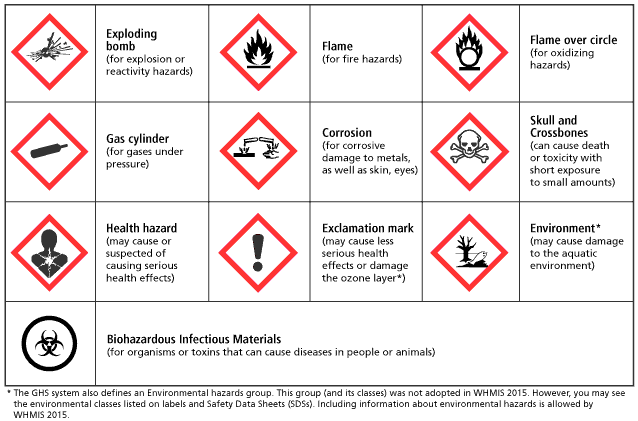
The SDS is used to determine which hazard codes apply to each chemical.
SUMMARY – Some things to remember when working with a chemical are:
- Never work alone. Employees engaged in hazardous activities should be within sight and hearing of another employee. These activities include chemical mixing which involves toxic or reactive chemicals, certain laboratory activities, and any processes where hazardous decomposition may occur. Do not pour hazardous material on the ground
- Contact lenses should not be worn while working with chemicals because vapors can become trapped or adhere to the lens of your eye.
- Employees should never eat or drink at workstations where chemicals or open containers are being used. After working with chemicals or before eating always wash your hands.
- If you detect any unusual odors in your work area contact your supervisor, superintendent or Safety Director. The presence of a chemical odor is not always a reliable detector. The odor of many chemicals can be sensed well below the safe level while the odor of other chemicals cannot be sensed until well above the safe level.
- Before disposing of any chemical check with your supervisor, superintendent, or Safety Director for proper procedures.
- Do not mix chemicals with which you are not familiar. Two common chemicals that are lethal when mixed are bleach and ammonia. You may not be able to predict how some chemicals may react when mixed.
- It is our Company’s responsibility to provide you with information and guidelines to follow when using chemicals; however, it is your responsibility as an employee to adhere to these guidelines. Your good health can never be replaced. Protect it in the workplace as well as at home.
COMMONLY USED TERMS IN SAFETY DATA SHEETS
- The following are some terms commonly found on Safety Data Sheets (SDS) provided by manufacturers:
- Vapor pressure: The pressure exerted by the vapor above a liquid surface usually expressed in millimeters of mercury. Molecules of a liquid are always in motion. The amount of motion depends upon the temperature of the liquid to the space above. The motion of the escaping molecules is confined to the space above if the liquid is in a closed container.
- Specific gravity: The relative weight of a given volume of liquid compared to the weight of an equal volume of water. Most flammable liquids are lighter than water and most non-flammable liquids are heavier than water. Keep oily, greasy, paint saturated rags, etc. in covered metal containers. Don't throw them in normal waste receptacles. Store flammable liquids in approved, properly marked containers, and put them in their proper area.
- Never pour flammable liquids or other chemical, including oil, into sewers or drains.
- For example, five gallons of isopropyl alcohol (a flammable liquid) weigh 32.85 pounds, five gallons of water weigh 41.55 pounds and five gallons of trichloroethane (a non-flammable liquid) weigh 59.85 pounds.
- Flashpoint: The lowest temperature at which a liquid gives off enough vapor to form a flammable mixture with oxygen present in the air at the surface of the liquid or within a container. For example, the flashpoint of gasoline vapor is -40 degrees Fahrenheit. This means that at a temperature of -40 degrees Fahrenheit or above gasoline emits enough vapor to catch fire from a source of flame or spark.
- Explosive range: The range of concentration of the flammable vapor in air in which a flash or fire can occur if the vapor is ignited. The upper and lower limits of the range are usually expressed in percent by volume. Any concentration below the lower limit is too lean to burn. Any concentration above the higher limit is too rich to burn. For example, the range for gasoline is 1.4% to 7.6%. The vapors will only burn between these limits.
- Evaporation rate: The ratio of time required to evaporate a measured volume of a liquid to the time required to evaporate the same volume of a reference liquid (usually ethyl ether) under ideal test conditions. The higher the ratio the slower the evaporation rate.
- Water solubility: The percentage of a substance that will dissolve in water. This is important in determining spill clean-up methods and extinguishing agents.
- Percent volatile: The percentage of a liquid that will evaporate at room temperature. Gasoline is 100% volatile which means over a period of time it will completely evaporate.
- pH: A means of expressing the degree of acidity or alkalinity of a solution. The pH range is from 0 to 14. Water is neutral and has a pH of 7. A pH above 7 indicates an alkaline base, the higher the number, the stronger the alkaline base. A pH below 7 indicates an acid, the lower the number, the stronger the acid.
- Threshold limit value (TLV): The time weighted average concentration for a normal 8-hour day and 40-hour week to which nearly all workers can be repeatedly exposed day after day without suffering any adverse effects. Because of wide variation in individual susceptibility a small percentage of employees may experience discomfort from some substances at concentrations at or below the threshold limit; a smaller percentage may be affected more seriously by aggravation of a pre-existing condition or by development of an occupational illness. These limits are not fine lines between safe and dangerous concentrations.
- Short-term exposure limits (STEL): A 15-minute time weighted average exposure which should not be exceeded at any time during a workday even if the eight-hour time weighted average is within the TLV. Exposures at the STEL should not be longer than 15 minutes and should not be repeated more than 4 times a day. There should be at least 60 minutes between successive exposures at the STEL.
- Ceiling limit: The concentration that should not be exceeded during any part of the working exposure.
EMERGENCY RESPONSE INVOLVING HAZARDOUS MATERIALS INCIDENT The following policies and procedures have been established to ensure the safety of employees and others in the event of a spill or leak of a hazardous material.
- A spill is an unexpected release of any hazardous material from a container.
- A leak is a release of any hazardous material from a container via a puncture or weak spot in the container.
- All spills or leaks involving hazardous materials must be reported to our Safety Director or Supervisors immediately. Our Safety Director will coordinate all activity necessary to ensure the incident is handled in a safe and proper manner from initial response through testing, reporting, clean up and documentation including the following as deemed necessary:
- Identification of the spilled or leaked material and review of the Safety Data Sheet (SDS) for pertinent information that will be needed to handle the situation.
- Protective actions if necessary, to preserve the health and safety of emergency responders and the public during an incident involving release of hazardous materials that have created a danger to health or the environment.
- Isolation of hazard area by denying access to the area by anyone not directly involved in emergency response operations, field work testing conducted due to the spill or leak or the clean-up of the hazardous material and contaminated area.
- Anyone with access to the contaminated area must be required to wear appropriate personal protective equipment as advised on the SDS for the hazardous material involved in the incident.
- Evacuation of people from a threatened area to a safer place if there is danger to an area surrounding the site of the spill or leak. An evacuation area has been designated at all of BLT Companies’ locations. Please make yourself aware of this evacuation area in the event of an emergency. Mock drills will take place on a random schedule to familiarize all employees of the exact procedure. A wide variety of emergencies both man-made and natural may require a workplace to be evacuated. These emergencies include – fires, explosions, floods, earthquakes, hurricanes, tornadoes, toxic material releases, radiological and biological accidents, civil disturbances, and workplace violence.
- Take appropriate measures to correct the condition and return the situation to a safe condition. Assure all clean up and decontamination procedures are performed consistent with procedures and information available including data on SDS and in compliance with ADEQ and EPA standards.
- Notification of proper authorities and agencies as required by the situation.
- Every hazardous materials incident is different. Each will have special problems and concerns, which is why it is important for employees to let our Safety Director determine what actions are needed and coordinate the process as deemed necessary.
REPORTING HAZARDOUS MATERIALS LEAKS OR SPILLS
If an employee is unable to contact our Safety Director and an immediate danger exists, the following addresses and phone numbers are to be used to notify the proper authorities in case of an emergency involving a spill or leak of hazardous materials:
Health Services Department Pollution Prevention Program
1740 West Adams Street 3033 North Central Avenue
Phoenix, AZ 85007 Phoenix, AZ 85012
Phone: 602-542-1000 Phone: 602-207-4235
Arizona Department of Environmental Quality -ADEQ Yuma Fire Department Station No. 3
Underground Storage Tanks Section 508 E 25th Street
3033 North Central Avenue Yuma, AZ 85365
Phoenix, AZ 85012 Phone: Emergency Dial 911
Phone: 602-207-4261
(Inspector: 602-262-1849)
PETROLEUM STORAGE TANKS
Aboveground – Tanks 500 gallon or greater are usually regulated: environmental agencies require registration and adequate containment structure unless your facility has a newer vaulted tank that is considered to have its own containment structure. Do not remove or relocate regulated tanks without Corporate Environmental Services approval. This activity requires agency notification and generation of a Tank Closure Report. Record keeping is required and usually consists of documenting monthly visual inspections. An overfill (high-level) protection alarm is required for all newer tanks. Make sure you know location of alarm.
General – Breakaway connections, shear valves, and automatic fuel nozzle should be installed on all fueling systems. In addition, above ground tank systems should have an anti-siphon valve. Vegetation, trash, and other flammable materials shall be kept clear from storage tanks and dispensing equipment for a distance of no less than 25 feet. Above ground tanks are required to have sufficient secondary containment and sufficiently protected with bollards or barriers no less than 4 feet apart. Secondary containment areas shall be kept free of flammable and combustible material, fluids and gasses. Fuel tanks and dispensing equipment shall be grounded to control static and electrical shock. Platforms, ladders, and walkways shall be provided to employees who manually gage or (stick measure) storage tanks. Appearance is critical: please promote and implement good housekeeping practices. Clean spills and leaks immediately. Know location of emergency shut-off/stop switches for the fuel island. Immediately report spills, leaks, discharges, or other releases to Corporate Environmental Services if amount of release is believed to be greater than 25 gallons of petroleum-based liquid.
BLOOD BORNE PATHOGENS EXPOSURE CONTROL PROGRAM
In compliance with Federal Register 1910.1030(c)(1)(I) we have designed our Blood Borne Pathogens Control Program to eliminate or minimize employee exposure to blood borne pathogens. All supervisors are to have a copy of Federal Register 1910.1030 in their procedure manuals for training and reference.
- Employees will receive instructions on how they can access a copy of our Blood Borne Pathogens Exposure Control Program which is part of our Safety & Employee Health Program at time of hire either by going to our website www.BLTCompanies.com or at our office.
- Employees will receive blood borne pathogens awareness training from our supervisors at an orientation toolbox meeting prior to beginning work at a job site.
- Employees will receive extensive blood borne pathogen training at annual safety training sessions scheduled each year. Employees will be notified of date, time, and place of training by payroll check attachment. Attendance is mandatory.
- Employees who work at job sites that have the following conditions have the potential for exposure to blood borne pathogens:
- Effluent drained on ground when plumbers hook up to sewer systems.
- Contaminants in restrooms when plumbers complete hook ups.
- Exposure to contaminants in portable toilets.
- All supervisors are to have a first aid kit in their vehicle. Direct access to the first aid kits is limited to supervisors. Only supervisors are authorized to render first aid and they are limited to treatment of minor cuts and abrasions only. Medically trained personnel are not provided by the Company.
- “Good Samaritan” acts such as assisting another worker with an injury is considered an occupational exposure.
- Through our Blood Borne Pathogens Exposure Control Program we provide awareness training of blood borne pathogen hazards to all employees. We do not provide protective equipment or supplies.
- Universal precautions should be observed to prevent contact with blood or potentially infectious materials. Where it is difficult to differentiate between body fluid types all such body fluids shall be considered potentially infectious materials. The following practices should be observed to minimize exposure.
- Wash or use antiseptic soap immediately after contamination.
- Perform all procedures involving blood or potentially infectious materials in such a manner as to minimize splashing, spraying or generation of droplets of these substances.
- If there has been an exposure incident, you are entitled to a confidential medical evaluation and follow up; however, you must report such an incident to your supervisor immediately, complete a Report of Significant Work Exposure to Bodily Fluids form and submit it to the office.
- Your Report of Significant Work Exposure to Bodily Fluids form must be filed with our office immediately but in no case later than ten calendar days after your exposure to bodily fluids.
- You must have blood drawn no later than ten calendar days after exposure.
- You must have blood tested for HIV by antibody testing no later than thirty calendar days after exposure and test results must be negative.
- You must be tested or diagnosed as HIV positive no later than eighteen months after exposure.
- You must file a worker’s compensation claim with the Industrial Commission of Arizona no later than one year from the date of diagnosis or positive blood test if you wish to receive benefits under the worker’s compensation system.
- Supervisors are to complete our Supervisor’s Report of Injury and Investigation form when a blood borne pathogens exposure incident is reported to them and submit the report to Brian Thomas, Owner/Manager.
INFECTION CONTROL PROGRAM
It is the policy of our company that we will ensure job placement does not compromise the health and safety of employees. We will maintain confidentiality of all records.
- The following are types of communicable diseases.
- HIV – Human Immunodeficiency Virus
- MRSA – Methicillin Resistant Staphylococcus Aureus
- TB – Tuberculosis
- Hepatitis B Virus.
2. There is a potential for exposure to communicable diseases through the following conditions.
- Punctures.
- Lacerations.
- Mucous membrane exposure (splash in eye or nose).
- Contamination of open wound.
3. MRSA is an infection caused by bacterium “staphylococcus aureus” or “staph” also known as a “super bug” which has become resistant to many of the commonly used antibiotics. There are two strains that exist and are based on the origin of exposure – HA-MRSA (hospital acquired) and CA-MRSA (community acquired). September 19, 2007 Arizona legislation passed a statute addressing worker compensation claims involving MRSA (A.R.S. 23-1043.04). The illness must be diagnosed within two to ten days. Person alleged to be a source of a significant exposure shall not be forced to release confidential information. Please note the following information regarding MRSA.
- Anyone can get MRSA. Persons most susceptible have significant exposure to bodily fluids or skin contact or in the regular course of employment have involvement handling or exposure to MRSA.
- Avoid contact with others that have uncovered wounds.
- Do not share personal items that come in contact with your skin, nose, mouth or other areas with exposed bodily fluids. These items include but are not limited to respirators, clothing, uniforms and towels that may have come in contact with the infected wounds.
- MRSA is transmitted primarily by person to person contact with secretions from skin lesions, nasal discharge or by hand.
- MRSA begins as a pimple that has popped, begins to drain and/or has pus. It appears like a spider bite, a boil or infected mosquito bite that progresses to a painful swollen red area with drainage.
- The following facilitate transmission of MRSA.
- Contact – avoid skin to skin contact with people.
- Contaminated surfaces – equipment, shared items.
- Compromised skin – cuts, abrasions.
- Crowding – assembly areas.
- Lack of cleanliness – absence of proper hygiene or housekeeping.
- MRSA prevention is based on awareness, cleanliness, and education.
- Disinfect areas most likely to be contaminated with one-part bleach and ten parts water.
- Wash hands regularly with soap and water or use 60% or more alcohol sanitizer.
- Keep cuts and wounds clean and covered by bandages until healed.
- Develop a written cleaning schedule listing items and surfaces to be disinfected using bleach or alcohol where applicable.
- Bandages should be discarded in a separate plastic bag. Remove bandages while wearing plastic gloves and discard with bandage.
- Immediately following exposure to communicable diseases, the following steps should be taken
- Lacerations and punctures should be cleansed with topical antiseptic solution and 60% or higher alcohol.
- Mucous membrane exposure (eye, mouth, nose or ear) should be flushed with water.
- Employee should report the exposure to supervisor immediately and complete worker compensation injury report notifying our office of exposure.
- If necessary, supervisor should contact emergency personnel for an evaluation and treatment instructions. Call 911 first if it is a potential life-threatening situation.
- Tetanus vaccine should be administered if not previously done within the last ten years.
- We will complete Employers First Report of Injury Form (101).
- Employee cooperation is required for infection control.
- Employee will be required to participate in medical follow up.
- If employee refuses to be tested for HIV, AIDS, virus, MRSA, etc. employee must sign a release form.
- Workers compensation carrier will be notified of the incident and all action taken to date.
- Physical exams and lab tests will be completed based upon the most current Center for Disease Control (CDC) protocol.
- Employee will sign a consent form for testing.
- Employee shall be evaluated clinically and serologically for evidence of infection as soon as possible after exposure.
- If employee does not want to continue follow up after initial testing demonstrates negative antibody response the employee must sign a release slip.
PERSONAL PROTECTIVE EQUIPMENT ASSESSMENT, SELECTION AND TRAINING
If hazards are present or likely to be present necessitating the use of personal protective equipment responsibilities of our supervisors will include the following prior to beginning work at the job site:
- Supervisors are to assess hazards requiring personal protective equipment at the job site.
- SURVEY: Conduct a walk-through of the areas in question. The purpose of the survey is to identify sources of hazards to workers and co-workers. Consideration should be given to the following basic hazard categories:
- Impact
- Penetration
- Compression (roll over)
- Chemical
- Heat
- Harmful dust
- Light (optical) radiation
- Other
- SOURCES: During the walk-through survey supervisors should observe:
- Sources of motion (i.e. machinery or processes where any movement of tools, machine elements or particles could exist or movement of personnel that could result in collision with stationery objects).
- Sources of high temperatures that could result in burns, eye injury or ignition of protective equipment, etc.
- Types of chemical exposures.
- Sources of harmful dust.
- Sources of light radiation (i.e. welding, brazing, cutting, furnaces, heat treating, high intensity lights, etc.).
- Sources of falling objects or potential for dropping objects.
- Sources of sharp objects which might pierce the feet or cut the hands.
- Sources of rolling or pinching objects which could crush the feet.
- Layout of workplace and location of co-workers.
- Electrical hazards.
- Sources of sound which could be a hazard.
- Location of emergency equipment.
- Hazard warning signs (or lack of).
- Injury/accident data should be reviewed with superintendents to help identify problem areas.
- After gathering information for the job site assessment by the walk-through survey supervisors need to organize and analyze data.
- ORGANIZE DATA: Organize the data and information for use in the assessment of hazards. The objective is to prepare an analysis of the hazards in the environment to enable proper selection of protective equipment.
- ANALYZE DATA: Having gathered and organized data on a work place an estimate of the potential for injuries should be made. Each of the basic hazard categories (shown under “Survey”) should be reviewed and a determination made as to the type, level of risk and seriousness of potential injury from each of the hazards found in the area. The possibility of exposure to several hazards simultaneously should be considered. Use our Assessment of Hazards Necessitating the Use of Personal Protective Equipment Checklist as a guide.
- REASSESSMENT OF HAZARDS: It is the responsibility of supervisors to reassess the workplace hazard situation as necessary by identifying and evaluating new equipment and processes, reviewing accident records with superintendents and revaluating the suitability of previously selected personal protective equipment.
- Supervisors are to select and have each affected employee use the types of personal protective equipment that will protect the affected employee from hazards identified in the hazard assessment.
- Become familiar with potential hazards, the type of protective equipment that is available, and what it can do (i.e. splash protection, impact protection, etc.).
- Compare the hazards associated with the environment (i.e. impact velocities, masses, projectile shape, radiation intensities) with the capabilities of the available protective equipment.
- Select the protective equipment which ensures a level of protection greater than the minimum required to protect employees from the hazards.
- Supervisors are to communicate selection decisions to each affected employee, fit the user with the protective device and give instructions on care and use of the personal protective equipment. It is very important that users be made aware of all warning labels for and limitations of their personal protective equipment.
- Supervisors are to select personal protective equipment that properly fits each affected employee.
- FITTING THE DEVICE: Careful consideration must be given to comfort and fit. Personal protective equipment that fits poorly will not afford the necessary protection. Continued wearing of the device is more likely if it fits the wearer comfortably. Protective devices are generally available in a variety of sizes. Care should be taken to ensure the right size is selected.
- DEVICES WITH ADJUSTABLE FEATURES: Adjustments should be made on an individual basis for comfortable fit that will maintain the protective device in the proper position. Particular care should be taken in fitting devices for eye protection against dust and chemical splash to ensure devices are sealed to the face. In addition, proper fitting of hard hats is important to ensure they will not fall off during work operations. In some cases, a chin strap may be necessary to keep a hard hat on an employee’s head. (Chin straps should break at a reasonably low force, however, to prevent a strangulation hazard.) Manufacturer’s instructions should be followed carefully.
- Supervisors are to use the following guidelines in selecting specific types of personal protective equipment and training employees on potential hazards and the proper use, maintenance and limitations of personal protective equipment.
- SELECTION GUIDELINES FOR EYE AND FACE PROTECTION:
- Each affected employee shall use appropriate eye or face protection when exposed to eye or face hazards from flying particles, molten metal, liquid chemicals, acids or caustic liquids, chemical gases or vapors, or potentially injurious light radiation.
- Each affected employee shall use eye protection that provides side protection when there is a hazard from flying objects. Detachable side protectors (i.e. clip-on or slide-on side shields) meeting the pertinent requirements of this section are acceptable.
- Each affected employee who wears prescription lenses while engaged in operations that involve eye hazards, shall wear eye protection that incorporates the prescription in its design, or shall wear eye protection that can be worn over the prescription lenses without disturbing proper position of the prescription lenses or the protective lenses.
- Eye and face personal protective equipment shall be distinctly marked to facilitate identification of the manufacturer.
- Each affected employee shall use equipment with filter lenses that have a shade number appropriate for the work being performed for protection from injurious light radiation.
- Supervisors are to refer to the Federal Register 29 CFR Part 1910 Subpart I and the State of Arizona OSHA Safety and Health Standards for the Construction Industry, CFR 29, Part 1926 Subpart E for tables and guidance in the proper selection of eye and face protection to protect against specific hazard sources.
- SELECTION GUIDELINES FOR HEAD PROTECTION: All head protection is designed to provide protection from impact and penetration hazards caused by falling objects. Head protection is also available which provides protection from electric shock and burn. When selecting head protection knowledge of potential electrical hazards is important. Supervisors are to refer to Federal Register 29 CFR Part 1910 Subpart I for guidelines on different classes of hard hat protection. Where falling object hazards are present hard hats must be worn. Examples of falling object hazards are as follows:
- Working below other workers who are using tools and materials which could fall.
- Working around or under conveyor belts which are carrying parts or materials.
- Working below machinery or processes which might cause material or objects to fall.
- SELECTION GUIDELINES FOR FOOT PROTECTION: Safety shoes and boots which meet the ANSI Z-41-1991 Standard provide both impact and compression protection. Where necessary safety shoes can be obtained which provide puncture protection. In some work situations metatarsal protection should be provided and in other special situations electrical conductive or insulating safety shoes would be appropriate.
- Safety shoes or boots with impact protection would be required for carrying or handling materials such as packages, objects, parts or heavy tools which could be dropped as well as for other activities where objects might fall onto the feet.
- Safety shoes or boots with compression protection would be required for work activities involving skid trucks (manual material handling carts), around bulk rolls and around heavy pipes all of which could potentially roll over an employee’s feet.
- Safety shoes or boots with puncture protection would be required where sharp objects such as nails, wire, tacks, screws, large staples, scrap metal, etc., could be stepped on by an employee causing a foot injury.
- SELECTION GUIDELINES FOR HAND PROTECTION: Gloves are often relied upon to prevent cuts, abrasions, burns and skin contact with chemicals that are capable of causing local or systemic effects following dermal exposure. OSHA is unaware of any gloves that provide protection against all potential hand hazards and commonly available glove materials provide only limited protection against many chemicals; therefore, it is important to select the most appropriate glove for a particular application and to determine how long it can be worn and whether it can be reused.
It is also important to know the performance characteristics of gloves relative to the specific hazard anticipated (i.e. chemical hazards, cut hazards, flame hazards, etc.). These performance characteristics should be assessed by using standard test procedures. Before purchasing gloves, our purchasing agent will request documentation from the manufacturer showing the gloves meet appropriate test standard(s) for the hazard(s) anticipated.
Other factors to be considered for the glove selection in general include:
- As long as the performance characteristics are acceptable in certain circumstances it may be more cost effective to regularly change cheaper gloves than to reuse more expensive types.
- The work activities of the employee should be studied to determine the degree of dexterity required, the duration, frequency and degree of exposure to the hazard and the physical stresses that will be applied.
- In selecting gloves for protection against chemical hazards the toxic properties of the chemical(s) must be determined; in particular, the ability of the chemical to cause local effects on the skin and/or to pass through the skin and cause systemic effects.
- Generally, any “chemical resistant” glove can be used for dry powders.
- For mixtures and formulated products (unless specific test data is available) a glove should be selected on the basis of the chemical component with the shortest breakthrough time since it is possible for solvents to carry active ingredients through polymeric materials.
- Employees must be able to remove gloves in such a manner as to prevent skin contamination.
- SELECTION GUIDELINES FOR HEARING PROTECTION: Wherever it is not feasible to reduce the noise levels or duration of exposures to those specified in Table D-2, Permissible Noise Exposures, State of Arizona OSHA Safety and Health Standards for the Construction Industry (29 CFR Part 1926.52) ear protective devices shall be provided and used.
- Ear protective devices inserted in the ear shall be fitted or determined individually by competent persons.
- Plain cotton is not an acceptable protective device.
f. SELECTION GUIDELINES FOR RESPIRATORY PROTECTION: See section in this Safety & Employee Health Program on our Respiratory Protection Program.
g. CLEANING AND MAINTENANCE: It is important that all personal protective equipment be kept clean and properly maintained. Cleaning is particularly important for eye and face protection where dirty or fogged lenses could impair vision.
- Personal protective equipment should be inspected, cleaned and maintained at regular intervals so that the personal protective equipment provides the requisite protection.
- Contaminated personal protective equipment which cannot be decontaminated should be disposed of in a manner that protects employees from exposure to hazards.
- TRAINING: The following guidelines specify training employees are to receive after a supervisor has completed an assessment of a job site, determined hazards necessitating the use of personal protective equipment and has selected the appropriate personal protective equipment. Supervisors are to use our Personal Protective Equipment Training Checklist as a guide.
- When personal protective equipment is necessary.
- What personal protective equipment is necessary.
- How to properly put on, adjust and wear personal protective equipment selected.
- Limitations of personal protective equipment selected.
- Proper care, maintenance, useful life and disposal of personal protective equipment selected.
The Company will furnish hard hats, safety glasses with side shields, cutting glasses, welding masks, safety harnesses, ear protection, back supports and other equipment as the job requires at no cost to you upon the beginning of your employment. All employees are required to wear full-length trousers and a shirt covering the upper torso and shoulder. Ripped or torn clothing is not acceptable. Shirts shall be tucked in at all times.
Eye and Face Protection
Eye and face protection are required at times to prevent injury from flying particles, dust, chips, sparks, or from splashes of liquids such as acids, solvents, and concrete and during all welding and cutting activities. For example, employees must wear appropriate personal protective equipment when working with grinders, power drills, solvents degreasers, or parts cleaners. If employees whose vision requires corrective lenses goggles must be worn, the goggles must fit over the glasses. The prescription glasses must be ANSI approved with side shields.
- When welding, special attention must be made to ensure the wearer is using the proper shade of welding lens.
- Take safeguards during welding and burning operations: inspect the general area and know where sparks from those operations are going; provide a standby extinguisher; protect combustibles in the work area – be especially careful around rubber-lined chutes.
- When welding, cutting, or soldering is performed near combustible materials, suitable precautions are to be taken to ensure smouldering metal or sparks do not result in a fire.
- When welding, cutting, or soldering, proper eye protection must be worn i.e. (welding hood, cutting goggles, etc.)
- At least one portable fire extinguisher shall be provided at each location where welding, cutting, or soldering with an arc or flame is performed.
- Welding, cutting or grinding inside a bin, hopper or tank may require following confined space procedures. If you are in doubt, contact a job safety personnel.
Head Protection
Head protection in the form of Company-provided hard hats will be worn at all times with the exception of inside of buildings. Any employee that is clocked in must have hard hats on with no exceptions, unless employee is in an office building or vehicles. It is your responsibility to wear all safety equipment as doing so, adheres with the policies of BLT Companies. BLT Companies will not be held responsible for injuries due to the lack of safety gear on your body.
OSHA 1296.100 States: Employees working in areas where there is a possible danger of head injury from impact, or from falling or flying objects, or from electrical shock and burns, shall be protected by protective helmets.
- All Employees shall comply with the Occupational Health and Safety Act.
- All Employees shall wear hard hats if there is an obvious overhead danger.
- All Employees shall wear a hard hat if they are unsure if the conditions require a hard hat.
- All Employees shall wear a hard hat whenever they are outside of their vehicle, on job sites and on company property.
- The exception is anyone working in the shop or simply moving from office to office.
THIS POLICY WILL BE STRICTLY ENFORCED.
EMPLOYEES SUBJECT TO JOBSITE REMOVAL OR TERMINATION IF THE GUIDELINES OF THIS POLICY ARE NOT FOLLOWED
Your signature on the Employee Training Verification Statement page acknowledges that you are aware and will abide by these rules. These hats may NOT be altered or worn backwards except by welders during welding operations. Hard hats may be equipped with reflective materials; where employees can easily be seen at night. The Company has the right to send you home if you do not have your proper safety equipment and dress code, including blue and white shirts.
Foot Protection
Safety shoes are required to prevent injury to the feet from falling objects and other foot hazards. Footwear must be approved by the Safety Department. Boots at least 8 inches high are recommended, steel toe are mandatory. Tennis shoes and sneaker type shoes are not permitted in operational areas.
Hearing Protection
Hearing Protection must be worn by all employees exposed to noise levels above an eight hour time-weighted average sound level of 85 decibels or above. This includes all operations. Audiometric testing is performed annually on all employees exposed to the above noise levels and communication letters apprizing you of your test results as well as recommended action to prevent future hearing loss are distributed. The Company provides earplugs with a N.R.R. rating of 30 or above or earmuffs with a N.R.R. rating of 29 or above.
Work Gloves
Work gloves are required when determined by your supervisor or on any job entailing handling rough material (such as concrete blocks), hot material, solvents or wet concrete. The Company furnishes gloves.
Life Vests
Employees working over or near water, where there is a danger of drowning, are required to wear life vests provided by the Company. Life vests will be securely fastened and worn by all employees who work on and over water, except when inside the confines of the dredge house.
Lifelines and Safety Harnesses
Employees entering silos, bins, hoppers, tanks or other similar hazardous areas will wear a Company-provided safety harness and attached safety line. The safety line will be tied off and attended by another employee. Safety harnesses and safety lines that are tied off will be worn by employees working in areas where there is potential to fall. Anchor points are capable of 5,000# per employee.
Reflective Clothing
All employees shall wear high visibility clothing or approved reflective vests in all plants, job sites, construction sites and shops.
Equipment Condition and Use
All safety equipment shall be maintained and used in accordance with the manufacturer's specifications, design, and in accordance with any corporate policy or program. Alterations by employees to any safety equipment will not be permitted. Report immediately to your supervisor/group leader any defect in your equipment.
Clothing
Suitable clothing must be worn. No loose clothing, neckties, etc. shall be worn around machinery. Canvas shoes, sandals, sneakers and tennis shoes are not permitted in any operational area. BLT blue & white button-down shirts must be worn at all times for all outside personnel. They should be buttoned, tucked-in and generally look professional. Jewelry, bracelets, chains, key rings, etc., will not be worn when in operational areas. This includes batch plants, asphalt plants, mining locations, mechanical shops, electrical shops, or any other designated by the Company.
Housekeeping
- Restroom facilities shall be provided at work areas. Restrooms shall be kept clean and sanitary.
- Good housekeeping is essential in all office, plant, pit, shop and yard areas at all times.
- Eliminate floor hazards such as oily, grease, debris, and tools, which can cause falls and fires.
- Keep all stairways and walkways free from spillage and obstructions.
- Store waste, oily rags, and other flammable material only in receptacles provided for that purpose.
- All receptacles or containers must have lids and the lids are to be kept closed.
SUBSTANCE ABUSE POLICY/DRUG & ALCOHOL TESTING POLICY
BLT Companies endeavors to maintain a safe, healthy work environment. Our written Substance Abuse Policy/Drug and Alcohol Testing Policy is an important part of our Safety & Employee Health Program. It prohibits the unlawful use of controlled substances prohibited under Arizona’s criminal statutes or alcohol within Company property, vehicles and job sites. It also prohibits the unlawful use of controlled substances such as prescription drugs including medical marijuana or alcohol away from work in a manner that impairs the employee’s abilities while at work. All employees need to read, understand and abide by this policy.
- Do not bring alcohol or drugs, including medical marijuana, to the workplace. The possession or sale of alcohol and/or drugs, including medical marijuana, within the Company’s offices, vehicles, job sites or supporting areas (yards, parking lots, etc.) will be grounds for immediate termination. Use of illegal drugs, medical marijuana and alcohol at work is strictly prohibited to maintain the highest standards of worker safety. Prescription drugs that do not impair an employee’s performance and over-the-counter drugs are not covered by this paragraph.
- The use of alcohol or drugs at any time such that it could adversely affect the safe performance of your job will be grounds for immediate termination. The Company will not tolerate any employees being impaired from drugs, legal or illegal, at work.
- If you are taking a prescription or over-the-counter drug, you are personally responsible for confirming with your physician that you may safely perform your normal duties while taking it.
- If you are taking a drug, including medical marijuana that could impair your performance you must advise your supervisor. If duties, which are not hazardous are available, your supervisor will reassign you; otherwise you will not be allowed to work. Employees should not report to work impaired.
- The Company expects every employee to report to work without alcohol or drugs in their system and to remain that way while at work. Employees are warned that some drugs, especially marijuana, remain in the system for extended periods. Usage of such drugs even away from the workplace may lead to violation of this policy in that they may impair an employee’s abilities and safe performance of job.
- Substance abuse of any kind while driving a Company vehicle will be grounds for immediate termination.
- Tests for drugs, including medical marijuana, or alcohol may be required at the discretion of your supervisor at any time. Generally, testing will also be required under the following conditions.
- Reports have been made to us of the possibility of you using or dealing illegal drugs.
- You receive an injury requiring medical attention. Employees who require medical attention after a workplace related injury are required to submit to an alcohol impairment test and a drug impairment test for the use of any controlled substance within twenty-four hours after we have been notified of the injury. Employees are reminded that all injuries must be reported to their supervisor immediately and our Employee’s Report of Injury form completed and submitted to the office as soon as possible.
- You are or have been working with or around another worker who receives an injury which requires medical attention.
- You are or have been working in the vicinity of a non-injury, property accident with an estimated loss greater than $500.
- You are scheduled to work at a job site where the owner or general contractor requires drug testing prior to allowing employees on the job site.
- Any employee who refuses to be tested is subject to termination. All testing must occur within two hours after the directive requiring it. A local facility, determined by Safety Director at time of testing, will be utilized for alcohol impairment and drug testing.
- Upon written request an employee has the right to obtain a copy of the written test results.
- An unreadable test result quantifies the same results as a positive test.
- Any employee who tests positive for drugs, including medical marijuana, or alcohol and feels the information shown on the test results is not accurate should notify us immediately and may request a retest of the original specimen.
- If the retest is positive or an uncontested original test is positive, the employee will be immediately terminated and will not be considered for reemployment until a negative test result is obtained and only then at the discretion of management.
- If management determines an employee may return to work after a negative test is obtained at a later date, the employee will be subject to frequent random testing.
- Upon written request employees have the right to explain in a confidential setting a positive test result. An exception will be made for individuals who test positive for off-duty marijuana use but have a valid prescription for medical marijuana consistent with Arizona statutes; however, it should be noted employees will not be allowed to work “impaired” or “under the influence” of marijuana. Use of illegal drugs, medical marijuana and alcohol at work is strictly prohibited to maintain the highest standards of worker safety. Any employee found to be under the influence of these substances or impaired at work will be terminated immediately.
- The Company’s management and its agents have the right to search its offices, vehicles, job sites and supporting areas (yards, parking lots, etc.) for alcohol and drugs including medical marijuana.
If you have questions concerning our Substance Abuse Policy/Drug and Alcohol Testing Policy please discuss them with your supervisor. It is the responsibility of every employee to understand and abide by this policy.
Any employee who has a problem with drugs or alcohol is encouraged to come forward. An employee voluntarily admitting they have an alcohol or substance abuse problem will not be terminated or disciplined but will be required to abide by frequent random alcohol and drug testing and receive negative test results in order to continue working. In order to provide a safe, healthy working environment for all employees, we must keep drugs, alcohol and impaired individuals out of our work environments.
AERIAL PLATFORM EQUIPMENT PROGRAM
The ANSI/SIA A92.6-1999 standard for self-propelled elevating work platforms became effective January 2, 2000. Only certified, trained employees may use or operate aerial platform equipment. The manufacturer’s operation and safety manuals are considered an important part of the aerial platform equipment and our Safety & Employee Health Program. They are to be kept on the aerial platform in a storage compartment and are to be utilized by users and operators of this equipment.
The purpose of our Safety & Employee Health Program guidelines is to provide policies, procedures and common-sense reminders for the use and maintenance of aerial platform equipment. It is our intent to promote a safe working environment for all employees.
BASIC JOB SITE SAFETY – Prior to starting work at any job site determine what if any personal protective equipment will be required by the job conditions. See the “Personal Protective Equipment Assessment, Selection and Training”, “Fall Protection Program” and “Respiratory Protection Program” sections of our Safety & Employee Health Program for more detailed information. General items to review include the following:
- Hard hats
- Safety shoes
- Safety glasses, goggles or face shield
- Work gloves
- Hearing protection
- Fall protection requirements
- Respirator or filter mask
Know emergency procedures for the job site location where you will be working.
- Find out where fire extinguishers and emergency equipment are located.
- Find out where emergency help can be obtained in a hurry.
- Find out where the closest emergency medical facilities are located.
SAFETY GUIDELINES PRIOR TO USE OF AERIAL PLATFORM EQUIPMENT A. Know how to operate the aerial platform you are using.
- Purpose of all controls, gauges and dials.
- Rated workload, speed range, braking and steering characteristics, turning radius and operating clearances.
- Read, understand and follow the “DANGER”, “WARNING”, “CAUTION” and other signs on the aerial platform equipment.
- Read and understand the manufacturer’s operator’s manual before using the aerial platform equipment. Notify our head mechanic or Safety Director if the manual is not located on the equipment.
- If there is something in the manufacturer’s manual, you don’t understand discuss it with your supervisor or superintendent before using the aerial platform equipment.
PROTECTIVE AND SAFETY DEVICES – All protective and safety devices are to be kept in place and in proper working order. Make certain all guards, railings, covers and safety signs are installed on the aerial platform equipment as required by the manufacturer and OSHA regulations. These may include the following:
- Gate, chain and/or bar closures
- Safety bars (mechanical locks)
- Stabilizers or outriggers
- Extending axles
- Turntable lock
- Emergency controls
- Interlock devices
- Continuously activated control
- Ground controls
- Control lever locks
- Audible and/or visual alarms
Know which devices are required on the aerial platform equipment you are using. Never remove or modify protective or safety devices.
SAFETY INSPECTION PRIOR TO USE OF AERIAL PLATFORM EQUIPMENT
Before using an aerial platform, it must be inspected.
- Check for missing, damaged, or unreadable safety signs.
- Check for broken, missing, damaged or loose parts.
- Check pivot pins for damaged or missing retaining devices.
- Check the tires for cuts, bulges and pressure as specified by the manufacturer.
- Perform all maintenance procedures outlined by the manufacturer of the aerial platform.
- Check for cracked welds and other evidence of structural damage.
- Check hydraulic system for leaks and damage.
- Check outriggers, stabilizers and extending axles if the aerial platform is so equipped.
- Check upper and lower control stations including auxiliary/emergency controls.
- Check platform guardrails and gates.
- Aerial platform equipment that does not pass inspection needs to be removed from service until the deficiencies are corrected.
AERIAL PLATFORM EQUIPMENT PREPARATIONS
- As part the maintenance of aerial platform equipment and as part of our Safety & Employee Health Program the equipment needs to be kept clean and safe.
- Before attempting to clean aerial platform equipment, be sure to lower the platform to the stowed position and turn off the engine.
- Clean steps, railings, ladders and the platform floor. Remove grease and/or oil. Brush away dust or mud.
- Replace slip-resistant tape or paint as required. Slippery surfaces can be hazardous.
- Keep work surfaces and elevating mechanisms clean and clear of debris.
- Do not leave tools, equipment or materials laying on platform floor. Loose items on the floor can cause an accident.
- Aerial platforms must be lowered to the stowed position and all power turned off before fueling.
- Charge batteries only in a well-ventilated area.
GROUND OR FLOOR LEVEL WORK AREA SAFETY
- Inspect the surface over which you will travel and work.
- Look for holes, debris, obstacles, drop-offs or rough spots.
- Look for weak spots or covers on ramps or floors.
- Look for oil spills, wet spots, slippery surfaces, soft soil or standing water.
- Watch for anything that might make you lose control or cause the aerial platform to tip over.
- Clean away debris and trash.
- Pick up anything that might puncture a tire.
- Make sure aisles, ramps, doorways and passages are clear.
- Make sure you know how you will approach the overhead work area and where you will place the aerial platform for proper lift clearance and be able to maintain the proper distance from electrical lines and apparatus.
AERIAL PLATFORM EQUIPMENT STARTING AND TESTING SAFETY
- Walk completely around the aerial platform making sure no one is under it, on it or close to it before starting the equipment. Let other workers and bystanders know you are starting the equipment and wait until everyone is clear.
- Use precautions while getting on or off an aerial platform.
- Use handrails, ladders or steps (as provided) when mounting the platform.
- Never use control levers as a hand hold when climbing on or off equipment.
- Never step on foot controls when climbing on or off.
- Never attempt to get on or off moving equipment.
- Never walk or climb the elevating assembly to gain access or to leave an elevated platform.
- Enter and exit the platform from the ground only.
- Make certain that all handrails, toe boards, gates and entry chains are in place and secured before raising the platform.
- Follow the starting procedures recommended by the manufacturer of the aerial platform. Check all instruments, gauges and indicator lights.
- After starting the equipment recheck all gauges and lights. Check the audible and/or visual alarms (if provided).
- Make sure everything is functioning correctly. Check all control functions including emergency stop mechanism from the upper control station and the lower control station (if provided). If any deficiencies are found report them to our head mechanic and remove the aerial platform from service until it has been repaired.
AERIAL PLATFORM OPERATION
- Make sure the aerial platform is ready for the job you want it to do. Know the rated workload of the equipment and do not exceed it.
- Before raising the platform disperse the load evenly making sure that nothing is interfering with any of the controls.
- Do not carry materials on railings unless approved for that purpose.
- Do not at any time add a load that exceeds the rated capacity of the equipment.
- Do not carry overhanging loads unless approved by the manufacturer.
- Check the work area for hazards that might cause the aerial platform to tip over. An aerial platform must be on a firm, flat, smooth and level surface any time the platform is raised (unless otherwise specified by the manufacturer).
- Maintain specified distances from electric power lines and apparatus (refer to manufacturer’s manual).
AERIAL PLATFORM OPERATING PRACTICES
- Operate controls smoothly.
- Never jam an operating control from one travel direction to the other. Return to neutral, stop, then proceed in the other direction.
- Avoid sudden stops, starts, turns or changes in direction.
- Never attempt to work the controls except from the operator’s control station.
- Never leave the work platform without first lowering it to the ground.
- If the aerial platform needs to be left unattended lower the platform, shut off the engine, engage the parking brake and take necessary steps to prevent unauthorized use in accordance with the manufacturer’s instruction manual.
- Never override any hydraulic, mechanical or electrical safety device.
- When driving the equipment or positioning the platform keep all parts of your body inside the platform railings.
- Stay alert as to the condition of the aerial platform. If something on it breaks, loosens or malfunctions stop using the equipment immediately and notify our head mechanic.
- Stop work, shut off the engine and report the problem immediately.
- Do not operate the equipment again until the condition has been corrected by authorized personnel.
- If it is not possible to lower the platform in a normal manner request rescue.
- Never allow unqualified, untrained or unauthorized persons to operate aerial platform equipment. H. Keep everyone clear of a working aerial platform.
- Never allow ground personnel near the aerial platform.
- Never permit anyone to stand or pass under a raised platform.
- Make certain everyone is clear of the equipment before you begin lowering the platform.
- Never drive an aerial platform up to someone standing in front of a fixed object.
- Never move or position any part of an aerial platform over anyone.
AERIAL PLATFORM TRAVEL SAFETY
- Before traveling on equipment be sure you are wearing your personal fall-protection devise (if required by OSHA) and it is properly attached to the appropriate lanyard attachment point.
- Whenever possible travel only in the full-down, stowed position for maximum stability.
- Limit travel speed to ground conditions and operate controls slowly and smoothly. When traveling at a high speed, avoid sharp turns and sudden stops. Allow sufficient distance for a safe stop.
- Before moving your aerial platform know and understand the manufacturer’s restrictions regarding travel of the equipment including as applicable:
- Position of stabilizers and/or outriggers.
- Position of extendible axles.
- Platform position (including extensions).
- Traversing or elevating on grades or slopes.
- Always keep your attention in the direction of travel and be sure to check clearance above, below and on all sides. Use a lookout when your view is obstructed.
- Do not use “high” speed in confined areas.
- When traveling with the platform in a raised position (only as approved by the manufacturer), use extreme caution and very slow speed. Pay particular attention to overhead hazards and your travel path.
- Do not tow an aerial platform without referring to your manufacturer’s manual for specific towing instructions.
- On a boom-type aerial platform do not “drive” the equipment to maneuver in close to an obstacle. Place the equipment and then use the swing and boom functions to get in close.
- Never drive the base or platform into a stationary object.
- Never use the boom to push the aerial platform along the ground or attempt to free the equipment by lifting the wheels off the ground with the boom.
- Never use the equipment to push or pull another object and never push or pull the equipment by another vehicle except as approved by the manufacturer.
RAISE AND LOWER AERIAL PLATFORMS SAFELY
- Make sure the aerial platform equipment is on firm level ground before raising the platform.
- If equipped, make sure extendible axles, outriggers or stabilizers are fully deployed.
- Outriggers or stabilizers may require blocking to provide a stable load bearing surface.
- Always check clearance on both sides of the equipment before extending outriggers, stabilizers or axles.
- If platform or any part of the aerial platform equipment becomes entangled with an adjacent structure do not attempt to free the equipment by operating platform controls. Call for assistance from appropriate qualified personnel to free the equipment.
- Never attach wire, cable or similar items to the platform. Should they tangle or catch on a fixed object the aerial platform could tip over.
- Never alter, remove or substitute any item which would reduce the overall weight or base stability of the aerial platform equipment such as counterweights, foam filled tires, batteries, etc.
- When lowering the platform to the ground from the lower control station (if provided), the operator must remain clear of the descending platform and other movable parts of the aerial platform.
- When the platform has been raised into the working position be extremely cautious to prevent any object from striking or interfering with the operating controls.
GENERAL AERIAL PLATFORM SAFETY GUIDELINES
- Secure all tools or other materials placed on the platform to keep them from shifting or falling. Keep ropes, electrical cords and hoses coiled and stowed away when not in use.
- Keep the platform floor clear of debris and loose objects which might cause you to slip.
- Never use ladders, planks, steps or other devices to provide additional reach or gain greater height.
- Do not lean over or sit or climb on the platform railing. Always keep both feet on the platform floor.
- Never belt off to an adjacent structure when working from an aerial platform. OSHA has determined that when working from an elevated scissors lift (ANSI A92.6 series) a worker need only be protected from falling by a properly designed and maintained guardrail system.
- Never allow anyone to tamper, service or operate an aerial platform from the lower control station while personnel are in the platform except in an emergency.
AERIAL PLATFORM TRANSPORT SAFETY
- When transporting the aerial platform on a truck or trailer know the overall height to avoid contacting overhead obstructions such as bridges, power lines, etc.
- Refer to the manufacturer’s manual when preparing an aerial platform for transport. Make sure all tie downs and blocks are in place and the platform is completely lowered and secured in the stowed position.
- If the aerial platform equipment is to be hauled refer to the manufacturer’s manual for loading procedures. Check truck and ramp capacities and grade of incline.
- Never raise, swing or rotate the boom or platform while the aerial platform equipment is loaded on a truck for transporting.
- Do not tow aerial platform equipment without referring to the manufacturer’s manual for specific towing instructions.
AERIAL PLATFORM PARKING SAFETY
- Park your equipment in a designated area or in an out-of-traffic area and only on level ground.
AERIAL PLATFORM SHUTDOWN SAFETY
- Travel to a suitable parking area.
- Place platform in stowed position.
- Come to a full stop
- Place controls in neutral
- Idle engine for gradual cooling.
- Shut off engine or electrical power.
- Take necessary steps to prevent unauthorized use.
- Refer to the manufacturer’s instruction manual for specific requirements of each type of aerial platform equipment regarding the shutdown procedure.
AERIAL PLATFORM DISMOUNTING SAFETY
- Observe proper shutdown practices before dismounting.
- Never dismount from moving equipment. Dismount carefully keeping your feet and hands away from the controls.
- Never jump off an aerial platform.
AERIAL PLATFORM TIRE AND WHEEL SAFETY
- Check tires.
- Correct pressure.
- Cuts or bulges.
- Nails or spikes.
- Uneven or excessive wear.
- Missing valve caps.
- Check wheels.
- Damaged rims.
- Missing or loose wheel nuts, bolts or bearing caps.
- Proper torque specifications (refer to manufacturer’s manual).
- Obvious misalignment.
- Have cuts or punctures repaired by authorized personnel before adding air. If pneumatic refer to manufacturer’s manuals for inflation procedures.
- Tires are to be repaired only by an authorized person using the proper procedures and safety equipment.
- Do not operate any type of aerial platform equipment unless you have been properly trained, the equipment has been inspected, is in good operating condition and has all safety devices in place.
SCAFFOLDING PROGRAM
If it is determined scaffolding is to be used at a job site it must comply with Subpart L Scaffolding of the State of Arizona OSHA Safety and Health Standards CFR 29, Part 1926. The key requirements of Subpart L are that the scaffolding must be of sound design, it must be the proper one for the job and there must be a competent person to oversee all aspects of scaffolding work–erection, inspection, movement, alteration and disassembly.
- Properly erected and maintained, scaffolding provides employees with safe access and a stable, level platform on which to work and store materials and tools temporarily.
- Prior to starting work at a job site our supervisors are to consult with our Safety Director regarding scaffolding requirements. Our Safety Director will determine what type of scaffolding will be needed and whether we will use our own scaffolding or make arrangements with a scaffolding vendor to provide and erect all or part of the scaffolding at the job site.
- Our Safety Director will be responsible for making sure only trained workers are allowed to erect scaffolding.
- Our supervisors are responsible for training employees at weekly tool box meetings in the proper safety and use of scaffolding prior to assigning its use.
- Our supervisors are responsible for continual inspection of scaffolding to see that safety features are not removed or by-passed by employees and are to prohibit anyone not authorized from using our scaffolding.
- If there is any doubt whether scaffolding is erected correctly and in compliance with Subpart L supervisors are to call OSHA for a courtesy inspection of the scaffolding prior to allowing anyone to use it.
- Periodically special comprehensive scaffolding and fall protection training sessions will be presented by a representative from our insurance carrier or a scaffolding vendor. When these training sessions are scheduled attendance is mandatory by all employees involved in the use of scaffolding.
- Supervisors are to refer to Subpart L for complete scaffolding standards. The following information is not complete and is supplied only as a training aid.
PRIOR TO ERECTION OF ALL SCAFFOLDING ASSEMBLIES: The job site should be inspected by our supervisors to determine ground conditions or strength of supporting structure and for proximity of electric power lines, overhead obstructions, wind conditions, the need for overhead protection or weather protection coverings. These conditions must be evaluated and discussed with our Safety Director so they will be adequately provided for in scaffolding decisions.
Stationary scaffolds over 125 feet in height and rolling scaffolds over 60 feet in height must be designed by a professional engineer. Wood planks should be inspected to see that they are graded for scaffold use, are sound and in good condition, straight grained, free from saw cuts, splits and holes.
ERECTION OF FIXED SCAFFOLD
• Scaffold must be erected, moved or disassembled only under the supervision of qualified persons. Hard hats must be worn by all persons erecting, moving, dismantling or using scaffolding.
• Base plates or screw jacks with base plates must be in firm contact with both the sills and the legs of the scaffolding. Compensate for uneven ground by using screw jacks with base plates. Do not use unstable objects such as blocks, loose bricks, etc.
• Federal OSHA requires that scaffolding must always be secured when the height of the scaffold exceeds four times the minimum base width.
• The bottom tie must be placed no higher than four times the minimum base width and every 26 feet vertically thereafter. Ties should be placed as close to the top of the scaffold as possible.
• Ties should be installed as the erection progresses and should not be removed until scaffold is dismantled to that height.
• Side brackets, cantilevered platforms, pulleys or hoist arms and wind conditions introduce overturning and uplift forces that must be considered and compensated for in the scaffold design. These assemblies may require additional bracing, tying or guying.
• Circular scaffolds erected completely around or within a structure may be restrained from tipping by the use of “stand-off” bracing members.
ERECTION OF ROLLING SCAFFOLDS:
• Height of the tower must not exceed four times the minimum base dimension. Outrigger frames or outrigger units on both sides of the tower may be used to increase base width dimension when necessary.
• All casters must be secured to frame legs or screw jacks with a nut and bolt or other secure means. Total weight of tower should not exceed the capacity of the casters.
• All frames must be fully cross-braced.
• Casters must be locked at all times when the scaffolding is not being moved.
• Toe-boards are required whenever people are required to work or pass under or around the platform.
• Access must be provided to all work platforms. If it is not available from the structure access ladders, frames with built-in ladders or stairways must be provided.
• Side and end brackets are designed to support people only. Materials should never be placed on cantilevered platforms unless the assembly has been designed to support material loads by a qualified person.
• All frames should be fastened together and counterweights or adequate ties used to compensate for overturning and uplift forces caused by these types of platforms.
GENERAL SCAFFOLD GUIDELINES
- Each scaffold must be inspected and approved by trained supervisory personnel prior to initial use and following alteration or movement of the scaffold. Our Safety Director is responsible for the selection of scaffolding. Our supervisors are responsible for inspection and approval of scaffolding and training employees at weekly toolbox meetings in the proper safety and use of scaffolding prior to assigning its use.
- There is no such thing as temporary scaffold. All scaffold must be erected and maintained to conform with established standards.
- Guardrails, mid-rails and toe-boards must be installed on all open sides of scaffolds that are more than ten feet in height, or on any scaffold less than 45 inches wide.
- Guardrails, mid-rails and toe-boards should be constructed from components furnished by the manufacturer. Where this is not possible use 2 x 4-inch lumber for the guardrails and 1 x 4-inch lumber for the mid-rails and toe-boards.
- Scaffold planks must be at least 2 x 10-inch full thickness lumber, scaffold grade or equivalent.
- Scaffold planks must be cleated and must extend over the end supports at least six inches but not more than twelve inches.
- All scaffolds must be fully planked. Employees are not to work from a single plank.
- Scaffold planks must be visually inspected before each use. Damaged scaffold planks must be destroyed immediately.
- Access ladders must be provided for each scaffold. Climbing off the end frames is prohibited unless their design incorporates an approved ladder.
- Adequate mud sills or other rigid footing capable of withstanding the maximum intended load must be provided. Tubular metal scaffolding requires metal base plates which must be secured to 2 x 10-inch wooden blocks or mud sills when used on surfaces other than concrete.
- Scaffolds must be tied off to the building or structure at intervals which do not exceed 30 feet horizontally and 26 feet vertically.
- Do not overload scaffolds. Materials should be brought up as needed. Remove excess materials and scrap from scaffold when work is completed.
- Scaffolds should be designed to support four times the anticipated weight of workers and materials when they will be in use.
FALL PROTECTION PROGRAM
Prior to beginning work at any job site, a careful evaluation will be made of the job site and our work procedures to identify fall hazards and determine what elements of this standard are applicable. Our Safety Director, superintendents and supervisors will be responsible for determining when we will be able to utilize conventional fall protection systems and when it may be necessary to use alternative systems.
If it is determined that it will be infeasible or will create a greater safety hazard to use a conventional fall protection system during some leading-edge work and/or during residential construction activities our Company may develop and implement a written fall protection plan specifically for that job site. In determining whether conventional fall protection systems are acceptable or if an alternative fall protection method will be needed it must first be determined what the hazards are, if the hazards can be avoided or removed from the site or if there is another way to do the job without having employees exposed to the fall hazard. To determine this, the following should be considered:
- Location of all fall hazards: walking/working surfaces, leading edges, holes, excavations, dangerous equipment, low-slope roofs, residential construction, unprotected sides and edges, hoist areas, form work, ramps, runways, other walkways, steep roofs, wall openings and other walking/working surfaces not otherwise addressed. For each fall hazard located, determine the following:
- Can the hazard be removed?
- Can a conventional fall protection system be used safely? If it can be demonstrated that using conventional fall protection systems during some leading-edge work and/or during residential construction activities would create a greater safety hazard a written fall protection plan can be developed for an alternative fall protection system.
- Can scaffolds, ladders or lifts be used?
- Can employees be protected through an alternative fall protection system? If it is determined that an alternative fall protection system is the best protection from fall hazards for employees at a job site, the following guidelines must be followed:
- An alternative fall protection system will require a written fall protection program complying with Subpart M that OSHA will accept.
- The fall protection program must be written by someone qualified through extensive knowledge, training and experience who will be able to identify fall hazards to which employees will be exposed.
- The fall protection program must be site specific and must be maintained up to date.
- Changes to the fall protection program must be approved by a qualified person.
- The fall protection program must be kept on site during the performance of all activities which it covers.
- The usage of the fall protection program must be under the supervision of a competent person.
- The fall protection program must include specifics as to why a conventional fall protection system will not be used on the job site. The alternatives must be detailed. Reasons why scaffolds and ladders (which are covered under Subpart L and Subpart X) cannot be used must also be shown.
- If an employee ever falls, there is a serious accident or a near-miss an investigation of the cause must be done immediately to determine if any changes must be made in the fall protection program to prevent future incidents.
- Employees will need to be trained under the fall protection program written for the job site.
- Alternative work practices under the fall protection program written for alternative fall protection will need to be enforced.
- May include controlled access zones and safety monitoring systems. Prior to determining if either of these are to be incorporated into a fall protection program these systems will be thoroughly researched by the qualified person who is writing the fall protection program to be used in place of a conventional fall protection system.
When an alternative fall protection system is to be used and a written fall protection program is developed for a specific job site it will supersede the fall protection program in our safety & employee health program. At all other job sites our fall protection program using conventional fall protection systems in compliance with subpart m will be enforced as follows:
Excluding the exceptions noted earlier fall protection must be provided for all employees working six feet or higher above a lower level. Conventional fall protection systems are made up of equipment which must meet certain OSHA requirements for design and/or strength as follows:
GUARDRAIL SYSTEMS: Whenever there is a wall opening such as a doorway or window, floor hole, stairway opening or any other unprotected side or edge, workers must be protected from a fall of six feet or more. See Subpart M for complete guardrail system requirements. A typical guardrail system includes:
- Top rail or edge approximately 42 inches above the walking/working surface. On window openings where there is a bottom sill less than 39 inches high there will still need to be a top rail installed at 42 inches. When employees are using stilts the top edge height of the top rail or equivalent member shall be increased an amount equal to the height of the stilts.
- Mid-rails must be placed midway between the top rail and the walking/working surface usually at about 21 inches.
- Screens, mesh or the equivalent may be used in place of a mid-rail. These must be installed between the top rail and the walking/working surface and must cover the entire opening.
- Balusters, additional mid-rails and architectural panels may also be necessary. When they are used there must not be openings of more than 19 inches.
- Guardrail systems must meet certain load requirements. All guardrail systems used must comply with the Subpart M standard, including:
- All surfaces must be kept smooth to prevent splinters, punctures, lacerations and snagging of clothing.
- Rails must be kept from extending past their posts so that employees and equipment do not hit them.
- Steel or plastic banding is too sharp for top rails or mid-rails and cannot be used.
- Guardrail systems should go all the way around any holes they are protecting.
- Ramps and runways should also have a guardrail system around all unprotected edges.
- Where holes are used as a point of access a gate or removable guardrail should be placed to protect against fall hazards.
- Plastic or synthetic rope systems can be used but must be checked for tightness and must continue to meet the strength test.
Personal fall arrest systems: Employees may also be protected against fall hazards by the use of personal fall arrest systems. A personal fall arrest system is made up of a combination of several components: anchorage points, connectors, body harnesses, lifelines, lanyards and deceleration devices. Body belts and non-locking snap hooks are no longer allowed to be used as part of a personal fall arrest system. Instead body harnesses and locking snap hooks must now be used.
Personal fall arrest systems shall when stopping a fall: limit maximum arresting forces to 1,800 pounds when a harness is used; limit free fall distance to 6 feet; limit maximum deceleration distance to 3.5 feet. Anchorages used for attachment of personal fall arrest equipment shall be independent and be capable of supporting 5,000 pounds per employee attached or maintain a safety factor of at least 2.
A competent person should make an inspection of all personal fall arrest system equipment prior to its use. If a personal fall arrest system and its components are subjected to the force of a fall each component must be removed from service and inspected by a competent person for damage before being used again. Harnesses, rip-stitch type lanyards and some other components are only design loaded to handle one fall. Any component designed for only one fall must be replaced after having sustained the force of a fall. Manufacturer’s instructions must be followed when using a personal fall arrest system.
Employees are encouraged to be involved in the decision of which type of personal fall arrest equipment they are going to use. This should be discussed with our Safety Director or a superintendent. Listed below are the various components of a personal fall arrest system.
- Lifelines: Flexible lines are used in personal fall arrest systems by attaching one end to an anchorage point and letting it hang vertically or stretching it horizontally between two anchorage points. The lifeline is a point of connection for other components of a personal fall arrest system.
- Lifelines are to be installed under the supervision of a qualified person.
- Horizontal lifelines’ and anchorages’ strength must be increased for each additional employee tied off to a single line.
- If a vertical type of lifeline is used only one person can be attached to each lifeline. Vertical lifelines must have a minimum breaking strength of 5,000 pounds.
- Lifelines should be made of a durable synthetic fiber or wire rope and should be protected from being cut or scraped during use.
- Lanyards: Ropes or straps made of a strong synthetic fiber or wire rope which connect to a body harness at one end and a lifeline, deceleration device or an anchorage point at the other. Shock absorbing lanyards are the kind that will absorb some of the load of a fall so that the body does not take a full shock. A lanyard needs to be attached to the anchorage point in a way that does not reduce its required strength. There are two ways to limit free fall using a lanyard:
- Use a shorter lanyard between the lifeline and your harness.
- Reduce the amount of slack in your lanyard by raising your tie-off point to the lifeline. Your tie-off to the lifeline or anchor always must be level with or higher than the connection to your belt or harness.
- Deceleration devices: Equipment designed to absorb much of the energy of a fall by slowing the rate of the fall. Common deceleration devices are rope grabs, ripstitch lanyards, shock absorbers and some automatic self-retracting lines. If the device limits the free fall distance to 2 feet, it must be able to withstand 3,000 pounds of force. Rope grabs are commonly used on a lifeline. A lanyard is attached to the device on one end and to the harness on the other. Self-retracting devices can be attached directly to the harness.
- Body harnesses: An apparatus worn to protect the employee by spreading the shock of the fall throughout the body rather than focusing it on the mid-section as a body belt does. A full body harness is made of straps secured around the thighs, pelvis, waist, chest and shoulders. The attachment point for a body harness must be located in the center of the wearer’s back, either at shoulder level or above their head. Before using harnesses inspect them carefully for any damage due to wear and tear. Make sure the clips are fastened securely and are firmly attached.
- Anchor points: Components of a personal fall arrest system to which lifelines, lanyards or deceleration devices are attached. The anchor point is attached to the walking/working surface and must be secured according to the manufacturer’s instructions. The anchor points should be installed under the supervision of a qualified person. Anchor points should only be used as fall protection for employees and not for equipment or materials.
- Make sure the anchorage is strong enough to withstand the fall arrest force.
- Inspect the anchorage for damage before hooking up.
- Use an anchor that has no obstacles under it onto which you could fall.
- An anchorage must be able to support a weight of at least 5,000 pounds for each worker attached.
- An anchorage must be independent from supporting or suspending a worker.
- Check the manufacturer’s labels regarding equipment stretch and deceleration distance.
- The farther your attachment to the lifeline is from the line’s anchor, the more the line can stretch.
- Using tie-offs: Tying off is connecting your harness directly or indirectly to a secure anchor.
- Tie off before you get into a position from which you could fall.
- Follow the manufacturer’s instructions on the best tie-off methods for your equipment.
- Tie-offs that use knots are weaker than other methods of attachment. They can reduce the lifeline or lanyard strength by 50 percent or more. A stronger lifeline or lanyard should be used to compensate for the weakening effect.
- Tying off around H-beams or I-beams can weaken the line because of the cutting action of the beam’s edge. You can prevent this by using webbing lanyard or a wire-core lifeline.
- Tie-offs where the line passes over or around rough or sharp surfaces reduces its strength drastically.
- The location of the tie-off should avoid the hazard of obstructions in the potential fall path of the worker.
POSITIONING DEVICE SYSTEMS: Designed to allow an employee to work on an elevated vertical surface with both hands free to do the work. If a positioning device system is to be used refer to the section in Subpart M that details the requirements for this system. These systems are not normally used in residential construction.
SAFETY NET SYSTEMS: Safety net systems are used to catch employees who have fallen. OSHA requires the installation of safety nets as close as possible under the walking/working surface where employees need to be protected but in no case more than 30 feet below. If a safety net system is to be used refer to the section in Subpart M that details the requirements of the system. Safety net systems are not usually practical on a residential construction site.
COVERS: Covers for holes in floors, roofs and other walking/working surfaces must meet the following requirements:
- Covers must be capable of supporting without failure at least twice the weight of employees, equipment and materials that may be imposed on the cover at any one time.
- All covers must be secured when installed to prevent accidental displacement by the wind, equipment or employees.
- All covers must be color-coded or marked with the word “hole” or “cover” to provide warning of the hazard.
- Covers located in roadways and vehicular aisles must be capable of supporting without failure at least twice the maximum axle load of the largest vehicle expected to cross over the cover.
PROTECTION FROM FALLING OBJECTS: The fall protection regulation is designed not only to protect employees from falls but also from having objects fall on them. Good housekeeping can make a job site safer from falling objects. Materials and debris should be properly cleaned up and tools put in proper storage areas to reduce the hazard of falling objects.
- When an employee is exposed to falling objects, a hard hat is to be worn.
- Our supervisors will assess job sites to determine if the following measures are needed to protect employees from falling objects:
- Toe-boards, screens or a guardrail system to prevent objects falling from higher levels.
- Keep potential fall objects far enough from the edge of the higher level so that they would not go over the edge if accidentally displaced.
- Barricade the area to which objects could fall and prohibit employees from entering barricaded areas.
- TRAINING: Prior to beginning work at a job site where it has been determined there will be fall hazards employees are to be trained to recognize fall hazards and the procedures to be used to minimize these hazards including:
- Nature of fall hazards at the job site.
- Correct procedures for erecting, maintaining, disassembling and inspecting the fall protection systems to be used.
- Use and operation of guardrail systems, personal fall arrest systems, safety net systems, warning line systems, safety monitoring systems, controlled access zones or any other protection which will be utilized.
- Correct procedures for the handling and storage of equipment and materials.
- Retraining will be required when there are changes made in the work place or changes are made in the types of fall protection systems or equipment to be used which makes previous training obsolete. Retraining will also be required when there is reason to believe an employee who has already been trained does not have the understanding and skill required to abide by fall protection procedures established.
- CERTIFICATION: Documentation will be maintained showing names of employees who receive fall protection training, date of training and who conducted the training.
- Fall protection will be worn by anyone working seven and half (7.5) feet above the ground or higher where proper catwalks and handrails are not provided or where there is significant risk of falling from a properly constructed catwalk.
LADDER PROGRAM Use the right ladder not a box, chair, paint bucket or any makeshift item. Place ladders securely. Only fiberglass or non-conductive portable ladders shall be used. Portable ladders shall be inspected for defects before use. Damaged or defective ladders shall be tagged with a "Do Not Use" tag and immediately removed from service. The supervisor shall be advised of the action taken and shall be responsible for having the ladder restored to a safe condition or replaced. Portable straight ladders shall be used at sufficient pitch. This can be readily determined by using the four to one rule. The bottom of the ladder shall be one foot away from the wall for every four feet of ladder length. The top and bottom supports on which a straight ladder rests shall be rigid and capable of supporting the loads to be imposed. The ladder shall extend 3 feet past the top support. Bottom and intermediate fastenings maybe needed to stabilize the ladder.
Ladders shall be secured at the top. Bottom and intermediate fastenings are needed to hold the ladder in place. All portable ladders shall be of sufficient length and shall be placed so a person will not be required to reach out too far from ladder or otherwise place himself in a hazardous position while on the portable ladders shall not be used in passageways, doorways, drives, or other location where they may be struck by traffic or where they endanger the personnel at floor or ground level unless the area around the ladder is protected by barricades and warning signs. All ladders shall be used in a safe manner and be free from cracks, broken rungs, or other defects. When ascending or descending, always face the ladder and maintain 3 points of contact at all ladders should be equipped with approved safety feet. Modified ladders shall not be used and broken ladders shall be reported to the foremen and taken out of service. All ladders must adhere to OSHA requirements. Never jump off equipment or from one machine to another. Access to machinery should be as follows: Face the step system. Use the three (3) points of contact at all times. Climb off the machine the same way.
OSHA has separate regulations for portable wooden, portable metal and fixed ladders. Regulations are specific about ladder design, inspection and use. The purpose of our ladder Safety & Employee Health Program is to provide information regarding ladders that will combine knowledge and common sense to help make a safe work environment for all employees. When you need to climb – use a ladder. Do not use a chair, box, paint bucket or other substitute. Three things that lead to accidents with ladders are selecting the wrong ladder for the job, not inspecting the ladder before using it and carelessness. Portable ladders which are used to climb on of off equipment must be tied off and extend a minimum of 36" above the landing. Any platform over six (6) feet high must have handrails and toe board around the area. When working above six (6) feet, an employee must be tied off with the approved body harness.
Ladder Selection: Select the right ladder for the job.
- Ladders are rated by how much weight they can safely hold. The weight limits include you and any equipment you are carrying.
- “I-A” holds 300 pounds (heavy duty).
- “I” holds 250 pounds (heavy duty).
- “II” holds 225 pounds (medium duty).
- “III” holds just 200 pounds (light duty).
- There are also limits on ladder length
- A stepladder should be no more than 20 feet high.
- A one-section ladder should be no more than 30 feet.
- An extension ladder can go to 60 feet but the sections must overlap.
Identifying Ladder Hazards: Always inspect a ladder before you use it. If a ladder has anything missing or broken don’t use it. Tag it as defective and remove it from service. Listed below are things to inspect on a ladder before using it.
- Steps and rungs are in place, intact, free from grease or oil, have slip resistant surfaces and are firmly attached.
- Support braces, bolts and screws are all in place and tight.
- Metal parts are lubricated.
- Rope is not worn or frayed.
- Spreaders or other locking devices are in place.
- Splinters or sharp edges are removed.
- Safety feet are in place.
- Metal ladders are not dented or bent.
Ladder Setup: Setting up the ladder correctly will help prevent accidents.
- Place ladder on level surface. Use wide boards under it if you are on soft ground.
- Set the feet so they are parallel with the surface the ladder rests against.
- Extend the ladder so there is at least three feet above the top support.
- Anchor the top and either tie the bottom or have someone hold it.
- Do not rest the ladder on a window or window sash or place it in front of a door unless it is locked or blocked.
- Position the ladder so the distance from the ladder base to the wall is one-fourth the length of the ladder.
- Position an extension ladder before you extend it.
Ladder Safety Procedures: Following ladder safety procedures will help prevent accidents.
- Have only one person on a ladder at a time.
- Wear shoes with clean, nonskid soles–not leather.
- Face the ladder while climbing up or down and hold the side rails with both hands.
- Carry tools up or down on a belt or with a rope or hoist not in your hands.
- Work with one hand on the ladder keeping your tools in a hanger or holder. Lock a leg around a rung if you need to work with both hands.
- Don’t step on the top two stepladder steps or top four ladder rungs.
- Keep your body centered on the ladder.
- Don’t move a ladder while you are on it.
- Keep your movements on a ladder slow and cautious.
Overreaching and leaning too far are common causes of falls from ladders. If you cannot reach the work comfortably raise the extension, use a longer ladder or move the ladder closer to the work to be done.
FLEET SAFETY PROGRAM
MANAGEMENT STATEMENT ON VEHICLE/EQUIPMENT SAFETY – Prevention of losses is a major management responsibility that leads to increased productivity and profitability throughout the entire Company. An effective loss control program is an essential tool in this effort. As Owner/Manager, I strongly support this program. Your supervisors have the additional role as Safety Managers and each of them have the responsibility of carrying out our Fleet Safety & Employee Health Program and complete authority to do so. The activities spelled out in this program are the guidelines for controlling injury or damage to personnel, cargo, property and the public. Employees are not to operate a Company vehicle until after they have been approved as a driver. Approval is based on a review of the employee’s motor vehicle record for a period of 39 months. Every employee must follow our policies to make this program effective. The results of your efforts will be revealed in the Company’s overall performance.
- Obey traffic control signs and safety rules.
- Drivers are not to stop to /from jobsites without Supervisor’s prior authorization, except in the event of an emergency.
- Seatbelts must be worn.
- If a driver receives a citation, the Company must be informed as soon as possible. It is the driver’s responsibility to pay for any fines related to the driver’s actions including not wearing seat belt, using cell phone, speeding or any other cause.
- Do not operate vehicles unless trained and authorized to do so.
- All engines are to be shut off before fueling.
- Wheel chocks are to be used on all mobile equipment when maintenance is being performed. This includes maintenance service vehicles, whenever they are parked. Use wheel chocks appropriately sized to the type of equipment you are using them on
- Cylinders must be capped and secured in an upright position.
- Quick lock connections shall be used.
- Use proper lifting procedures and get help with heavy loads. When applicable use the assistance of a forklift or crane to lift the desired object.
- Do not hitch rides on any machinery as a passenger, except where provisions have been made, by design, to accommodate the passenger.
- Prior to repairs being made to equipment, DO NOT START the equipment.
- A tag MUST be placed on the steering wheel or at the starting controls and keys must be removed and the machine positively locked out as per Company lockout policy.
- Block all raised equipment such as dozer blades, loader buckets, scraper aprons, etc. prior to making repairs on or around them. If stands are used to support equipment they must be placed on firm level ground and the stands must be certified for the weight they are supporting. Use only approved pins and attachments for the stands. DO NOT use bolts in place of pins. Use safety spreader bars or adequate blocking when working on belly dump gates while they are open.
- Raised truck beds must be secured using a safety strut bar and block at the hinge point while work is being performed. Make use of steps and handhold when stepping on or off of equipment.
- Mixer Washout – All customers will have designated washout locations. Drivers who do not washout in the designated washout locations will be expensed for the amount billed to BLT from the customer.
DRIVER APPROVAL PROCESS: Employees who do not meet the criteria shown below will not be allowed to drive any Company vehicle or their own vehicle on the Company’s behalf. They will not be given use of a Company gas credit card, be reimbursed for gas expenses, receive a gas allowance and will not be allowed to receive gas from Company gas pumps.
- Only approved drivers are authorized to drive a Company vehicle or drive their own vehicle on behalf of the Company.
- Prior to obtaining approved driver status an employee needs to complete and sign our form “Authorization Form/Department of Motor Vehicle Records” authorizing us to request a motor vehicle record (MVR) for our review process.
- Our general criteria for an approved driver is an employee’s MVR:
- Must show LESS than four moving citations within the last 39 months.
- Must NOT show a DUI citation within the last 39 months.
- Must NOT show a reckless driving citation within the last 39 months.
- We reserve the right to make a decision on an individual basis at our discretion.
- MVR’s are run prior to approval as a Company driver and annually on all approved drivers.
- All approved drivers need to maintain a current valid driver’s license.
- All approved drivers need to review our entire Fleet Safety & Employee Health Program.
- An employee driving their own vehicle on our behalf must also provide proof of insurance on the vehicle they are driving.
- All new drivers must complete the New Orientation and be signed off by the Safety Director and Truck Boss.
SAFETY DIRECTOR AND SUPERINTENDENT RESPONSIBILITIES: By action of the Owner/Manager our Safety Director and the superintendents have been given the responsibility for implementing and enforcing our Fleet Safety & Employee Health Program. These responsibilities include:
- Supervising the selection of employees allowed to drive on behalf of the Company by following our approved driver policies.
- Not allowing an employee to drive a Company vehicle until they have been accepted as an approved driver.
- Reviewing and/or investigating all accidents and/or incidents involving a Company vehicle and completing our Superintendent’s Follow Up Report of Vehicle Accident form.
- Submitting their completed Superintendent’s Follow Up Report of Vehicle Accident and/or Incident form to the General Safety Committee for review and discussion.
- Participating in General Safety Committee meetings.
- Conducting safety meetings with supervisors and communicating information as applicable from the General Safety Committee meetings.
- Monitoring and reviewing weekly Toolbox Meeting forms completed by supervisors.
- Following through on the status of recommendations submitted by insurance carrier loss control agents and outside regulatory agencies including OSHA.
- Implementing regulatory requirements for hiring drivers including but not necessarily limited to:
- Employment application.
- Personal interview.
- Motor vehicle report.
SHOP MAINTENANCE SUPERINTENDENT RESPONSIBILITIES: The shop maintenance
superintendent responsibilities shall include:
- Establishing and monitoring preventative maintenance and vehicle inspection programs including procedures for follow-up corrective actions on deficiencies noted in vehicle inspection reports.
- Making sure all vehicles are in safe condition prior to returning them to service including working seat belts and back up horns as applicable.
COMPANY DRIVER RESPONSIBILITIES: Employees driving for the Company have responsibilities which include:
- Maintaining a valid driver’s license.
- Attending all weekly toolbox meetings.
- Properly maintaining and caring for assigned Company vehicle. All cleanliness is sole responsibility of driver and or operator for the equipment for which they are assigned. No chemical may be used to clean the equipment without prior approval from management. Regularly servicing assigned vehicle and recording maintenance and repairs on our Vehicle Maintenance Log. This log is to be kept in the glove compartment of the vehicle. Routine servicing shall include:
- Oil, oil filter and air filter changed every 3,000 miles.
- Fluid levels checked regularly.
- Tire air pressure checked regularly.
- Caring for assigned vehicle includes keeping interior free of unnecessary debris, clutter and trash.
- Reporting all accidents involving yourself or the Company vehicle you are assigned. Police need to be called for all accidents. Accidents must be reported immediately to your supervisor. As soon as possible follow up in writing by completing our Employee Report of Vehicle Accident Involving Company Vehicle form and submitting it to the office.
- Reporting any problems, breakdowns or defects in vehicles or equipment promptly to the shop maintenance superintendent.
- Obeying the Company yard and job site speed limit (5 MPH).
- Adhering to the Company policy forbidding all types of firearms within Company properties, vehicles and equipment including job sites.
- Working and driving in a safe manner at all times.
- Using seat belts at all times. Wearing seat belts is not just Company policy – it is the law.
- Making sure the Company vehicle you are assigned has the following:
- Current license plates/tags.
- Proper registration for vehicle (and trailer, if applicable).
- Current insurance card in glove compartment of vehicle.
- Blank Employee Report of Vehicle Accident Involving Company Vehicle form in glove compartment of vehicle.
- Vehicle Maintenance Log form in glove compartment of vehicle
VEHICLE SAFETY EQUIPMENT: Safety equipment is both a Company requirement and a Department of Transportation regulation. Employees assigned a Company vehicle should verify it is properly equipped prior to driving it. If you are missing any safety equipment or have defective safety equipment notify the shop maintenance superintendent immediately. If you are missing a current insurance card, report forms or current registration/tags, notify the office.
- Reflectors or flares must be in Company vehicles at all times.
- Back up horns when required by law must be installed on Company vehicles and equipment which will be used on job sites.
- Seat belts must be operable in all Company vehicles.
- All supervisors are to have fire extinguishers in their Company vehicles.
- All supervisors are to have first aid kits in their Company vehicles.
- If you are towing equipment double safety chains must be used.
LIMITATIONS OF COMPANY VEHICLE USE: The Company vehicle assigned to you is provided to be personally driven by you as an employee of the Company in the furtherance of the Company’s business. Your authority to use the vehicle and to permit its use by others is subject to the following guidelines:
- Employees are not allowed to use Company vehicles for personal purposes. If an employee has been authorized use of a Company vehicle for commuting to and from work personal use is limited strictly to commuting to and from work.
- The Company vehicle assigned to the employee may not be used or operated by anyone other than assigned employee. It may not be driven for personal use.
- The Company vehicle assigned to employee may be loaned to another employee temporarily with the prior approval of supervisor or superintendent only. The supervisor or superintendent approving use of the Company vehicle by another employee must verify the temporary driver has been approved as a driver.
- It may be necessary for employees to carry business associates or other employees in the Company vehicle assigned to employee from time to time. It is the responsibility as the driver of the Company vehicle to ensure seat belts are worn by all passengers as well as by employee.
- Employee is prohibited from picking up hitchhikers or giving rides to strangers.
- If employee has been given permission to use the Company vehicle assigned for commuting to and from work it is the employee’s responsibility to park the vehicle in a safe area at place of residence. No reimbursement will be made for home storage of the Company vehicle.
- It is the employee’s responsibility to keep the vehicle safe by locking the doors and removing the keys from the vehicle when not in use. An anti-theft device such as The Club is to be used when the vehicle is locked and parked.
VEHICLE INSURANCE AND ACCIDENTS: The Company vehicle you have been assigned is insured under a fleet policy. This insurance policy protects the Company, you and any other legally qualified person who has been approved as a driver for the Company and who operates the vehicle with permission of the Company.
As a driver of a Company vehicle, it is your responsibility to report all accidents immediately to the police, your supervisor and as soon as possible complete our Employee Report of Vehicle Accident Involving Company Vehicle form and submit it to the office. Listed below are events which are considered reportable accidents:
- The Company vehicle you are driving is involved in a collision with another person’s property whether it is a car, house, lawn or other type of property.
- The Company vehicle you are driving injures another person whether the person is a pedestrian or riding in another vehicle.
- Another person is riding in the Company vehicle you are driving and something happens which might give the person occasion to file suit for damages against you, the Company or the legal owner of the vehicle.
- You are injured while driving a Company vehicle.
- The Company vehicle you are assigned is damaged whether another person, car or property is involved and whether or not the vehicle is damaged while being used or is parked.
At the time of an accident involving a Company vehicle you have been assigned you should take the following actions:
- If anyone is injured see they receive proper medical attention. Do not move an injured person unless it is absolutely necessary as further injury may result. First aid training is not provided to employees that would qualify them to treat serious injuries. Supervisors may treat minor cuts and abrasions only. Other employees need to leave all treatment for authorized persons to handle. Make the injured person comfortable until trained personnel arrive.
- All accidents are to be reported to the police.
- Write the names, addresses and telephone numbers of all witnesses on witness cards.
- Obtain name of the other driver’s insurance carrier.
- Note license plate numbers of all vehicles involved. Also, note the license plate numbers of any vehicles which may have been carrying witnesses even if these people do not identify themselves. They can be traced if necessary.
- Only discuss the accident with someone from our Company, a representative for our Company and the police.
- Report the accident immediately to your supervisor.
- Complete our Employee Report of Vehicle Accident Involving Company Vehicle. Make a sketch on the back of the form showing street names, position of vehicles and the direction of travel at the time of the accident. Submit the completed form to the office as soon as possible.
- If the Company vehicle you have been assigned is stolen report the theft immediately to the police and to your supervisor. Complete our Report of Theft form. Make a note as to whether the vehicle was locked or unlocked and where it was parked. Report any tools, equipment and materials which were stolen with the vehicle.
In the event of an accident, injuries receive priority. See that proper medical attention is obtained.
- Do not argue or accuse anyone.
- Do not voluntarily assume liability or agree to settle any claim made against you.
- While it is proper procedure for you (and the other driver) to identify yourself, and produce your driver’s license and vehicle registration you do not have to divulge any details of your insurance coverage other than the carrier’s name and the policy number.
- All claims resulting from accidents involving a Company vehicle will be handled entirely by our insurance carrier’s claims department. An employee should never assume any portion of the cost for repairs resulting from an accident. All settlements should be made through our insurance carrier.
REVOCATION OF COMPANY VEHICLE PRIVILEGES: No employee is allowed to drive a Company vehicle either on roadways or job sites until a Motor Vehicle Report (MVR) has been run. An employee’s driving record will be reviewed for the prior 39-month period before they can be approved as a driver for our Company.
When an employee is approved as a driver they should make sure they understand their responsibilities as a driver of a Company vehicle. Our Company reserves the right to revoke the use of a Company vehicle at any time at its discretion. Disciplinary action up to and including termination will result if it is established an employee has:
- Knowingly been involved in the manufacture, transportation, possession, sale or use of narcotic drugs while operating a Company vehicle.
- Operated a Company vehicle while under the influence of alcohol.
- Operated a Company vehicle while under the influence of drugs which impair their ability to function as a driver whether the drugs are prescribed by a doctor.
- Left the scene of an accident.
- Lost their driver’s license because of suspension, revocation, withdrawal or denial of an operator’s license.
- Caused a serious accident due to gross negligence or incompetence.
DRIVING A COMPANY VEHICLE IS A PRIVILEGE – NOT A RIGHT: All Company vehicles are to be operated in a safe, legal, courteous and prudent manner. Safe driving will result in fewer accidents.
- No employee has the authority to direct another employee to knowingly break the law.
- Discourteous and/or reckless operation of vehicles will not be tolerated. The operation of a Company vehicle is a reflection of the Company.
GENERAL VEHICLE RULES
- CLEANLINESS OF EQUIPMENT & TRUCKS – It is each employee’s responsibility to keep a clean piece of equipment at all times, whether it be the appearance of inside or outside. It is solely the responsibility of each operator to maintain a reasonably clean piece of equipment. The employee understands that he or she may be sent home at any time with no pay if they cannot reasonably maintain the cleanliness expected.
- You will be given 3 warnings/write-ups if you truck or equipment is deemed unclean. Upon the 4th warning, you will be terminated.
- It is the responsibility of the driver or operator to clean your truck/equipment between load times, dead times, etc. It is not to be used for wasted time by sleeping, hiding, eating, conjugating, talking or just plain procrastinating.
- DAMAGES -The employee understands that damages occurred to their assigned piece of equipment or any other property or private property or private equipment are subject to be paid by employee.
- NO ALTERATIONS – No tampering with any equipment inside of vehicle, such as radio, GPS units and no hanging of any objects from mirrors or any other location within the cab. No obstructions to windows by tinting or hanging flags. No modification to outside of the equipment.
EQUIPMENT OPERATION – Operate equipment only after you have received thorough instruction from a competent person and you have been authorized to do so. Equipment is not to be operated until a complete inspection has been performed. NOTE: Refer to DOT Inspection of Equipment and Vehicle Inspection Log for guidance. Before a piece of equipment is used for the first time on a shift, it will be given a thorough pre-shift inspection. Exercise extreme caution when operating in an area with overhead wires. Before moving equipment, the operator is to check to make sure the area is clear and sound the horn three times before backing. Persons will not work or pass under the buckets, booms, or any other suspended objects. Employee must fill out a pre-inspection prior to every shift and turn in one copy to the shop and keep one copy for their records in the vehicle.
Obey all posted traffic signs. Wear safety belts when operating all Company equipment. Seatbelts must be worn when the vehicle is in motion. All ground-engaging tools must be lowered to the ground when parked.
Loader buckets shall always be carried low to the ground when traveling. Loader operators shall not keep loaded buckets elevated while waiting for trucks. Each operator must inspect loader before each shift and report defects to foreman. Make special note of the fire extinguishers and broken cab windows. Defects affecting safety must be repaired before operation. No passengers are allowed in the cab. When a new operator is being instructed, radio communication shall be used. If it is necessary to raise the bucket for repairs to the machine, be sure the bucket and wheels are properly blocked before starting work. The operator shall check around his loader and sound horn before moving the loader. When an operator leaves his loader, he should set parking brakes, lower bucket to ground level, shift into neutral position, and turn off engine.
POWERED HAULAGE/MOBILE EQUIPMENT – All mobile and heavy equipment must be operated carefully and safely at all times.
- A pre-shift safety inspection must be performed on all mobile equipment before it is operated. Operators of mobile equipment must report problem conditions on the pre-shift inspection form. All major defects must be immediately reported to supervisory personnel and repaired.
- Operators must engage the parking brake when leaving mobile equipment unattended. When parked on a grade, the wheels shall be chocked. Mobile equipment shall not be left unattended unless the brakes are set. Mobile equipment with wheels or tracks, when parked on a grade, shall be chocked.
- No one is permitted to ride outside the cab of front-end loaders, dozers, trucks or any other type of mobile equipment.
- The truck bed is to be in the "down" position before entering a tunnel and/or going under a loading bin, loading silo, conveyor, high voltage lines or other object that could be a collision hazard. A minimum distance of 10' must be kept between a raised truck bed, crane, etc., and overhead power lines.
- Cabs of mobile equipment shall be kept free of extraneous materials, including pop cans, bottles, starting fluid containers, etc.
- Employees performing maintenance or repairs on mobile equipment shall remove the ignition key and tag the steering mechanism to prevent accidental starting or moving of the equipment. Wheels shall be chocked to prevent movement.
- No guard, safety appliance warning device (back-up alarm), or other device shall be removed from equipment, or made ineffective or inoperable, except for the purpose of making repairs, lubrications or adjustments.
- Any device removed is to be replaced immediately upon completion of the repair or maintenance work.
- Buckets on front-end loaders, cranes, shovels, draglines, blades on dozers, and pan scraper bowls shall be lowered to the ground when the equipment is idle. Operators shall sound horn before starting trains, when trains approach crossing, meeting trains on adjacent tracks, any place where vision is obscured, or any other time a warning is appropriate.
TRAFFIC CONTROL – The primary function of traffic control procedures is to move traffic safely through or around work areas. Construction and maintenance areas can present to the motorist unexpected or unusual situations as far as traffic operations are concerned. Because of this, special care should be taken in these areas. Even emergency maintenance work should be planned and conducted with the safety of the motorist, pedestrian, and the employee kept in mind at all times. Traffic should be routed as nearly as possible to those for normal highway situations. Traffic movement should be inhibited as little as possible. Motorists should be guided in a clear and positive manner while approaching and traversing work areas.
All employees working adjacent to the traveling public must wear clothing with hi-vis night visibility. Flagging should only be employed when required to control traffic or when all other methods of traffic control are inadequate to warn and direct motorists. Conditions may exist where work must be conducted in nighttime hours, necessitating increased use of warning lights and illumination for work areas with advanced warning systems. Whenever a motor vehicle is stopped on the roadway or shoulder of a roadway the driver shall immediately activate the vehicles warning signal flashers and continue the flashing until the driver places the proper warning devices in accordance with Part 393.95 of the Federal Motor Carrier Safety Regulations. All traffic control devices shall be removed immediately once they are no longer needed. When roadside assistance is necessary and you impede traffic, additional personnel must be retained to direct traffic. When pulling off the side of the roadway, turn your wheels all the way to the right in the unfortunate event a vehicle rear-ends the maintenance truck. This will keep the truck from being driven into the disabled vehicle.
FORKLIFT PROGRAM
In December of 1998, OSHA issued new regulations covering the type of training required for all forklift operators under CRF29 1910.178 and 1926.602. Only certified trained employees may use or operate forklifts.
FORKLIFT TRUCKS – Only authorized and trained employees who have successfully completed Forklift Operator Safety Training shall be authorized to operate a powered industrial truck or forklift.
- Seatbelts must be worn while operating.
- If the lift starts to tip over, never jump or grab the overhead guard, you will be injured or killed. Instead, push yourself back in the seat with both hands on the steering wheel, lean away from the point of impact.
- Trucks are not to be driven up to anyone standing in front of a bench or other fixed object.
- No person is allowed to stand or pass under the elevated portion of a forklift whether the forklift is loaded or empty.
- Arms and legs should not be placed between the uprights of the mast or outside the running lines of the forklift.
- A safe platform firmly secured to the forks must be used when lifting personnel with a lift truck.
- Railroad tracks must be crossed diagonally whenever possible.
- All loads being handled must be within the rated capacity of the lift truck.
- Brakes shall be set on trucks, trailers, and railroad cars when loading or unloading with a forklift.
- Trailers should be secured with chocks, or dock restraints during forklift loading and unloading.
- When leaving a forklift truck unattended, the forks are to be fully lowered, controls neutralized, power shut off and brakes set.
- Travel with the load as low to the ground as possible without blocking vision.
- Travel in reverse if the load blocks your view.
- Sound the horn when changing direction, in congested areas or when your view is limited.
- Use extreme care when backing up with a forklift or front-end loader.
- Use only pallets in good condition.
- Always operate mobile equipment at a safe speed.
The purpose of our Safety & Employee Health Program guidelines is to provide policies, procedures and common-sense reminders for the use and maintenance of forklifts. It is our intent to promote a safe working environment for all employees.
BASIC FORKLIFT INFORMATION
- Forklifts are specialized, multi-user vehicles which can do many tasks that require heavy lifting, moving or stacking.
- Forklifts allow us to load and unload materials of various sizes, shapes and weights that would otherwise be difficult to handle.
- Forklifts can be dangerous if they are not operated by people who are carefully trained in the safety rules that such equipment demands.
- A forklift even unloaded is heavier than many cars and not as well-balanced.
SAFETY GUIDELINES PRIOR TO USE OF A FORKLIFT
- To drive a forklift safely you need to understand the possible hazards and know what to do to avoid them. Forklift hazards to be aware of include the following:
- Tipping over.
- Colliding with a vehicle, equipment or person.
- Dropping a load.
- Know how to operate the forklift you are using. Use the manufacturer’s manuals for specifics regarding each forklift.
- Purpose of all controls and instrumentation.
- Engine or motor operation.
- Steering and maneuvering.
- Visibility.
- Fork and/or attachment adaptation, operation and limitations of their use.
- Forklift capacity and stability.
- Forklift inspection and maintenance.
- Forklift operators need to avoid situations that could cause the forklift or the load to drop. When identifying the potential hazards of a specific job consider the following:
- The forklift’s capacity.
- The characteristics of the load.
- The route to be covered including floor surfaces and conditions.
- Any limitations in the areas where the load is to be picked up and dropped.
- Other activities going on in the work area including pedestrian traffic.
- The condition of the forklift itself.
- Load balancing.
PROTECTIVE AND SAFETY DEVICES
- Trained operators must understand and use the manual provided by the forklift manufacturer as well as the safety rules required by OSHA and the Company.
- Some of the protective and safety devices a forklift may have are as follows:
- A label or nameplate that tells how many pounds the forklift can carry safely.
- An overhead guard that protects the operator from falling objects and from being crushed if the vehicle tilts over.
- A load backrest extension on certain forklifts to help keep the load from falling backward.
- Mast tilt controls so you can move the load forward and backward while you’re getting it into position. Mast tilt controls are not to be used while you are moving.
- A parking brake.
- Lights and horn to warn others you are coming.
- If seatbelts are provided, they must be worn.
WORK AREA AND GENERAL FORKLIFT SAFETY
- Prior to using a forklift inspect the area where you will be operating it for potential hazards.
- Make sure there is adequate lighting or extra lighting on the forklift.
- Make sure there is sufficient headroom under overhead installations, lights, pipes, sprinklers systems, etc.
- Be aware of other traffic in the area.
- Stunt driving and horseplay are never permitted.
- Never drive a forklift up to a person who’s standing in front of any fixed object.
- Never permit a person to stand or pass under a forklift’s elevated portion even if it’s empty.
- Never allow an unauthorized person to ride on a forklift.
- Keep your arms, hands and legs inside the body of the forklift.
- If you’re working in an area that has traffic including other forklifts, vehicles or pedestrians always be alert as to their location.
FORKLIFT TRAVEL SAFETY
- Slow down, stop and sound the horn at places where you can’t see what might be approaching from another direction.
- Keep a clear view of your path of travel. If your load blocks your forward view travel with the load trailing.
- Slow down on wet or slippery surfaces.
- Slow down before making a turn. Avoid sharp turns that could tip the forklift.
- Avoid driving over loose objects.
- Drive slowly and carefully over dock-boards or bridge-plates. Don’t exceed their rated capacity.
- If you’re going up or down a grade of more than 10% drive with the load upgrade and raise it only enough to clear the surface.
- Keep a safe distance from the edge of elevated ramps or platforms.
- Slow down and take extra precautions when driving over uneven terrain or loose dirt.
LOADING AND UNLOADING FORKLIFT SAFETY
- Before loading make sure the load is within the forklift’s rated capacity, is stable and can be centered. If a load is loose or uneven stack and/or tie the pieces.
- To pick up the load set the forks high and wide enough to go under it. Then drive into the loading position, put the load squarely on the forks and drive under the load until it touches the carriage slightly. Next, tilt the mast back and lift the load. Before you start to travel tilt it back a little more.
- As you carry the load, keep it tilted back and low with the forks six to eight inches above the ground.
- Don’t raise or lower the load while you are moving.
- Don’t carry anything on the overhead guard.
- When you unload turn the forklift slowly into position and go straight at the location where items are to be unloaded.
- When you unload onto a stake bed or flatbed be sure the forklift’s rear wheels are chocked with brakes locked on. Check to make sure the dock plate is secure then position the load, tilt it forward and release it.
- To unload onto a rack or stack check how high you can safely stack materials. Raise and position the load to the correct height, move it slowly into position, tilt the load forward and lower it onto the rack or stack. Finally, pull the forks back slowly then back out slowly looking over your shoulder.
FORKLIFT PARKING SAFETY
- Parking areas should be designated on flat surfaces in a space that doesn’t block traffic flow.
- OSHA has specific procedures to follow when you leave a forklift unattended or are for any reason 25 or more feet away from it.
- Fully lower the load-engaging means.
- Neutralize the controls.
- Shut off the power.
- Set the brakes.
- Remove the key.
- If you are parking on an incline block the wheels.
FORKLIFT REFUELING OR RECHARGING SAFETY
- Refueling or recharging must be performed with the forklift engine turned off and in assigned, ventilated areas away from anything that could cause a fire or explosion.
- Smoking is prohibited.
- Fire extinguishers as well as spill and clean-up equipment should be nearby.
FORKLIFT MAINTENANCE
- Forklifts need to be inspected regularly and must be carefully maintained.
- Check the forklift daily before use to make sure everything is working properly and is in good shape. Follow procedures from the manufacturer’s manual.
- Be sure there are no leaks and that forks aren’t bent or damaged.
- Never use a forklift that has a defect or that sparks or smokes, needs a repair or is any way unsafe. Leave repairs to authorized personnel.
FORKLIFT OPERATOR TRAINING
- Training can only be done by knowledgeable and experienced trainers.
- Training must consist of a combination of formal instruction and practical demonstrations and exercises.
- Training must encompass a wide range of subjects and skills specified in OSHA regulations.
- Refresher training must be given as required by OSHA.
- Operators must be evaluated at least once every three years.
- Training is to be certified in writing. Do not operate a forklift unless you have been properly trained, the forklift has been inspected, is in good operating condition and has all safety devices in place.
RESPIRATORY PROTECTION PROGRAM
The complete standard for the use of respirators in the construction industry is in the State of Arizona OSHA Safety and Health Standards for the Construction Industry, CFR 29, Part 1926.103. Please reference this standard for additional information.
The purpose of our Respiratory Protection Program is to ensure the protection of all employees from hazards through proper use of respirators. In emergencies or when environmental controls either fail or are inadequate to prevent harmful exposure to employees, appropriate respiratory protective devices shall be provided by the Company and their use will be enforced. Procedures outlined in this program will be used in the selection and use of respirators.
Respirators will be selected on the basis of hazards to which the employee will be exposed. Our supervisors will be assessing job site hazards requiring personal protective equipment including respiratory protective equipment prior to work beginning on a job site. See the section in this Safety & Employee Health Program on our Personal Protective Equipment Assessment, Selection and Training Program. Supervisors will need to:
- Determine what the hazard is.
- Choose equipment that will perform the function intended and is certified for this function.
- Make the proper selection of respirator according to the guidance of ANSI Publication, Practices for Respiratory Protection, ANSI Z88.2-1969.
- Consider the chemical and physical properties of the contaminant, the toxicity and concentration of the hazardous material and the amount of oxygen present in selecting the proper respirator.
- Consider the nature and extent of the hazard, work rate, area to be covered, mobility, work requirements and conditions and the limitations and correct characteristics of the available respirators in selecting the proper respirator.
- The user will be instructed and trained in the proper use and maintenance of respirators and their limitations. A representative from our vendor supplying us with respiratory protection equipment will conduct training sessions. These training sessions will include the use, limitations and maintenance of the respirators they are supplying our Company. They will also give employees a qualitative fit test.
- Where practical respirators will be assigned to individual employees for their exclusive use.
- Employees will be responsible for proper cleaning of respirators they use.
- Respirators will be thoroughly cleaned and disinfected at the end of each day’s work.
- Respirators used by more than one employee will be thoroughly cleaned and disinfected after each use.
- Employees will be responsible for storing respirators in a convenient, clean and sanitary location.
- Respirators are to be protected from dust, sunlight, heat, extreme cold, excessive moisture or damaging chemicals.
- Protection against any mechanical damage should also be provided. Respirators should be stored so that face pieces and exhalation valves rest in a normal position to prevent the rubber or plastic from reforming into an abnormal shape.
- Manufacturer’s suggested storage instructions are to be followed.
- Employees will be responsible for inspection of the respirators they are using.
- Respirators used routinely are to be inspected during cleaning. Worn or deteriorated parts are to be replaced.
- Respirators are to be inspected for wear and deterioration of their components before and after each use. Special attention should be given to rubber or plastic parts which can deteriorate. The face piece, especially the face and seal surface, headband, valves, connecting tube, fittings and canister must be in good condition. A respirator check must include a check of the tightness of the connections.
- All defects need to be reported to the supervisor or purchasing agent. A respirator in need of repair will not be used until the repair is completed. Repairs must be made only by experienced persons using parts specifically designed for the respirator. The manufacturer’s instructions should be consulted for any repair and no attempt should be made to repair or replace components or make adjustments beyond the manufacturer’s recommendations.
- Supervisors will be responsible for appropriate surveillance of work area conditions and degrees of employee exposure or stress.
- Job site conditions will need to be reassessed as work progresses. Changes in operating procedures, temperature, air movement, humidity and work practices may influence the concentration of a substance in the work area atmosphere.
- Conditions or situations that need to be called to the attention of the General Safety Committee are to be documented by completion and submittal of our Employee Safety Information Report form.
Respirators must be MSHA/NIOSH certified. Only approved respirators are to be used.
SUMMARY OF SUPERVISORS RESPONSIBILITIES PRIOR TO BEGINNING WORK AT A JOB SITE:
- Determine if there are or will be respiratory hazards on the job site.
- Identify the kind of respiratory hazard.
- Select the appropriate respirator for the hazard.
- Ensure that each employee who will be exposed to a respiratory hazard receives the proper equipment and training including:
- Nature of respiratory hazard and what may happen if the respiratory protective equipment is not used properly.
- Engineering and administrative controls being used and the need for the respirator as added protection.
- Reasons for the selection of a particular type of respirator.
- Methods of putting on the respirator and checking its fit and operation.
- Proper wear of the respirator. Respirators should not be worn when conditions prevent a good face seal. Such conditions may be a growth of beard, sideburns, a skull cap that projects under the face piece or temple pieces on glasses.
- Respirator maintenance and storage.
- Proper method for handling emergency situations.
- Information that improper respirator use or maintenance may cause overexposure and that combined use of poorly fitted and maintained respirators can cause chronic disease or death from overexposure to air contaminants.
- Assess job site conditions, employee exposure and stress. Take immediate steps to correct any hazardous situation and complete our Employee Safety Information Report form if unsafe conditions or practices are observed.
Each employee who is required to wear respiratory protection equipment has the responsibility to:
- Always use respiratory equipment as instructed.
- Guard against damaging the respiratory protection equipment.
- Go immediately to an area of “clean air” if their respiratory protection equipment malfunctions.
- Report any malfunctioning of respiratory protective equipment to our supervisors including:
- Discomfort.
- Resistance in breathing.
- Fatigue due to respirator usage.
- Interference with vision or communications.
- Restriction of movement.
- Clean and disinfect respiratory protective equipment at end of each day.
- Store respiratory protective equipment in clean and sanitary location protected from dust, sunlight, heat, extreme cold, excessive moisture or damaging chemicals.
- Inspect respiratory protective equipment before and after each use.
- Follow manufacturer’s suggested instructions regarding respiratory protective equipment.
TYPES OF RESPIRATORY HAZARDS:
- CHEMICAL HAZARDS: Toxic materials can enter the body in three ways: (1) through the gastrointestinal tract (when swallowed); (2) through the skin; (3) through the lungs. Of these three modes of entry the respiratory system presents the quickest and most direct avenue of entry because of its close association with the circulatory system and the constant need for oxygen.
- RESPIRATORY HAZARDS: There are four basic types of inhalation hazards: (1) oxygen deficient; (2) particulates; (3) gases and vapors; (4) a combination of particulates, gases and vapors. When the oxygen content is below 19.5% (such as high altitude or other conditions under pressure) air-supplied not air-purifying respirators must be worn. In assessing exposure conditions keep in mind a painter could end up in an oxygen deficient environment when painting in a confined space where paint vapors could displace the oxygen in the air.
- CONFINED SPACES: Employees required to work in a confined space (e.g. bins, hoppers, silos) must have a verbal permit before entering the confined space. This permit defines the nature of the work to be done, how long it's expected to take, and the precautions taken to ensure the safety of the employee in the confined space. Precautions include making sure the atmosphere is safe, appropriate lockouts are in place, what rescue procedures are in place, who will serve as attendant outside the space and how the attendant will communicate with the employee in the confined space. Confined spaces requiring permits are marked with signs. If you are instructed to enter a confined space that is not posted, ask your supervisor.
- BIOLOGICAL EFFECTS: Particles of airborne solids or liquids (such as paint spray mist) can irritate the upper respiratory tract, producing allergies, fibrosis, fever or even cancer. When fine particles collect in the lungs they impair health simply by occupying the space normally used for oxygen transfer. Some particles, such as lead, can be absorbed directly into the bloodstream and damage other organs in the body. Usually you cannot see harmful gases and vapors and you cannot always smell them either. They are essentially part of the air. These invisible agents can also irritate the respiratory tract, lead to pneumonia, cause loss of feeling, systemic poisoning, unconsciousness and death.
BASIC CLASSIFICATIONS OF RESPIRATORS: There are two basic classifications of respirators:
- AIR PURIFYING: These use filters or a sorbent to remove harmful substances from the air. They range from simple disposable to sophisticated powered air purifying respirators.
- Air purifying respirators do not supply oxygen and may not be used in an oxygen deficient atmosphere or an atmosphere that is immediately dangerous to life or health (IDLH).
- CHEMICAL CARTRIDGE AIR PURIFYING RESPIRATORS: When painting, your half-mask air purifying respirator should be used with a black cartridge approved for not more than one-tenth percent organic vapors. A pre-filter should be placed outside the cartridge usually in a snap-on cover. With a pre-filter your respirator is approved for use in dust, mists and organic vapors from solvent or reducer in the paint mixture.
- ATMOSPHERE SUPPLYING RESPIRATORS: Designed to provide breathable air from a clean air source other than the surrounding contaminated work atmosphere. They range from supplied air respirators to self-contained breathing apparatus.
The time needed to perform a given task including the time necessary to enter and leave a contaminated area is one factor that determines the type of respiratory protection needed. The air supply rate is another factor to consider when using respirators. The wearer’s work rate determines the volume of air breathed per minute. The volume of air supplied to meet the breathing requirements is of great significance when using atmosphere supplying respirators such as self-contained and air-line respirators that use cylinders because this volume determines their operating life.
FIT TESTING – Qualitative fit testing involves the introduction of a harmless odorous or irritating substance into the breathing zone around the respirator being worn. If no odor or irritation is detected a proper fit is indicated.
Although respirators are designed for maximum efficiency, they cannot provide protection without a tight seal between the face piece and wearer. Consequently, beards and other facial hair can seriously affect the fit of a face piece. To assure proper respirator protection a face piece must be checked each time the respirator is worn.
It is the policy of BLT Companies to provide its employees with a safe and healthful work environment. The guidelines in this program are designed to help reduce employee exposure to occupational dusts, fumes, mists, radionuclides, gases and vapors. The primary objective is to prevent excessive exposure to these contaminants. This is accomplished when feasible by accepted engineering and work practice control measures. When effective engineering controls are not feasible or while they are being implemented or evaluated respiratory protection may be required to achieve this goal.
The purpose of our Respiratory Protection Program is to ensure the protection of employees which are assigned work tasks requiring respirator use. Respirators are to be utilized in accordance with the procedures outlined in this program and have been selected for use in work areas in which known respiratory hazards exist. Compliance with the requirements of this program are a condition of employment and will be strictly enforced. Our program has been developed in accordance with requirements established by OSHA 29 CFR 1910.134 and 29 CFR 1926.103 and may be updated and revised as operations and/or regulatory requirements change.
BLT Companies will maintain records of employee training, fit testing and physical/medical examinations in accordance with OSHA regulations for respiratory protection as shown in 29 CFR 1910.134 and 29 CFR 1926.103. Our Safety Director is designated to oversee our Respiratory Protection Program and conduct evaluations of program effectiveness.
SAFETY DIRECTOR: Our Safety Director will oversee the Respiratory Protection Program by:
- Reviewing with supervisors’ respirator requirements for each new job site.
- Selecting and designating employees for assignment to job tasks which require respiratory protection.
- Providing medical surveillance to ensure that designated employees are physically qualified to utilize the respirators which are necessary in their work.
- Providing employees with approved and properly selected respiratory protective equipment and parts, a change schedule for canisters and filters, cleaning, disinfecting, storing, inspecting and repairing respirators and procedures for proper use of respirators in routine and foreseeable emergency situations.
- Providing employees with annual fit testing and ensuring employees are properly trained to utilize and maintain the equipment assigned.
- Maintaining employee fit testing and training documentation.
- Providing a formal annual evaluation of the Respiratory Protection Program.
SUPERVISORS:
- Supervisors will maintain ongoing surveillance of employee exposure or stress. If conditions change such that respirator effectiveness may be affected our Safety Director will reevaluate the respirator selection.
- Upon assignment to a new job site, supervisors will review respirator requirements for the new job site with our Safety Director.
- Supervisors will instruct all employees assigned to each new job site requiring respirators as to the need, use, limitations and care of their respirator according to training procedures established by our Safety Director.
- Supervisors will periodically spot check respirators for fit, usage and condition.
EMPLOYEES: Employees shall be responsible for:
- Inspecting, cleaning, disinfecting, storing and repairing respiratory protective equipment in accordance with instructions and training received.
- Wearing only the types of respirators for which they have been fitted and assigned.
- Proper utilization of respirators including putting the respirator on correctly and performing negative and positive pressure test to ensure an adequate face seal.
- Ensuring an adequate face seal by not having beards or other facial hair that prevents direct contact between the face and the edge of the respirator.
- Reporting any malfunction of respirator equipment to their supervisor or our Safety Director.
- Participating in medical surveillance and training relative to our Respiratory Protection Program.
MEDICAL SURVEILLANCE – Our Safety Director will conduct medical surveillance to ensure that employees are not assigned to tasks requiring the use of respirators unless they have been found physically capable of performing such work.
SELECTION AND USE OF RESPIRATORS – Respirators have been determined to be necessary in spray paint areas during the pressurized spray application of paint products. This type of operation is likely to involve the emission of vapors and dusts into the employee’s breathing zone. The Safety Data Sheets, for the majority of these products, recommend that employees utilize negative pressure, half mask, cartridge type respirators with organic vapor cartridges with filters. Some of these products require employees to utilize airline respirators due to their extremely hazardous nature and poor warning properties.
Airline respirators will be used by employees during spray painting applications in paint spray booths. The utilization of air supplied respirator equipment in these areas will ensure the employee is adequately protected from air contaminants emitted during these painting operations.
A check of the breathable air supply will be made periodically using a Draeger pump and tubes for carbon monoxide to ensure carbon monoxide levels in the supplied air are less than 10 parts per million.
Negative pressure half mask respirators with the appropriate organic vapor cartridges with filters have been selected for employee use during paint spray applications. To ensure that organic vapor cartridges and filters are changed prior to the end of service life, the manufacturer will be contacted to determine at what intervals the cartridges and filters are to be changed based on objective information, air monitoring data and identification and evaluation of the respiratory hazards in the workplace.
Employees performing the work tasks described above are required to utilize the respirator equipment which has been provided. Failure to do so will result in immediate disciplinary action.
EXCEPTION: You are not required to participate in our Respiratory Protection Program if the respirator use is voluntary and if you are utilizing a filtering face piece, (i.e. dust mask).
Employees using a respirator will be allowed to leave the work area for any of the reasons shown below. If an employee leaves the work area for any of these reasons they are not to reenter until the specific problem has been identified and corrected. This may require repair or replacement of the respirator.
- To wash face and face piece as necessary to prevent skin or eye irritation.
- Detection of vapor or gas breakthrough, changes in breathing resistance or face piece leakage.
- To replace the respirator or filter, cartridge or canister.
- Upon malfunction of the respirator.
- If severe discomfort in wearing the respirator is detected.
- Illness of the respirator wearer including: sensation of dizziness, nausea, weakness, breathing difficulty, coughing, sneezing, vomiting, fever or chills.
RESPIRATORY FIT TESTING PROCEDURES: Qualitative fit testing will be conducted according to OSHA accepted protocols. Fit testing will be conducted prior to initial use, whenever a different face piece is used, if there are changes in the employee’s physical condition and annually utilizing irritant smoke. Instruction will be given to ensure the employee is capable of properly putting on and taking off the respirator, performing both negative and positive face seal tests and obtaining a proper face piece to face seal prior to fit testing. A written record of the test results will be maintained by our Safety Director.
EMPLOYEE TRAINING: Training shall be provided annually to all employees who are required to use respirators in the performance of their work and whenever deemed necessary by the Safety Director to re-establish employee proficiency. Employees using respirators will be provided appropriate medical surveillance to ensure their qualification. Training will include the following:
- Nature of the respiratory hazards which may be encountered during routine situations and emergencies including warnings concerning improper use.
- An explanation of the engineering controls provided in their work area to minimize exposure to respiratory hazards
- Reasons for selection of the particular type of respirator which has been provided for their use.
- Capability and limitations of the selected respirator.
- Methods of putting on and removing the respirator and checking its fit and operation.
- Proper use of the respirator.
- Procedures and schedules for cleaning, disinfecting, storing, inspecting and repairing respirators.
Recognition of medical signs and symptoms that may limit or prevent the effective use of respirators. An employee must be given an opportunity during training to wear the respirator in a safe air environment for a period of time to become familiar with it and to practice adjustments.
RESPIRATOR INSPECTION, MAINTENANCE AND STORAGE
- INSPECTION: All respirators shall be inspected by the wearer immediately before and after each use and during cleaning. Inspection shall include the following:
- Checking the condition of respirator for wear, distortion and missing parts that might compromise respirator function and effectiveness.
- Checking for dirt, paint or contaminant residue that could compromise the respirator.
- REPAIRS: All replacement of parts or repairs shall be done in conjunction with our Safety Director. All respirators or parts found unusable will be discarded immediately. An adequate and properly selected supply of respirators and parts will be maintained and is available for employee use.
- CLEANING AND DISINFECTING: Respirators which are intended for further use will be maintained in a clean and sanitary condition. Employees will clean their mask type respirators with a mild detergent solution in warm water and dry the respirators prior to storage.
- STORAGE: Respirators will be placed in ziplock bags and stored in a manner to protect the respirator from environmental damage and distortion.
- CHANGE SCHEDULE: Our Safety Director will identify and evaluate the respiratory hazard(s) in the workplace and implement a change schedule for cartridges and filters that is based on objective information or data and will ensure that cartridges are changed before the end of the service life.
- RESPIRATOR PROGRAM EVALUATION: The following procedures will be utilized in continual evaluation of the respirator program. A formal evaluation will be conducted annually by our Safety Director to determine continued program effectiveness.
- WEARER ACCEPTANCE: The effectiveness of a respirator program is largely determined by the degree of worker acceptance. Observe wearers during normal activities and by soliciting their comments.
- EXAMINATION OF RESPIRATORS IN USE: Respiratory protection is no better than the respirator in use even when worn conscientiously. Periodic equipment inspections are to be conducted by our Safety Director.
PROPER LIFTING TECHNIQUE
No piece of personal protective equipment can substitute for proper lifting techniques:
- Don't overextend yourself. If you feel a lifting situation may be beyond your capabilities, use mechanical means or get employee assistance.
- If a back support is provided make sure it is adjusted properly before you begin to lift.
- If your hands are wet or greasy, clean them or use work gloves.
- Keep your back straight and lift with your legs. Don't lean over an object and lift it by straightening up.
- Keep the object as close to your body as possible.
- If you lose your grip on the object, let it drop. Don't lunge and try to re-grip it.
- When holding an object, turn by pivoting on your feet. Don't turn at your waist.
- Loosen or remove you back support when not in use.
HEAT STRESS PREVENTION/SUNLIGHT EXPOSURE
When working in warm climates, added precautions must be taken especially during the summer months. Heat tends to increase accident potential due to such factors as sweaty palms, dizziness and fogged glasses. Working in hot environments can lower mental alertness and physical performance due to increased body temperature. Heat related disorders such as heat stroke, heat exhaustion, cramps, rash and fainting, are more likely to occur among workers who have not adjusted to working in heat. This would include those who have been away from work due to vacation, leave or illness. Preventive steps, which can be taken for all workers are: Do not lengthen rest periods; instead allow more frequent shorter rest periods. Provide a cool area for rest periods. Increase worker fluid intake to maintain balance with water loss from sweating. In the course of a day's work you may produce two to three gallons of sweat. Most workers exposed to hot conditions drink less than needed due to low thirst drive. Therefore, you should not depend on thirst to signal when and how much to drink. Instead, you should drink five to seven ounces every fifteen to twenty minutes to replenish lost water.
Sunlight Exposure -Especially during the summer months, it is important to remember that not only are you exposed to heat stress, but also to UV rays of the sun. There are a few common-sense rules that must be followed to minimize sun exposure and the harmful effects it can have on your skin:
- Always wear your hard hat and safety glasses
- It is recommended that you wear long sleeve shirts, gloves, and cover any exposed skin on neck and ears.
- If there is a spot of shade afoot or two from where you're standing, move into it.
- Ask your physician for a skin inspection during your routine physical examination
WAREHOUSE & PLANT FACILITIES
- Warehouses and storage shall be kept clean, well-lit and organized at all times.
- Floor areas are to be kept free of tripping hazards, spilled oil or fluids and swept at regular intervals.
- Warehouses that utilize forklifts or material lifts shall have designated safe areas for pedestrians. These areas shall be painted on the floor and operator shall not drive into these safe areas.
- Store heavy items on bottom shelves and lighter items on higher shelves.
- Do not climb on shelving. Use approved ladders or steps.
- Heating equipment must be kept clear of flammable or combustible material for a distance of 3 feet on all sides.
- All chemicals and hazardous materials shall be properly labeled and never stored above waist level.
- Spill prevention kit shall be maintained and used immediately in the event of a spill.
- Plant equipment must be locked out at the power source and tagged with a DO NOT START tag by each individual working on the equipment BEFORE maintenance work begins.
- When entering a bin, hopper or tank each individual will wear a lifeline and safety harness. The lifeline will be anchored securely outside the bin. A person will remain outside near the lifeline anchor to monitor individuals working inside.
- All field-fabricated guards should be constructed to meet all MSHA and OSHA standards at the minimum. Any guards removed for maintenance must be installed before returning the equipment to service.
- Any equipment raised by hoist or come-along is to be securely blocked before working on or underneath it.
- Before equipment is started for testing or returned to operation, a visual check of the area will be made to assure all personnel are clear of the equipment and any tools or rigging have been removed. Warning horns used for normal operations will also be used prior to startup for testing or return to operation.
- Upon completion of the repair, all walkways, guards and handrails should be cleaned of any scrap material, used parts and grease.
- Riding on conveyors is strictly prohibited.
- Pull cord stop lines located along conveyor belts are for emergency use only.
- Tools, parts, etc. are to be raised and lowered from plants with a rope.
MINE SAFETY
Employees working full-time at the mine will abide by all rules regulated by MSHA, specifically to Part 46. For further safety information regarding mine safety, refer to documentation located at the BLT Companies mine office.
- Under no circumstances is anyone allowed to ride elevators, conveyors, or any equipment in motion.
- When mining near a wall or bank, the stability of the area is of utmost importance. All operators shall always face the wall or bank directly (perpendicular or at 90° angle to the face).
- Whenever it becomes necessary for a person to work over the feed opening of a crusher or in a storage bin, he shall be equipped with a safety harness and lifeline. The lifeline shall be tied sufficiently to prevent him from being caught in parts of the crusher or trapped in the bin. Two men shall be present at all times and any feed opening gates must be secured. All power will be locked and tagged out. Barricades shall be placed at ramps and dump areas, warning loader operators that someone is in the bin or crusher feed.
- Strict housekeeping practices must be followed. Do not leave tools, scrap steel or material lying around, as they may wind up in the crusher.
- Do not operate machinery or equipment unless you are trained and authorized to do so.
- No guard, safety appliance warning device (back-up alarm) or other safety device shall be removed from equipment, or made ineffective or inoperable, except for the purpose of making repairs, lubrications, or adjustments. Any device removed is to be replaced immediately upon completion of the repair or maintenance work.
- Jack stands or other steel supports must be used when performing work under equipment-raised truck beds, etc., to prevent falling.
- Buckets on front-end loaders, cranes, shovels, draglines, blades on dozers, and pan scraper bowls shall be lowered to the ground when the equipment is idle.
- General Rules Regarding Injuries from Sliding or Falling Rock, Crushed Stone, or Sand
- Inspect excavation or quarry walls before entering hazardous area. Note problems to foreman.
- Be certain that stone and sand are stockpiled and maintained in a manner that prevents collapse or slippage.
- Do not scale faces or walls, unless specially trained.
- Strip over burden a sufficient distance back from face to prevent sliding or washing.
- Do not work between equipment and pit or bank where escape from falls or slides is blocked.
- Do not work under suspended loads.
- Be extremely cautious near frozen stockpiles. Never walk or work on or under an overhang.
- Do not operate vehicles unless trained and authorized to do so.
- Circle vehicle before starting-check for persons, obstructions, fluid leaks, flats, etc.
- Be aware of traffic patterns and changes.
- Report defective back-up alarms.
- Use of seat belts is mandatory.
- Inspect vehicles and report their condition on pre-shift form. Any defect should be reported prior to putting equipment into operation.
- Operators shall sound horn before starting trains, when trains approach crossing, meeting trains on adjacent tracks, any place where vision is obscured or any other time when warning is appropriate.
Major Cause of Accidents when Working at Mining Operations
- Contact with machinery, conveyors, equipment, hot substances, and other objects.
- Struck by falling rock, vehicle parts, and other falling or flying objects.
- Falls from elevated surfaces, vehicles, and falls on working surfaces.
- Collision or upset of automobiles, trucks, tractors, loaders, pavers, and other vehicles.
- Struck by moving trucks, equipment and other objects.
- Caught in crushers, belt conveyors, gears, belts, and pulleys.
- Slips and falls on slippery surfaces, conveyors, working surfaces, trucks, and trailers.
Machinery
Electric power should be properly locked out before repairing, adjusting, or cleaning conveyors, machines, or other equipment. Be sure you know the location of the emergency stop devices. Report and repair any unguarded gears, shafts, pulleys, or other moving parts prior to start-up. Do not enter the swing radius of shovels or cranes.
Rail Yard – Working in and around the rail yard can be hazardous. There are frequently two or three locomotives working simultaneously in or near our location. Never stand between cars or take shortcuts by passing between cars. Switchmen or brakeman shall precede the train when approaching a grade crossing. Always look both ways before entering the crossing and only cross the tracks at the crossing.
Drag lines/Dredges – Employees working over or near water, where there is a danger of drowning, are required to wear life vests provided by the Company. Life vests will be securely fastened and worn by all employees who work on and over water, except when inside the confines of the dredge house. All excavation operators shall know and follow safe digging procedures established for the equipment and conditions at their location, as instructed by their supervisor. These procedures are designed to maximize the stability of the diggable material beneath the machine and to avoid undermining the stable slope either at, ahead of, or behind the machine, or along the adjacent digging face, when operating near a corner. Climbing on the dragline boom while it is in motion is forbidden. All employees handling live power cables must wear leather/rubber glove combination and use cable hooks. Signal dragline operator and obtain his O.K. before boarding dragline. While dragline is operating, stand clear of cables feeding in on sheaves or drums. The dragline operator will not walk the machine unless he can see the assistant operator while doing so or is in contact with the assistant operator by portable radio. The exception to this rule is when in the opinion of the operator, an emergency exists. The dragline operator will take signals from only one designated employee. The single exception to this rule is a “STOP" signal. The operator will obey any stop signal. Maintain a clearance of ten feet between dragline boom and overhead power lines. If the boom should come in contact with overhead wires, the following procedures must be followed:
a) Stay on the machine until the boom is cleared or the power is shut off.
b) Keep everyone on the ground away from the machine.
If you must leave the machine, LEAP away from the machine. DO NOT Step off.
Under no circumstances will the dragline operator swing the bucket over the pit or pit car while employees are working in that area. Any employee who must work in the pit must notify the dragline operator prior to starting the work. Oiling of rollers will be done only when the dragline operator is aware that the oilier is on the platform oiling the rollers. Employees are not permitted to walk pipelines.
Ground Control – Employees shall examine their work areas before starting work and frequently thereafter. Any and all unsafe conditions shall be reported to supervisor and corrected immediately. Employees shall not work between equipment and other objects, i.e., stockpiles, high walls, etc., where the equipment may hinder escape from falls or slides. Scaling operations will be under supervision of the quarry manager.
Sandblasting Operations – Sandblasters shall always wear gloves, protective hood, and respirator. Sandblasters shall not direct the nozzle toward other personnel. Personnel not involved in the sandblasting operation shall remain at least 25 feet outside of the sandblast area unless they specifically notify the sandblaster prior to entering the area. Sandblast nozzles may not be left unattended while the air supply is being pumped into the sand pots.
LOCKOUT TAGOUT (LOTO)
Anytime you work on any piece of equipment, it will be LOTO!!!
- Communicate with Mine Supervisor, Mine Maintenance Supervisor and Mine Operator to inform them of the pending shut down.
- After everyone is informed of the pending shut down, pull lever to de-energize equipment that will be worked on.
- Everyone involved in maintenance or repair will have a lockout on the switch.
- If there are multiple people doing repairs, a multiple lockout chain will be attached.
- Make sure there is a tag on the device, explaining the nature of the repair, date and time.
- Make sure the equipment does not start up after the switch is deenergized.
- If you are working on mobile equipment, make sure the master key is off and equipment key is pulled from the ignition.
- Hang a tag on door, steering wheel or ladder explaining the nature of the repair, date and time and names of employees working on it.
- Chalk tires
- Under no circumstances, will anyone remove anyone’s lock or be in possession of anyone else’s key.
- After everything is LOTO, you may proceed with shutdown procedure.
SHUT DOWN
- After Mine Supervisor, Mine Maintenance Supervisor and Mine Operator are informed of shutdown, proceed with LOTO.
- LOTO
- Job Hazard Analysis (JHA): Tailgate Meeting with everyone involved in procedure
- Explain tools needed
- Explain dangers of the job
- Block device with approved blocking procedures for stored energy
- Inform of any other known hazard or obstacles that may cause danger or injury to someone.
- Block the device so it won’t move while working on equipment.
- Use approved methods
- Contact Safety Director, Mine Supervisor or Mine Maintenance Supervisor with any questions or concerns.
- Only then may you proceed with removing guards for repairs.
START-UP
- Tailgate meeting explaining the procedure
- Remove device to keep equipment form moving
- Operator to make sure everyone is clear with a wave of arms above their heads, relaying that everything is okay.
- Arms waved below waist implies DO NOT START
- Operators will confirm guards will be in place before start-up.
- Pull your lock from the device or equipment
- Before energizing, step out to make sure everyone is clear using hand signals, telephone or two-way radios
- Only after ensuring everything and everyone is clear, may you energize the device again.
- Sound the horn
- There will be a 30-second delay from when the horn is heard until the equipment will start.
STANDARD OPERATING PROCEDURES FOR BLOCKING CONVEYOR BELT FROM MOTION
These procedures are to be followed anytime you are working on or around the conveyor belt in conjunction with shut-down procedures
- After Mine Supervisor, Mine Maintenance Supervisor and Mine Operator are informed of shutdown, proceed with LOTO.
- PPE needed, but not limited to:
- Hard hat
- Gloves
- Ear protection
- Safety glasses
- Tools needed, but not limited to:
- Aluminum belt clamp
- Two tension clamps for the belt clamp
- Two chain come-alongs
- Tailgate meeting to discuss
- Procedure
- PPE
- Tools needed
- Job Hazard Analysis (JHA) completed
- LOTO Procedure
- Everyone working on the conveyor belt will use their own lock.
- Try-out procedure to check for stored energy
- Attached belt clamp on top and bottom side of belt
- Put tensions clamps on belt tension clamps
- Attach one end of come-along to frame, other end to tension clamp.
- Come-along will be tightened until unable to be tightened further.
- Guards can be removed for repairs
- Work can proceed
- Once work is complete, follow start-up procedures.
ASPHALT PLANT
Liquid Oil – Always wear your Personal Protection Equipment. Keep clear of all hot oil. Be aware of heated items. Never grab anything without gloves. Safety heat shields must be worn.
Environmental – Use proper products to clean oil spills. Never dump oil on ground. Dispose of oil in proper manner and location.
Equipment Traffic – Always pay close attention to trucks entering and existing scales. Watch for all equipment traffic
Safety around plant – Always have communication with others. Always wear safety heat equipment on site. Always tag out equipment. Never perform a task on your own without noticing others. Be aware of the location of fire extinguishers and water rinse off stations.
SECURE TAILGATE
To ensure the safety of our drivers and the public, we have a mandatory policy regarding the securing of tailgates on all dump trucks and end dumps. All tailgates must be securely chained or otherwise fastened on every load.
- While current regulations do not specifically mandate the use of chains, they do require safety measures to prevent incidents caused by unsecured or improperly supported tailgates.
- All tailgates must be chained or otherwise secured during transit to prevent accidental openings.
- Chains, fasteners and gate latches must be inspected during both pre-trip and post-trip inspections.
- Failure to secure a tailgate resulting in a spilled load on any roadway will lead to disciplinary actions, including unpaid time off and may lead to termination.
- Drivers are responsible for assisting with cleanup in the event of a spill. Leaving the scene of a spill will result in unpaid time off and may lead to termination.
This policy is designed to protect your safety, the safety of others on the road and the integrity of our business.
COMMUNICATION AND TRAINING METHODS
The initial training of new employees and the on-going training of all employees are vital parts of our Safety & Employee Health Program. It is only by ensuring every employee is aware of their responsibilities and the role they play in our Safety & Employee Health Program that together we can create a safe work environment for all employees. As part of our Safety & Employee Health Program we have established the following methods of communicating safety information, policies and training programs to employees.
WRITTEN SAFETY & EMPLOYEE HEALTH PROGRAM: All employees will receive the Company Safety & Employee Health Program upon hiring. It is a condition of employment that employees read, understand and abide by policies and procedures outlined in our Safety & Employee Health Program. Employees sign and return a tear-out acknowledgment form from their Safety & Employee Health Program documenting they understand this. See the section in this Safety & Employee Health Program on Employee Responsibilities. In the event of major revisions, a copy will be available in all Supervisor’s Office and also to any employee who requests one.
WEEKLY TOOL BOX MEETINGS: Supervisors are responsible for conducting weekly tool box meetings documenting the meetings by completing Tool Box Meeting forms. Problems, suggestions and recommendations resulting from tool box meetings are recorded on the Tool Box Meeting form for review by the General Safety Committee. See the section in this Safety & Employee Health Program on Supervisor Responsibilities. Topics to be covered during tool box meetings are as follows:
- New hire orientation topics.
- New job site topics.
- Suggested on-going training topics.
- Special topics.
- Site specific emergency action plan.
FALL PROTECTION: Prior to beginning work at any job site a careful evaluation will be made of the job site and our work procedures to determine what fall protection systems will be utilized and employees will be trained to recognize fall hazards and the procedures to be used to minimize these hazards. See the section of this Safety & Employee Health Program on our Fall Protection Program.
SPECIAL TRAINING SEMINARS: Periodically training seminars are conducted by representatives from our insurance carrier or vendors regarding topics such as fall protection, scaffolding, equipment and other areas of safety concerns. Training seminars are documented with date, time, place, topic of discussion and employees attending seminar.
RESPIRATOR TRAINING SESSIONS: Employees working with hazardous materials requiring respirators will attend respirator training sessions prior to using these materials in the work place. See the section in this Safety & Employee Health Program on our Respirator Protection Program.
LOW VELOCITY GUN TRAINING SESSIONS: Metal framers who will be using low velocity guns will be sent to a training session where they will be certified and licensed to operate this equipment.
SAFETY POLICY POSTERS: Company safety posters are posted at job site trailers and Company bulletin boards as a reminder of our commitment to a safe work place.
EMPLOYEE SAFETY REPORTS OR SUGGESTIONS: Employees are encouraged to make safety suggestions or report unsafe work place conditions or practices by completing our Employee Safety Information Report form. Employees are advised on the form, “…the use of this form or other reports of unsafe conditions or practices is protected by law. It is illegal for an employer to take any action against an employee in reprisal for exercising rights to participate in communications involving safety.” An employee may submit our Employee Safety Information Report form anonymously.
Knowing how important communication is in enforcement of safety we have indicated several places in our Safety & Employee Health Program employees are to contact Brian Thomas or their direct supervisor if they feel there is an unsafe work practice or condition, if they are not receiving adequate or proper training in weekly tool box meetings or if there is any safety problem they have not been able to solve directly with their supervisor.
TOOL BOX MEETINGS
Supervisors are required to conduct weekly tool box meetings. Tool box meetings are to be used to train new and existing employees in general safety guidelines, accident and injury prevention, hazardous materials, blood borne pathogens and MRSA awareness, proper use and types of equipment needed for specific situations including personal protective equipment and emergency procedures.
All weekly tool box meetings are to be documented by completion of our Tool Box Meeting form. Our Tool Box Meeting form has a list of suggested topics to be covered at tool box meetings in addition to the new hire orientation and new job site topics. A properly completed Tool Box Meeting form will document when and where meeting was held, who attended and what topics were discussed. Tool Box Meeting forms should also be used to document problems or suggestions discussed during the meetings.
Tool box meetings are to be used by supervisors to pass along information from management or special training seminars supervisors have attended.
Every employee’s attitude should be one of determination that accidents can be prevented. It is the responsibility of our supervisors to be sure there is a concerted effort under way at all times to follow all safe work procedures and health practices which are a part of our Safety & Employee Health Program. Supervisors are not to silently condone unsafe or unhealthy actions.
INDICATORS FOR TRAINING/RETRAINING
Listed below are specific indicators supervisors should use as a guideline for determining if additional training is needed by individual employees or crews:
- Excess waste or scrap.
- High labor turnover.
- Increase in the number of “near misses” which could have resulted in injuries or illnesses.
- Recent upswing in actual accident experience.
- High injury or illness incidence.
- Change in products or processes used.
- New equipment.
- Repeated questioning by employees seeking answers which may seem obvious to you.
Supervisors are to give particular attention to new employees. Considerable losses can be avoided over a period of time by supervisors making the effort to train new employees during their first few hours and days to do things the right way. At the same time attention must be paid to regular crew members, even employees who have been with our Company for a long period of time. An employee who continues to repeat an unsafe procedure is not working safely even if an accident has not resulted from the situation.
This Company abides by all applicable guidelines set forth as per OSHA Safety & Health Standards CFR 29, Part 1926.
DEFINITIONS
ANSI: American National Standards Institute
Authorized person: a person approved or assigned by the employer to perform a specific type of duty or duties or to be at a specific location or locations at the job site.
Competent person: a person who is capable of identifying existing and predictable hazards in the surroundings or working conditions which are unsanitary, hazardous or dangerous to employees and who has authorization to take prompt corrective measures to eliminate them.
Designated person: a person who is an “authorized person” as defined above. Hazardous substance: a substance which by reason of being explosive, flammable, poisonous, corrosive, oxidizing, irritating or otherwise harmful is likely to cause death or injury.
Qualified person: a person who by possession of a recognized degree, certificate or professional standing or who by extensive knowledge, training and experience has successfully demonstrated their ability to solve or resolve problems relating to the subject matter, the work or the project.
RECAP OF IMPORTANT PHONE NUMBERS: If our Safety Director is unavailable and an immediate danger exists, please use the following contact information to notify the proper authorities.
MEDICAL: Call 911 first if it is a potential life-threatening situation.
Yuma Fire Department Station No. 3 Health Services Department
508 E 25th Street 1740 West Adams Street
Yuma, AZ 85365 Phoenix, AZ 85007
Phone: Emergency Dial 911 Phone: 602-542-1000
SAFETY & EMPLOYEE FORMS (TO FOLLOW)
EMPLOYEE GENERAL DISPLICINE REPORT |
||||||
DRIVER/OPERATOR NAME: |
|
DATE & TIME OF INCIDENT: |
|
|||
|
LOCATION OF INCIDENT |
|
|||||
|
EQUIPMENT/UNIT # |
|
|||||
|
INCIDENT, BRIEFLY: |
|
|||||
|
INCIDENT DETAILS: |
|
|||||
|
CAUSE OF INCIDENT: |
|
|||||
|
REMEDY TO INCIDENT: |
|
|||||
|
PREVENTION REOCCURENCE ACTION TAKEN: |
|
|||||
|
EMPLOYEE RAMIFICATIONS: |
|
|||||
|
EMPLOYEE SIGNATURE |
DATE |
SUPERVISOR NAMES/SIGNATURES |
DATE |
|||
|
|
|
|
|
|||
EMPLOYEE INCIDENT REPORT |
||||||
DRIVER/OPERATOR NAME: |
|
DATE & TIME OF INCIDENT: |
|
|||
|
LOCATION OF INCIDENT |
|
|||||
|
EQUIPMENT/UNIT # |
|
|||||
|
INCIDENT, BRIEFLY: |
|
|||||
|
INCIDENT DETAILS: |
|
|||||
|
CAUSE OF INCIDENT: |
|
|||||
|
REMEDY TO INCIDENT: |
|
|||||
|
PREVENTION REOCCURENCE ACTION TAKEN: |
|
|||||
|
EMPLOYEE RAMIFICATIONS: |
|
|||||
|
EMPLOYEE SIGNATURE |
DATE |
SUPERVISOR NAMES/SIGNATURES |
DATE |
|||
|
|
|
|
|
|||
EMPLOYEE SAFETY INCIDENT REPORT |
||||||
DRIVER/OPERATOR NAME: |
|
DATE & TIME OF INCIDENT: |
|
|||
|
LOCATION OF INCIDENT |
|
|||||
|
EQUIPMENT/UNIT # |
|
|||||
|
INCIDENT, BRIEFLY: |
|
|||||
|
INCIDENT DETAILS: |
|
|||||
|
CAUSE OF INCIDENT: |
|
|||||
|
REMEDY TO INCIDENT: |
|
|||||
|
PREVENTION REOCCURENCE ACTION TAKEN: |
|
|||||
|
EMPLOYEE RAMIFICATIONS: |
|
|||||
|
EMPLOYEE SIGNATURE |
DATE |
SUPERVISOR NAMES/SIGNATURES |
DATE |
|||
|
|
|
|
|
|||

Notice of Responsibility – Company Policy Violation
Employee Name:
Date/Time:
Clocked In Late Did not Clock In/Out

Improvement Plan:
I would like more training on this subject.
Further violations of company policy will result in disciplinary action, up to and including, time off without pay and/or termination.
Employee Signature:
Supervisor Signature:
Event Report – Company Policy Violation
Employee Name:
Date/Time:
Event:
Improvement Plan:
I would like more training on this subject.
Further violations of company policy will result in disciplinary action, up to and including, time off without pay and/or termination.
Employee Signature:
Supervisor Signature:
EMPLOYEE’S REPORT OF INJURY
Employees must report all injuries immediately to their supervisor, no matter how minor the injury may appear. As a follow up, employees are to complete and submit this form as soon as possible. Employees who require medical attention after a workplace related injury are required to submit to an alcohol impairment test and a drug test for the unlawful use of any controlled substance prohibited under Arizona’s criminal statues within twenty-four hours after we have been notified of the injury.
Injured Employee’s:
Social security number: Position:
Date of accident: Time of accident:
Supervisor’s name:
Location of accident:
Describe how the accident occurred:
What part of body was injured:
Describe your injuries in detail:
Who did you report injury to: Date & time injury was reported:
Date and time you first sought medical attention:
Name of doctor and/or hospital where you first sought medical attention:
In your opinion, what if anything, could have been done to prevent this accident:
In your opinion, what factors contributed to this accident happening:
In your opinion, did actions or conditions created by anyone not employed by our company, contribute to your injury happening: [ ] yes [ ] no. If yes, please give name of person(s) or company and an explanation of events or conditions which you feel contributed to your accident:
Please list names of witnesses:
Signature of Injured Employee: Date:
SUPERVISOR’S REPORT OF INJURY AND INVESTIGATION
The injured employee and/or supervisor must notify our office of an injury within 24 hours. The supervisor is to investigate the cause of the accident and follow up by completing and submitting this form to the office as soon as possible.
INJURED EMPLOYEE’S NAME:
Date of accident: Time of accident:
Employee’s Position:___________
Date and time accident was reported to you:
Names of all witnesses:
Accident resulted in: [ ] injury [ ] fatality [ ] property damage. Please describe nature of injury or property damage:
First aid given: [ ] yes [ ] no. Medical treatment required: [ ] yes [ ] no.
Location of accident:
Task being performed when accident happened:
Describe how accident happened:
SUPERVISOR’S REPORT OF INJURY AND INVESTIGATION (CON’T)
In your opinion, what actions, events or conditions contributed most directly to this accident:
In your opinion, did actions or conditions created by anyone not employed by our company, contribute to this accident: [ ] yes [ ] no. If yes, please give name of person(s) or company and an explanation of events or conditions which you feel contributed to this accident:
In your opinion, what if anything, could have been done to prevent this accident:
Recommended corrective measures, additional training or plan of action you would like to recommend to the General Safety Committee as a result of your investigation of this accident:
Signature of Supervisor: Date:
GENERAL SAFETY COMMITTEE ACCIDENT FOLLOW UP
INJURED EMPLOYEE’S NAME:
Position: Last date of hire:
Date & time of accident: Location of Accident:___________________________
Brief recap of accident and injuries:
Investigating supervisor’s name:
TIME LOST [ ] yes [ ] no STILL OFF [ ] yes [ ] no Number of days lost to date:
The Safety Director will review the attached Employee’s Report of Injury and Supervisor’s Report of Injury and Investigation for the above referenced injury to determine the underlying causes of the accident and when warranted, discuss with General Safety Committee.
I. Management issues
A. Awareness of safety E. Poor job design
B. Support of safety F. Training
C. Improper purchasing G. New hire practices
D. Poor maintenance H. Communication
II. Supervisor’s safety performance
- Inadequate training C. Lack of enforcement
- Inadequate procedures D. Motivation
III. Employee factors
- Lack of training C. Improper motivation
- Lack of skills D. Carelessness
VII. Why did condition exist which caused accident/incident?
VIII. Why did employee’s behaviour or actions happen? Which contributed to this accident/incident?
Decision on recommended plan of action, if any
Preventive measures suggested by employee on attached Employee’s Report of Injury:
Additional recommendations and/or plan of action by General Safety Committee:
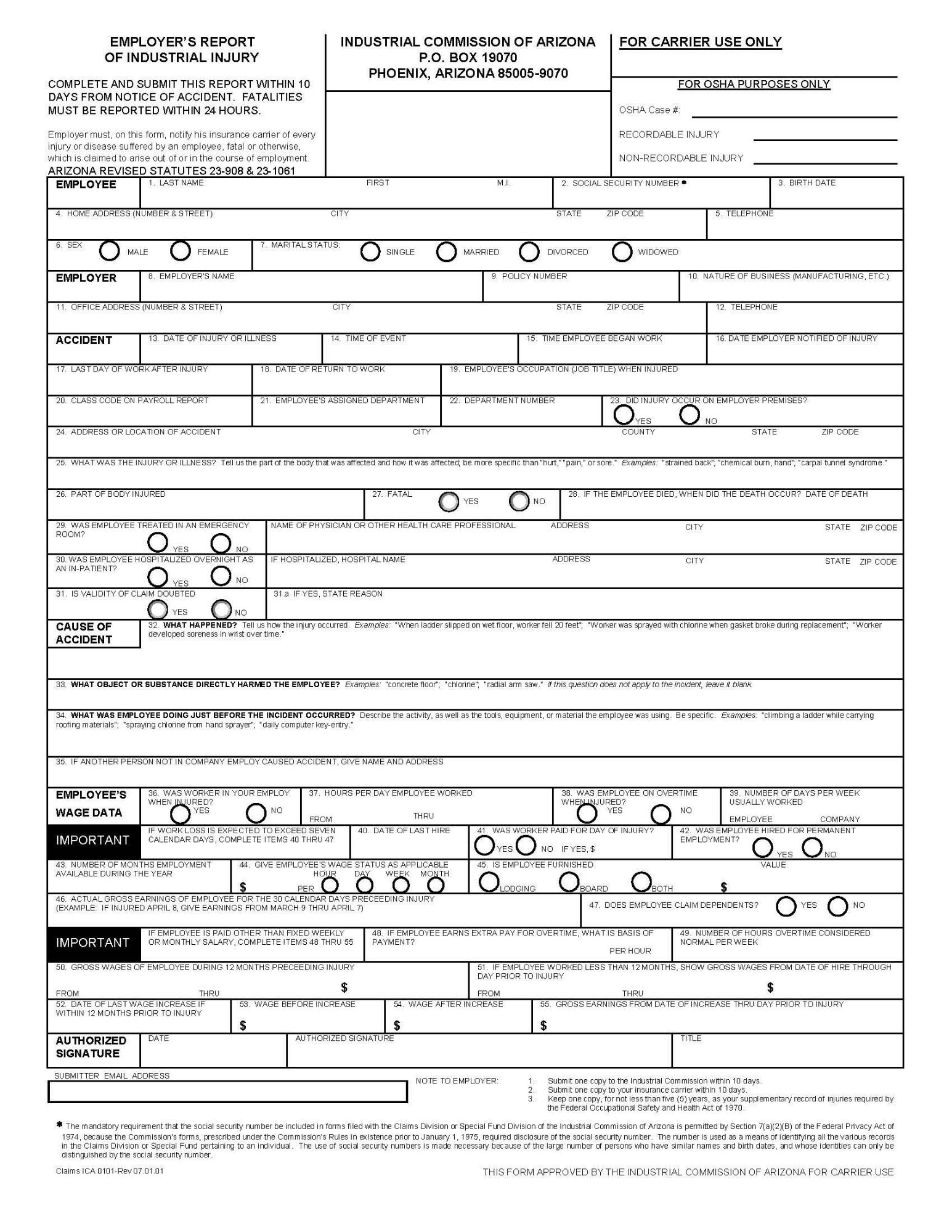
NEAR MISS/POTENTIAL ACCIDENT FORM
Supervisors are to complete the top portion of this form if they observe a “near miss”, see a situation which may potentially cause an accident or if a near miss or potential accident is reported to them by an employee. The completed form should be submitted to the office as soon as possible. The General Safety Committee will review the form at the following committee meeting to determine what if any action should be taken.
Date of occurrence: Time of occurrence: [ ] am [ ] pm
Location where incident occurred (be specific):
SEQUENCE OF EVENTS: Describe in detail exactly what the conditions were that created the opportunity for an accident to occur including whether it was due to unsafe work practices, unsafe working conditions or a combination of both: Unsafe work practice: [ ] yes [ ] no. If yes, please describe in detail: ___________________________________________________________________________________________________________________
Unsafe working condition: [ ] yes [ ] no. If yes, please describe in detail:
Other pertinent information:
Was another company or an employee of another company responsible for the condition: [ ]yes [ ]no. If yes, who in your opinion, was responsible:
Did you notify the general contractor or builder on the job site: [ ] yes [ ] no. If yes, name of person notified:
CORRECTIVE ACTION PLAN: Describe in detail what has been done or will be done to prevent the possibility of an accident occurring due to the above described situation. Include who is responsible for taking the corrective action and when it will be completed:
Supervisor completing form: Date:
****************************************************************************************************
REVIEW BY GENERAL SAFETY COMMITTEE Will the corrective action plan described by the supervisor eliminate the unsafe work practice or unsafe working condition: [ ] yes [ ] no. If yes, has the plan been effectively implemented: [ ] yes [ ] no. If no, what corrective action measures should be taken, who will be responsible, and when will the measures be completed:
EMPLOYEE REPORT OF ACCIDENT INVOLVING COMPANY VEHICLE
An employee involved in an accident while driving a company vehicle must report the accident immediately and follow up as soon as possible by completing and submitting this form along with an information card from the driver of the other vehicle and witness cards as applicable. All accidents involving a company vehicle must be reported to the police. See the section in this Safety Program on our Fleet Safety Program for more information.
OUR DRIVER’S NAME: Injured: [ ] yes [ ] no
If yes, describe:
Date of accident: Time of accident: ______[ ] am [ ] pm
Location of accident:
Police/Sheriff name: Badge #:
Report #:
Were you cited: [ ] yes [ ] no Was other driver cited: [ ] yes [ ] no
Our vehicle #: License plate #:
Passengers in our vehicle: [ ] yes [ ] no. If yes, list names and whether there were injuries:
Passenger #1: Injured: [ ] yes [ ] no. If yes, describe:
Passenger #2: Injured: [ ] yes [ ] no. If yes, describe:
Describe in detail how the accident happened and who in your opinion caused the accident. Use the back of this form if more room is needed. Draw a diagram of the accident scene on the back of this form showing street names, location of all vehicles and direction of travel at the time of the accident:
Describe damages to our vehicle:
EMPLOYEE REPORT OF ACCIDENT INVOLVING COMPANY VEHICLE (CON’T)
OTHER DRIVER’S NAME: Injured: [ ] yes [ ] no
If yes, describe:
Driver’s State & License #: Telephone #: _______________________________________
Address: City:_____________________________________________State:_________Zip:_________
Passenger #1: Injured: [ ] yes [ ] no. If yes, describe:
Passenger #2: Injured: [ ] yes [ ] no. If yes, describe:
Owner of other vehicle: Phone:
Address: City: State: Zip:
Insurance agent: Telephone #:
Insurance carrier: Policy #:
Make of vehicle: Model: Year: License plate #:
Describe damages to other vehicle:
SUPERVISOR’S FOLLOW UP REPORT OF VEHICLE ACCIDENT
Supervisors are to review Employee Report of Vehicle Accident Involving Company Vehicle forms submitted, investigate the accident, complete and submit this form for review by the General Safety Committee at its next meeting.
Our driver’s name: Position:
Date of accident:
Our vehicle # and description:
Accident resulted in: [ ] injury [ ] fatality [ ] property damage Describe in detail injuries, fatality or property damage:
What actions, events or conditions, in your opinion, contributed most directly to this accident:
Was accident avoidable: [ ] yes [ ] no. If yes, how:
Can anything be done to prevent accidents of this type in the future: [ ] yes [ ] no. If yes, what:
SUPERVISOR’S FOLLOW UP REPORT OF VEHICLE ACCIDENT (CON’T)
Plan of action you would like to recommend to the General Safety Committee as a result of your investigation. Include information on who will be responsible for implementing the plan of action and when it will be implemented if approved by the General Safety Committee:
Superintendent completing form:
Date:
ACCIDENT/INCIDENT REPORT
Employees are to complete and submit this form if they are involved in or witness an incident or accident in which an employee or company property is involved and a person not employed by our company is injured or there is damage to equipment or property not belonging to our company.
DATE OF ACCIDENT/INCIDENT: Time:____ [ ] am [ ] pm
Location of accident/incident:
Describe in detail what happened:
Were any of our employees involved in the incident: [ ] yes [ ] no. If yes, list employee names:
Was any of our company’s equipment, material, scaffolding, tools, etc., involved in the incident: [ ] yes [ ] no. If yes, list what was involved:
Was anyone other than an employee injured: [ ] yes [ ] no. If yes, please give available information: Name:
Employed by:
Address:
Nature of injuries:
Was equipment belonging to someone other than our company damaged: [ ] yes [ ] no. If yes, please describe what was damaged and nature of damages:
Please list names of all witnesses and where they can be reached:
Witness: Phone #:
Witness: Phone #:
Did you report the incident to the general contractor’s job site superintendent: [ ] yes [ ] no.
Job site superintendent: Telephone #:
Employee completing form: Date:
EMPLOYEE SAFETY INFORMATION REPORT
Employees are to complete and submit this form if they want to report an unsafe workplace condition or practice or if they would like to recommend a safety suggestion to our company.
Description and location of unsafe working condition or practice you would like to report:
In your opinion what are the causes or conditions contributing to the unsafe condition or practice you have described above:
Have you reported the above unsafe condition or practice to your supervisor: [ ] yes [ ] no. If yes, date you and the Supervisor to whom you reported condition:
Do you have a recommendation for eliminating the unsafe condition or practice you have reported above: [ ] yes [ ] no. If yes, please explain:
S A F E T Y S U G G E S T I O N Employees are encouraged to submit safety suggestions. Suggestions will be reviewed by the General Safety Committee to determine if the suggestions will be an improvement to existing safety and health rules, policies and procedures.
Employee completing form: Date:
Employees are advised that the use of this form or other reports of unsafe conditions or practices are protected by law. It is illegal for an employer to take any action against an employee in reprisal for exercising rights to participate in communications involving safety.
REPORT OF THEFT
Employees are to complete and submit this form to report the theft of company vehicles, equipment, materials, tools or other property. All thefts must be reported to the police. PLEASE BE SURE TO WRITE DOWN THE POLICE/SHERIFF EVENT NUMBER.
Police/Sheriff event #: Officer’s name:
Employee who discovered theft:
Date & Time theft was discovered:
Location where theft was discovered:
Please give details of how the theft was discovered and any information which may help the police or our insurance company in their investigation of the theft:
Was anything destroyed or broken into during the theft: [ ] yes [ ] no. If yes, please explain:
Were security measures required by company policy in place at the time of the theft: [ ] yes [ ] no. If no, please explain to the best of your knowledge why they weren’t being used:
Do you have any recommendations regarding measures that could be taken to avoid a similar theft in the future: [ ] yes [ ] no. If yes, please explain:
PLEASE LIST ALL ITEMS & QNTY STOLEN, DAMAGED OR DESTROYED (If more room is needed, please continue on back of form.)
Employee completing form: Date: